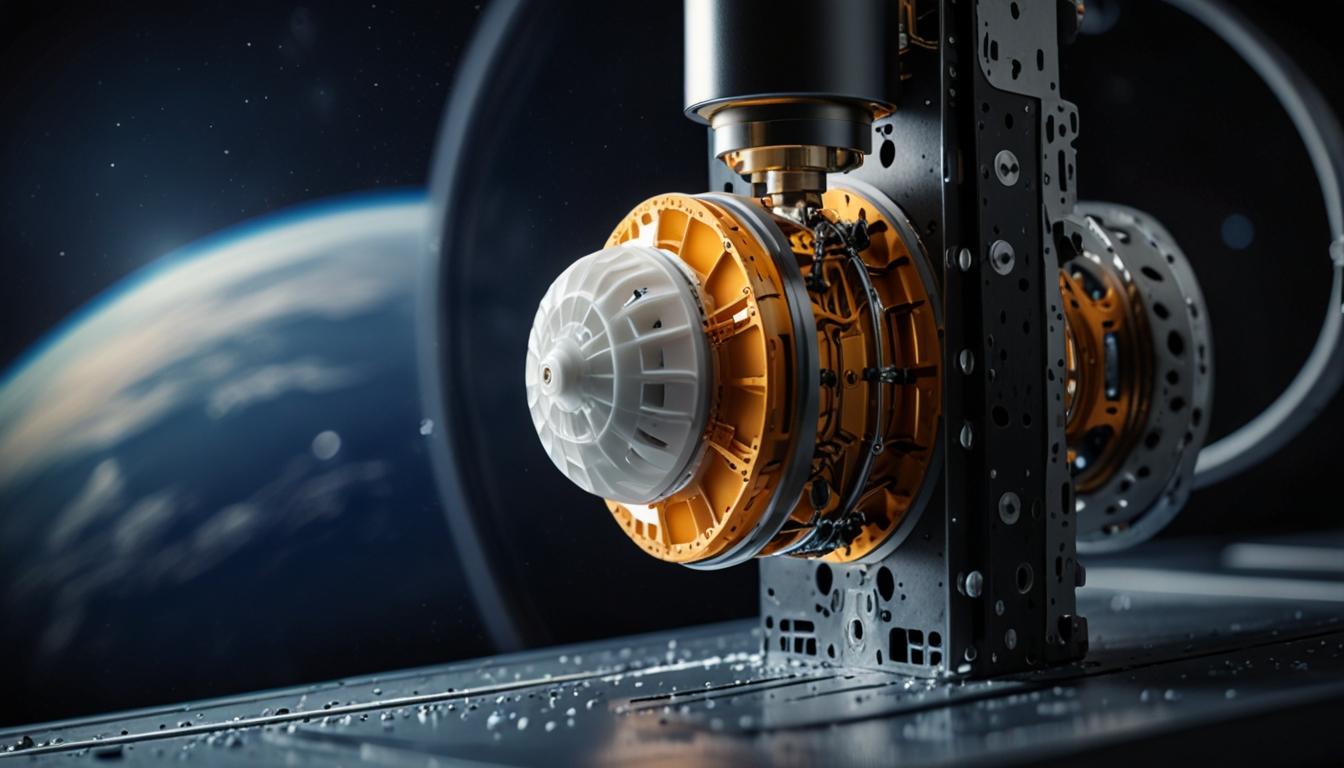
AI-Driven Innovation Powers Growth in 3D Printing for Low-Cost Satellite Market
New York, 30 September 2024 — The global market for 3D printing in low-cost satellite manufacturing is poised for substantial growth, with projections indicating an expansion of USD 39.32 billion from 2024 to 2028. This market, already rising at an accelerated compound annual growth rate (CAGR) of 75.62%, is being driven by rapid advancements in satellite development and an increasing number of space exploration missions. However, the industry faces notable challenges related to scalability and material compatibility.
In 2023, the space industry marked a series of significant achievements. Key highlights include the European Space Agency’s (ESA) Jupiter Icy Moons Explorer (Juice), set to arrive at Jupiter by July 2031, and the Indian Space Research Organization's (ISRO) successful Chandrayaan-3 mission, launched with a budget under USD 100 million. SpaceX also made headlines by deploying 91 satellites using its Falcon 9 rocket, and conducting pioneering launches involving the first-ever 3D-printed rocket and two Starship test launches. Such advancements underscore the growing demand for cost-effective satellites, hence promoting the global 3D printing market in satellite manufacturing.
Market Transformations and Technological Advances
3D printing technology is reshaping the satellite manufacturing landscape. This innovation facilitates the production of crucial components for nano, microsatellites, and small satellites, including housing, propulsion systems, and intricate parts such as antennas, brackets, and shields. The advanced printer technology and materials supplied by key industry players like Airbus SE, EOS GmbH, and Lockheed Martin Corp. are instrumental in driving down costs and streamlining production processes for satellite manufacturers and space agencies. This approach significantly reduces waste and enhances the efficiency of satellite parts production.
The primary market growth areas span across several regions, with North America contributing 47% to the market share, followed closely by Europe, APAC, South America, and the Middle East and Africa. The technology is increasingly adopted for diverse applications including communication, Earth observation, navigation, internet access, telecommunications, broadcasting services, and military operations.
Challenges in Scalability
Despite the significant advantages, scaling 3D printing for large-scale production remains a daunting challenge. The slow production speed of 3D printers limits their efficacy for high-volume manufacturing, necessitating improvements to meet market demands. Additionally, the compatibility of 3D printers with a range of materials essential for satellite manufacturing is limited. Post-processing steps such as polishing and painting are also labour-intensive and time-consuming, thereby adding to production costs and timelines.
Sector-Specific Insights
The aerospace and defence sectors are at the forefront of adopting low-cost satellite technology. The US Department of Defense (DoD), for instance, has consistently increased investment in satellite technology, focusing on communication, surveillance, and reconnaissance capabilities. 3D printing's ability to produce complex geometries and on-demand manufacturing significantly benefits these sectors by reducing manufacturing lead times and costs. SpaceX’s use of 3D printing for components in its Falcon 9 rockets illustrates the cost-saving potential. Similarly, NASA’s launch of its first 3D-printed satellite in 2015 and Alba Orbital's development of the PocketQube in 2022 highlight the growing importance of this technology.
Growth Potential
The ongoing advancements in 3D printing technology are likely to continue to drive market growth. By enabling the production of complex structures and allowing for customisation, 3D printing is proving to be a game-changer for budget-conscious space missions. The market is expected to see increased investment from space agencies and private sector manufacturers who seek to leverage 3D printing for its cost-efficiency and production capabilities.
Conclusion
The evolution of 3D printing technology in the satellite manufacturing sector is ushering in a new era of innovation and cost efficiency. As the space industry continues to expand with more exploration missions and increasing demands for satellite-based services, the role of 3D printing in producing affordable, high-quality satellites is becoming more pivotal. Despite current challenges in scalability and material compatibility, continued advancements in technology are expected to address these hurdles, propelling the market forward in the coming years.
Source: Noah Wire Services