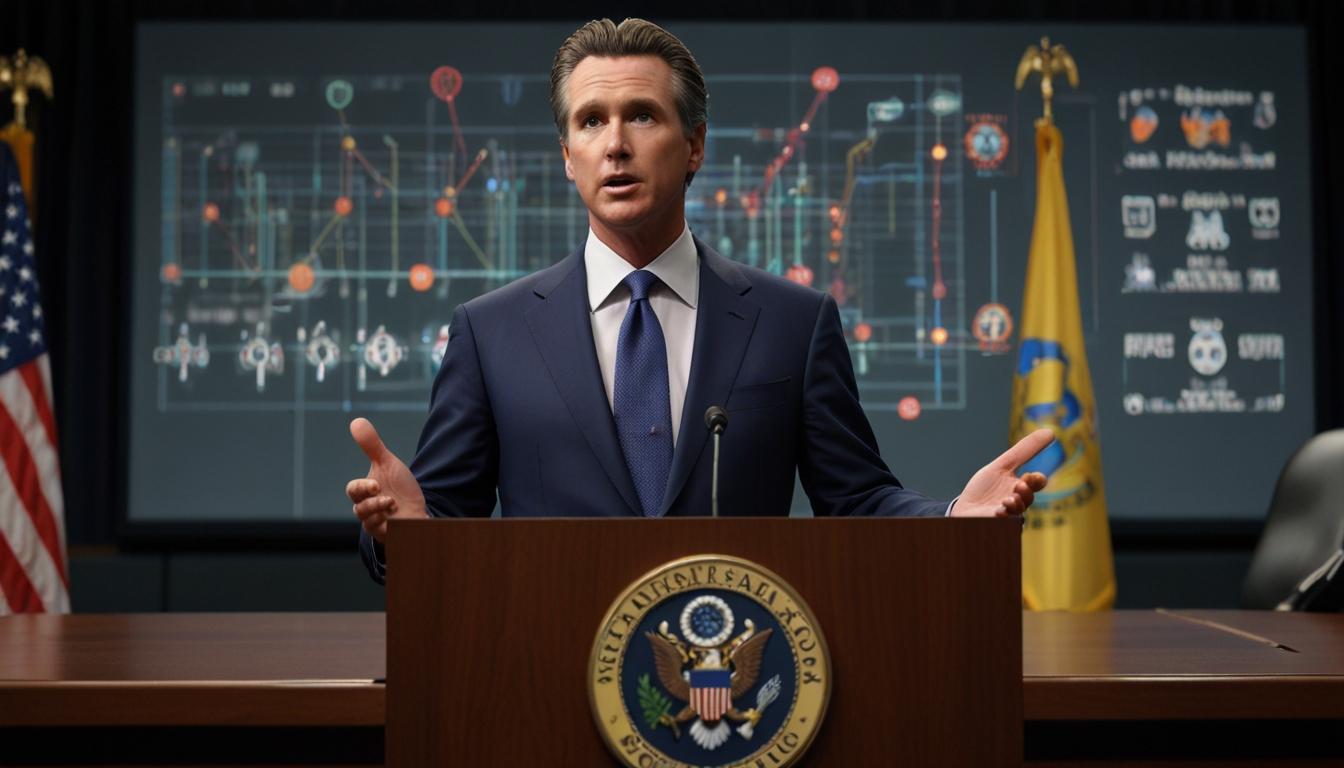
Newsom Vetoes Ambitious AI Regulation Bill Amid Broader Industry Concerns
California Governor Gavin Newsom vetoed Senate Bill 1047 on Saturday, a controversial and far-reaching artificial intelligence (AI) regulation proposal. The bill, described by The New York Times as "the most ambitious proposal in the nation aimed at curtailing the growth of the new technology," would have imposed stringent safety testing and regulatory measures on large AI models.
In explaining his decision, Newsom stated that while the bill's intentions were commendable, it failed to differentiate between high-risk AI applications and basic functionalities. "While well-intentioned, SB 1047 does not take into account whether an AI system is deployed in high-risk environments, involves critical decision-making, or the use of sensitive data," the Democratic governor said. "Instead, the bill applies stringent standards to even the most basic functions -- so long as a large system deploys it. I do not believe this is the best approach to protecting the public from real threats posed by the technology."
Had it been enacted, SB 1047 would have required safety testing for large AI models before public release, empowered the state’s attorney general to sue companies responsible for technologies causing significant harm, and mandated a kill switch to deactivate AI systems in case of considerable threats.
Despite the veto, Newsom emphasised the importance of proactive safety measures for AI. "We cannot afford to wait for a major catastrophe to occur before taking action to protect the public. California will not abandon its responsibility," he commented. "Proactive guardrails should be implemented, and severe consequences for bad actors must be clear and enforceable."
Senate Bill 1047's co-author, Senator Scott Wiener, expressed disappointment following the veto, labelling it a "setback." "This veto leaves us with the troubling reality that companies aiming to create an extremely powerful technology face no binding restrictions from US policymakers, particularly given Congress's continuing paralysis around regulating the tech industry in any meaningful way," he said. Wiener also affirmed that California would persist in its efforts to lead the conversation on AI regulation. “California will continue to lead in that conversation. We are not going anywhere.”
The rejection of the bill comes amidst broader concerns within the technology sector about over-regulation, especially regarding recent European Union regulations. Christian Klein, CEO of SAP, Europe's largest software firm, recently cautioned EU policymakers against stringent AI regulations, arguing that it could place Europe at a massive competitive disadvantage compared to the US. “I’m totally against regulating the technology; it would harm the competitiveness of Europe a lot if I can better test my AI models here,” Klein told the Financial Times during a visit to Silicon Valley.
The European AI Act, which has already come into effect, focuses on regulating powerful large language models (LLMs) and ensuring transparency from technology companies. This contrasts with the US, where a lack of comprehensive federal AI regulation has led some states to independently legislate against specific AI usages like deepfakes.
Klein articulated his belief that AI technology should not be regulated directly but rather its impact on businesses and end users should be managed. “I think the right discussion is happening in Europe right now: how can we regulate the impact on businesses, on end users? Don’t regulate the technology. Regulate the outcome,” he said.
Klein's comments underscore ongoing concerns in the tech industry around global regulatory approaches to AI. SAP, which is investing €2 billion annually in AI, continues to develop AI capabilities and attract talent, especially from US universities like UCLA, Berkeley, and Stanford.
In summary, the veto of SB 1047 by Governor Newsom highlights the ongoing debate on how best to regulate rapidly advancing AI technologies. The decision mirrors broader industry concerns about over-regulation potentially stifling innovation and competitiveness, particularly in contrast to approaches observed in Europe.
Source: Noah Wire Services