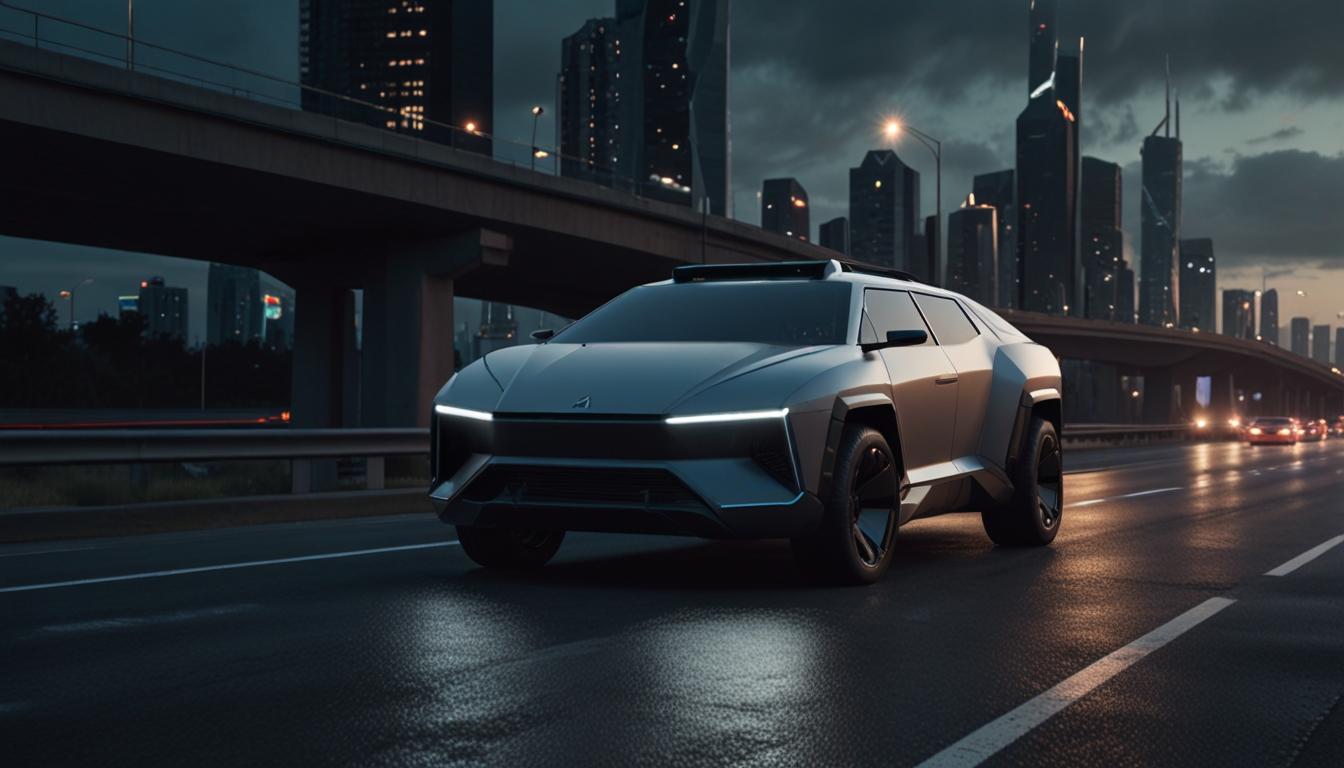
Tesla's Cybertruck Receives Full Self-Driving Update with Crucial Enhancements
Tesla's eagerly anticipated Cybertruck has now been outfitted with the Full Self-Driving (FSD) capabilities that were promised since its inception. A select group of early access testers and VIP customers are the first recipients of the latest software update, version 2024.32.20, which introduces major advancements in semi-autonomous driving.
The cutting-edge update, designated FSD V12.5.5, signifies a technological leap forward by incorporating an end-to-end highway stack that relies heavily on Tesla’s sophisticated neural networks. These artificial intelligence systems employ machine learning, utilising extensive footage captured by Tesla’s fleet of camera systems to facilitate faster and more accurate decision-making on public roads. Previously, this end-to-end capability was confined to urban settings, but it is now being extended to high-speed highways.
Traditionally, software engineers had to manually code the potential decisions a Tesla vehicle might need to make whilst in supervised Full Self-Driving mode. However, with this update, Tesla's AI can dynamically make decisions based on real-world scenarios and environments, enhancing the vehicle's autonomous capabilities without extensive manual input.
In addition to expanding FSD capabilities to more environments, the update promises several improvements such as earlier and more natural autonomous lane changes, more decisive actions at stop lights and intersections, better lane selection, and accurate signalling at roundabouts. These features are critical steps towards Tesla’s ultimate goal of achieving unsupervised Full Self-Driving functionality, a strategic move crucial for the success of its planned robotaxi service, with further announcements expected on October 10.
Notably, the latest update introduces a new driving mode formerly referred to as 'Hurry Mode', now simply called 'Speed Mode'. This mode is expected to allow more aggressive acceleration and proactive overtaking of slower vehicles on highways, potentially offering a more efficient driving experience for users who prefer a brisker pace.
Despite these advancements, the broader Tesla community must remain patient, as the current rollout is restricted to a few Cybertruck owners. According to a post by Ashok Elluswamy, Tesla’s Autopilot director, on social media platform X, the team is "close to an early release build for remaining platforms", with internal employees slated to be the next recipients.
The journey towards fully autonomous driving has not been without obstacles. One key measure of success is the reduction of 'disengagements' per miles driven—instances where the vehicle relinquishes control back to the driver. Tesla has claimed consistent reductions in these disengagements with each software update. However, data from the open-source FSD Community Tracker, an initiative by Tesla owners, indicates mixed results. Recent software versions have shown either stagnant or regressive trends in miles driven without a critical FSD disengagement.
As Tesla gears up for its Hollywood-spec robotaxi event, the company remains eager to highlight its advancements in autonomous driving. However, despite the promise of improvements and a smoother driving experience, achieving unsupervised autonomous driving at a level safe enough for a robotaxi fleet remains a formidable challenge.
Tesla continues to push the envelope in the realm of self-driving technology, but the road to fully autonomous driving capable of supporting a commercial robotaxi service still seems distant.
Source: Noah Wire Services