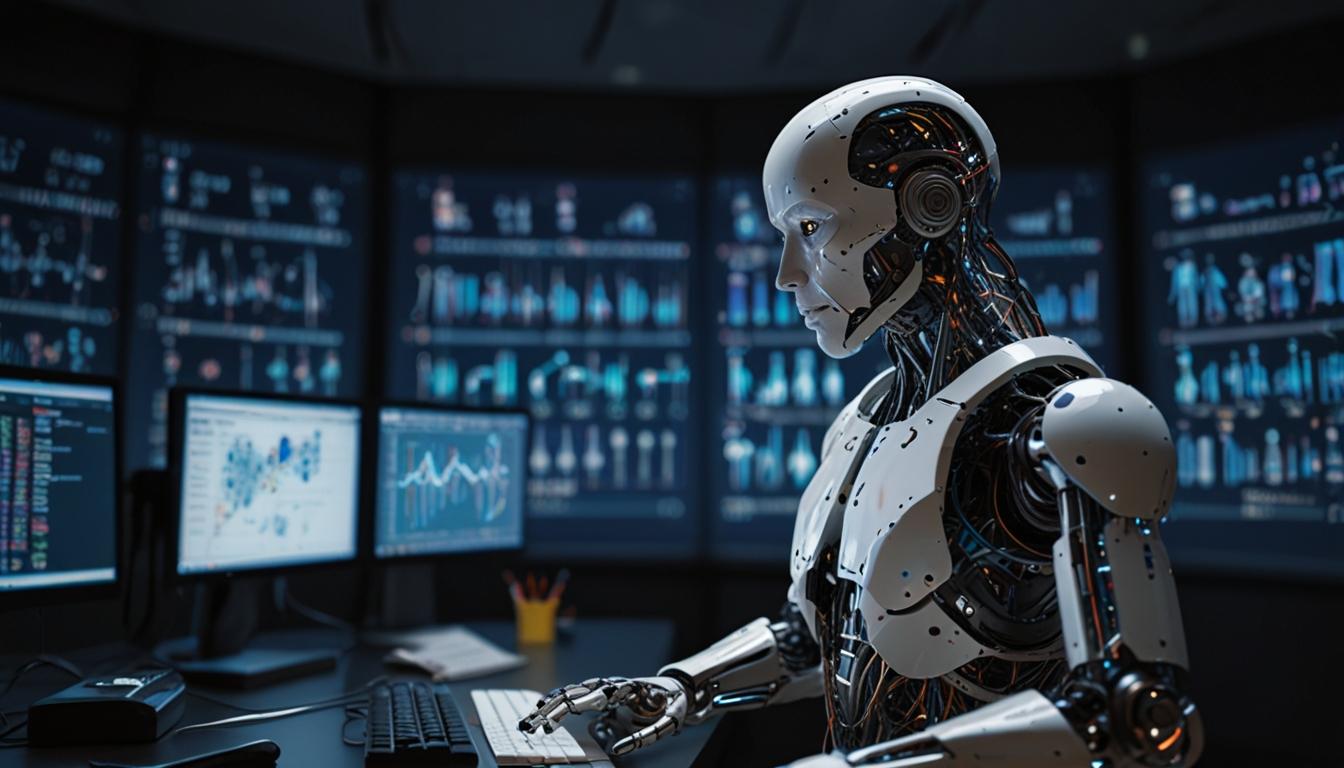
Artificial intelligence (AI) is increasingly influencing a range of industries, from finance to film, and now it's making significant strides in the realm of scientific research. Scientists are exploring the potential for AI to revolutionise their field, with some even speculating that an "AI scientist" could one day achieve a Nobel Prize-worthy discovery. The concept of an AI scientist capable of such a feat was proposed by Japanese scientist Hiroaki Kitano in 2021 through his "Nobel Turing Challenge." This challenge aims to create an autonomous AI that can independently conduct research deserving of a Nobel by 2050.
Currently, approximately 100 "robot scientists" exist globally, as noted by Ross King, a professor of machine intelligence at Chalmers University in Sweden. One of the pioneering achievements in this domain was King's 2009 publication on "Robot Scientist Adam," the first machine to independently make scientific discoveries. Adam was designed to autonomously form hypotheses, design experiments to test them, execute these experiments via laboratory robots, and learn from the outcomes. Though Adam's discoveries focused on the genetics of yeast, they were considered significant enough to prove the feasibility of machine-driven scientific enquiry.
Eve, a successor to Adam, was subsequently created to research drug candidates for malaria and other tropical diseases. These robot scientists offer distinct advantages, such as lower operational costs and the ability to work incessantly around the clock, providing meticulous documentation of every step in the research process.
However, King acknowledges that current AI technologies are still far from emulating a Nobel-calibre scientist. A more sophisticated level of intelligence and the ability to comprehensively understand complex scientific paradigms are necessary to reach such an accolade.
Inga Strumke, an associate professor at the Norwegian University of Science and Technology, affirms that the advent of AI in science does not currently pose a threat to human scientists. While AI has yet to replace traditional scientific methodologies, its influence on how research is conducted is undeniable. A prominent example is AlphaFold, developed by Google DeepMind, which has proven revolutionary in predicting protein structures from amino acid sequences, a task traditionally overwhelming for human calculation.
Strumke highlights a significant limitation of AI models, such as neural networks. While they excel at processing vast data sets and providing answers, they often fail to explain the underlying reasons for those answers. Hence, even though AlphaFold has accurately predicted over 200 million protein structures, it does not inherently enhance human understanding of the biological sciences.
Despite this, the work done by AlphaFold has garnered significant recognition, placing its creators—Google DeepMind's John Jumper and CEO Demis Hassabis—among serious contenders for future Nobel Prizes. In 2023, they were awarded the prestigious Lasker Award, and they are considered leading candidates for the 2024 Nobel Prize in Chemistry. David Pendlebury from the analytics group Clarivate suggests that while it may be unconventional for such recent work to receive a Nobel Prize, the impact of AI-aided research in future Nobel recognitions seems likely.
Although scientific discoveries traditionally honoured by the Nobel prizes often date back decades, there is a strong belief that AI-supported research will soon lead to Nobel Prize-winning breakthroughs. Experts predict this integration of computational advancements into scientific achievements will become increasingly prominent within the next decade.
Source: Noah Wire Services