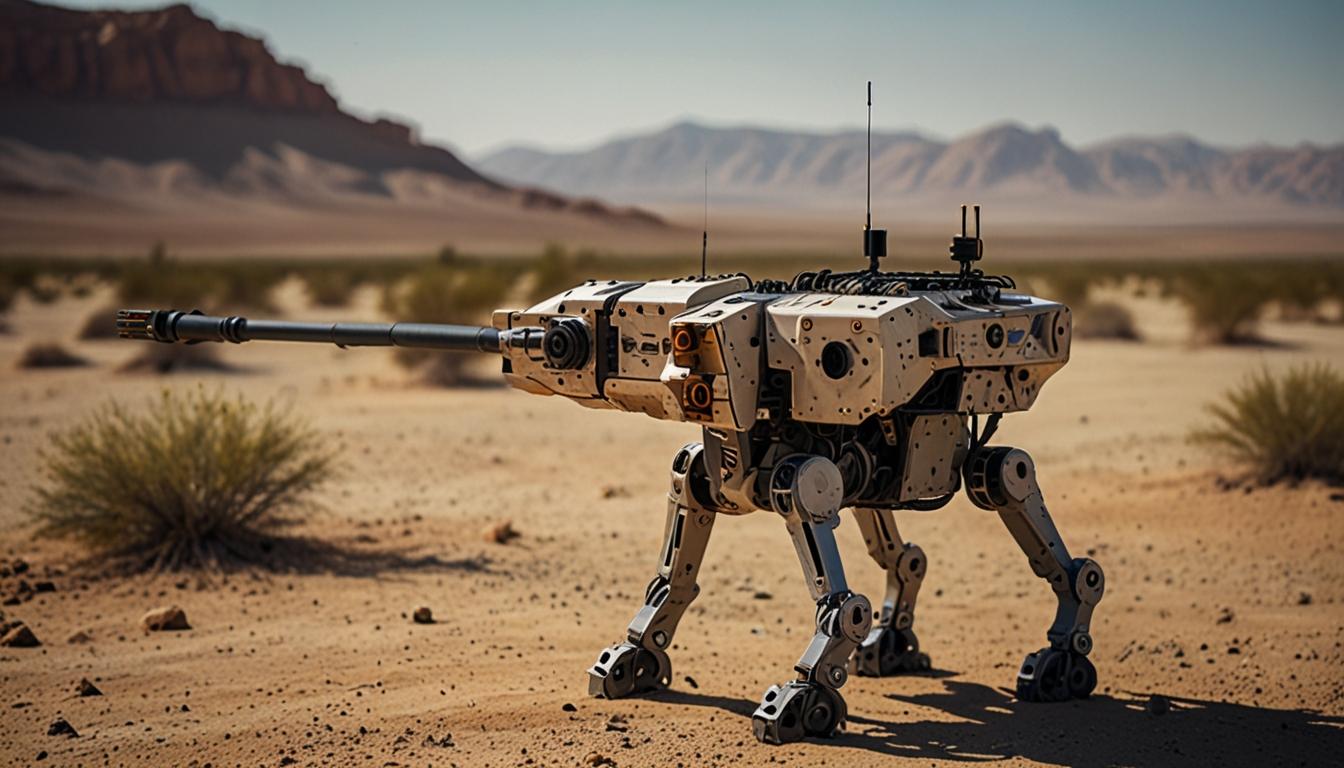
US Army Conducts Robot Dog Testing Equipped with AI-Enabled Rifles in Middle East
In a move that underscores the evolving nature of modern warfare, the US Army has been testing advanced robotic technology in the usually volatile Middle East region. Recent reports disclose that rifle-equipped robot dogs have been directed to undergo extensive ground-testing at the Red Sands Integrated Experimentation Center, located in Saudi Arabia.
The test involves the Ghost Robotics Vision 60 quadrupedal-unmanned ground vehicle (Q-UGV), a cutting-edge platform that has raised eyebrows with its incorporation of an AR-15/M16-pattern rifle. This sophisticated weapon is mounted on a rotating turret affixed to the front of the robot, enabling precision targeting. Photos released by the Defense Visual Information Distribution Service (DVIDS) exhibit the mobility and adaptability of these high-tech drones.
Although specific outcomes from these tests remain undisclosed, a US Central Command spokesperson confirmed the robots' engagement with static ground targets during trials, suggesting a focus on real-world application assessments. The testing of these robots originates from their initial unveiling during Operation Hard Kill in August, where their artificial intelligence-enabled weapon systems were presented.
Middle East: A Testing Ground for Emerging Technology
The strategic decision to conduct these experiments in the Middle East appears to correlate with the region's escalating security challenges. Increasing threats have evidently turned the Middle East into a fertile testing ground for advanced US defense technologies.
In recent months, the operational scope has expanded beyond the Q-UGV. Fifteen counter-drone weapons have been put through rigorous evaluations in Saudi Arabia, demonstrating the United States' commitment to refining its defensive capabilities.
Moreover, the US Army introduced Stryker-mounted laser weapon prototypes to the region in March to assess their practical utility in hostile environments. Similarly, the "Dronebuster" portable counter-drone system was showcased during a military drill in Jordan, adding to a growing repertoire of technologies trialed in the area.
In parallel efforts, the US Air Force has deployed its Unmanned Long-Endurance Tactical Reconnaissance Aircraft (ULTRA) in the United Arab Emirates. This mission aims to enhance intelligence, surveillance, and reconnaissance operations, further illustrating the comprehensive testing strategy being employed across multiple domains of military technology.
Advancements in Military Robotics
The United States' focus on integrating robotics with advanced weaponry emphasizes a shift towards autonomy in warfare. The inclusion of artificial intelligence in these systems potentially marks a new era of combat strategy, one where unmanned machines could play pivotal roles on the battlefield.
As tensions persist and technologies evolve, the Middle East remains a significant for the examination and deployment of these cutting-edge innovations. Through these ongoing trials, the US military seeks to bolster its tactical repertoire, ensuring preparedness in an ever-changing geopolitical landscape.
Source: Noah Wire Services