Astronomers Discover Link Between Cosmic Phenomena
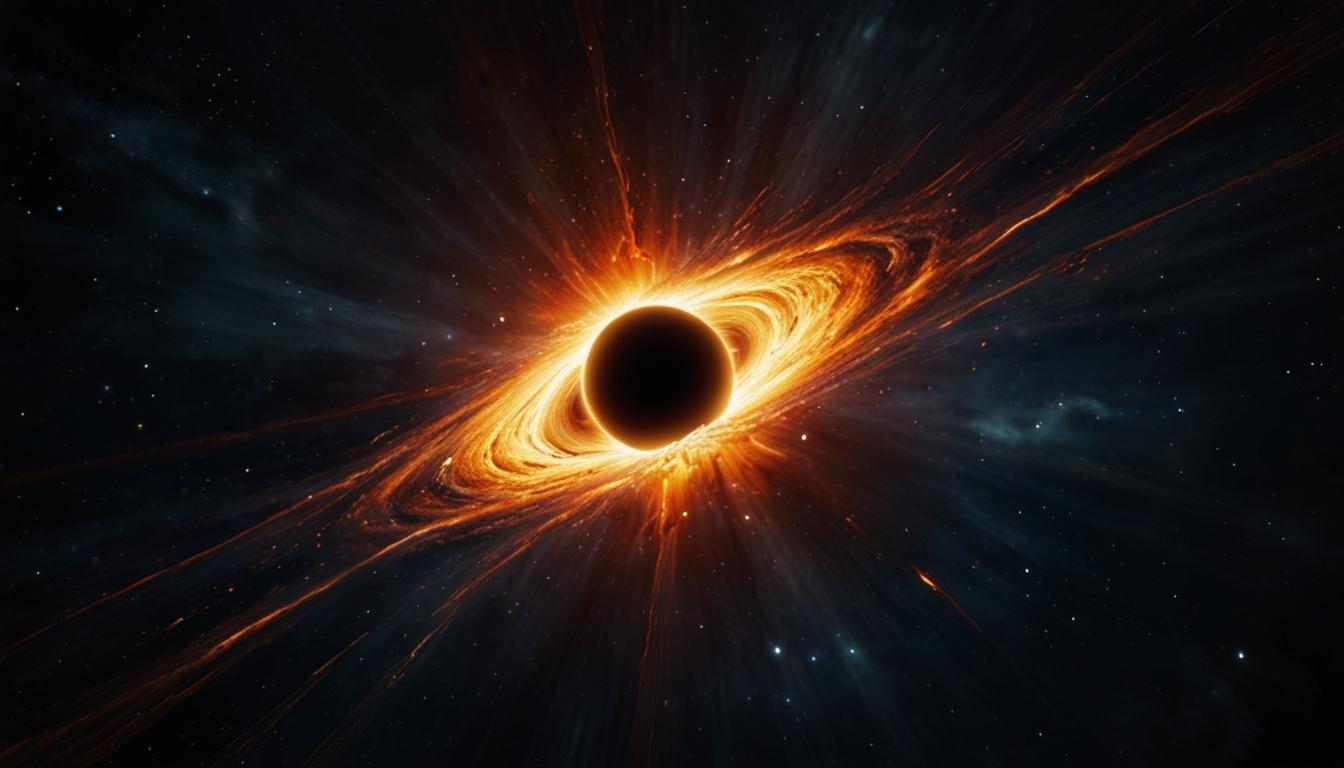
Astronomers and astrophysicists have made a significant breakthrough in understanding two cosmic phenomena that have puzzled scientists for years. A research team led by Queen’s University Belfast has observed a supermassive black hole tearing apart a star and using the released energy to impact a neighbouring star. This discovery has linked two mysterious cosmic occurrences known as “tidal disruption events” (TDEs) and “quasi-periodic eruptions” (QPEs).
The phenomenon of TDEs involves a star getting too close to a supermassive black hole, resulting in the star being torn apart in a brilliant burst of light. Meanwhile, QPEs are understood as bright, periodic flashes detected at the centres of galaxies and believed to have been related to supermassive black holes, although the exact mechanism was unclear until now.
The international team, comprising institutions such as Queen’s University Belfast and the Massachusetts Institute of Technology, utilised data from NASA’s Chandra X-ray Observatory, the Hubble Space Telescope, and NASA’s Neutron Star Interior Composition Explorer (Nicer). They observed that after a star was destroyed by a black hole, its remnants formed a disc-shaped structure around the black hole. Over several years, this disc expanded and began to repeatedly collide with a nearby star, which was initially at a safe distance from the black hole. Each collision resulted in outbursts of gas and X-rays, thus providing evidence that TDEs and QPEs are interconnected.
Commenting on the discovery, Dheeraj Pasham from MIT stated, “There had been feverish speculation that these phenomena were connected, and now we’ve discovered the proof that they are.”
Andrew Mummery from Oxford University added, “We now realise we need to wait a few years for the eruptions to ‘turn on’ after a star has been torn apart because it takes some time for the disk to spread out far enough to encounter another star.”
The findings were detailed in a study published in the journal Nature.
Electronic Tongue Offers Leap in Taste Detection and AI Insights
In a separate development, researchers at Penn State in the United States have unveiled an electronic tongue capable of taste detection that surpasses human capabilities. This graphene-based device shows promise in revolutionising various fields, from food safety (assessing the quality, authenticity, and freshness of food items) to medical diagnostics.
The electronic tongue consists of a graphene-based ion-sensitive field-effect transistor linked to an artificial neural network trained to identify tastes by mimicking the function of the human gustatory cortex. This component of the brain interprets signals from taste receptors located in the mouth.
The neural network achieved a tasting accuracy of over 95% by using insights from reverse engineering a process known as Shapley additive explanations. This method allowed researchers to delve into how the neural network arrived at its conclusions, potentially enhancing future AI safety and development.
Professor Saptarshi Das, leading the research at Penn State, compared this process to human taste perception: “We found that the network looked at more subtle characteristics in the data – things we, as humans, struggle to define properly.”
The device effectively tested various liquids, including different types of milk, sodas, coffee blends, and fruit juices, demonstrating its capacity to distinguish between subtle variations. It also shows potential for applications in medical diagnostics, given its broad detection and classification abilities.
The electronic tongue's development has been reported in a study published in the journal Nature, highlighting its potential for widespread deployment across different industries due to its robust and adaptable sensor technology. The project's success has been supported by a Space Technology Graduate Research Opportunities grant from NASA.
Source: Noah Wire Services