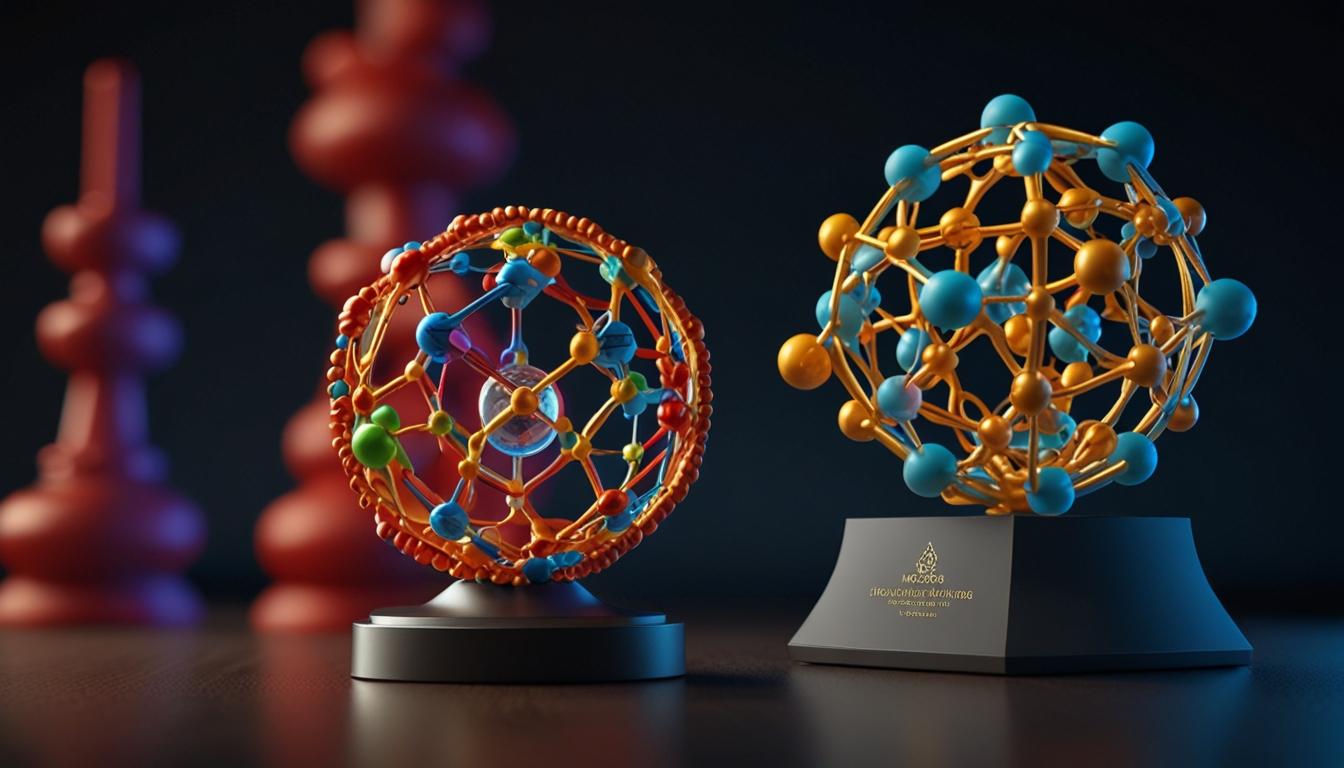
In a momentous development for the scientific community, the 2024 Nobel Prize in Chemistry has been awarded to researchers from Google DeepMind and the University of Washington for pioneering work on AlphaFold – a revolutionary artificial intelligence (AI) system that predicts the structure of proteins. This groundbreaking innovation promises to significantly advance our understanding of molecular biology, with far-reaching implications for health and disease treatment.
AlphaFold, developed by DeepMind, Google's AI research laboratory based in London, utilises advanced deep learning techniques to determine the three-dimensional structures of proteins rapidly and accurately. The significance of this technology was highlighted on the global stage with the award of the Nobel Prize. Half of the prize was awarded to David Baker from the University of Washington, while the other half was shared by Demis Hassabis and John M. Jumper from DeepMind.
Understanding protein structures has long been a fundamental, yet challenging, aspect of biological research. Proteins are constructed from chains of amino acids, the sequence of which is specified by DNA. These chains fold into complex shapes, or "3D machines", which are crucial for their function within the human body. Traditionally, deciphering these structures has been a laborious process, often taking years of painstaking laboratory experiments.
For decades, techniques such as X-ray crystallography have been employed to determine protein structures. This method requires proteins to be tested under various chemical conditions and involves the use of X-rays to ascertain the spatial arrangement of atoms within the protein. The resulting data is then compiled and stored in the Protein Data Bank, a global resource for researchers.
AlphaFold was trained using this extensive database, enabling it to predict protein structures with unprecedented speed and accuracy. As described by Rivka Isaacson, a scientist involved in beta testing the latest version of AlphaFold, the software can now achieve in minutes what previously took scientists months or years.
Introduced in early 2024, AlphaFold3 offers new features that enhance its capabilities further. Researchers can now model larger and more varied molecules, including DNA and metals, and even modify amino acids to mimic cellular chemical signalling. These advancements allow for even more complex and dynamic protein interactions to be predicted, opening new avenues for scientific exploration.
At King’s College London, Isaacson’s team utilised AlphaFold to successfully predict the structure of a complex formed by two bacterial proteins associated with hospital superbugs. Previous versions of the software had been unable to accurately depict this interaction, highlighting AlphaFold3’s improved capabilities.
Exploring the dynamic behaviour of proteins is identified as the next significant challenge in the field, following AlphaFold's breakthroughs in static structure prediction. Proteins vary considerably in shape, size, and flexibility, and understanding their dynamics—how they move and interact—is vital to fully comprehending their functions. Techniques such as nuclear magnetic resonance (NMR) spectroscopy, which can measure precise atomic distances and observe proteins in motion, are expected to complement AlphaFold’s predictions.
The Nobel Prize recognition underscores the impact of AlphaFold on the quest to map out molecular machinery within the human body. As researchers continue to refine and validate these tools, the potential for new treatments, medicines, and vaccines grows ever more promising, heralding a new era in molecular biology and biotechnology.
Source: Noah Wire Services