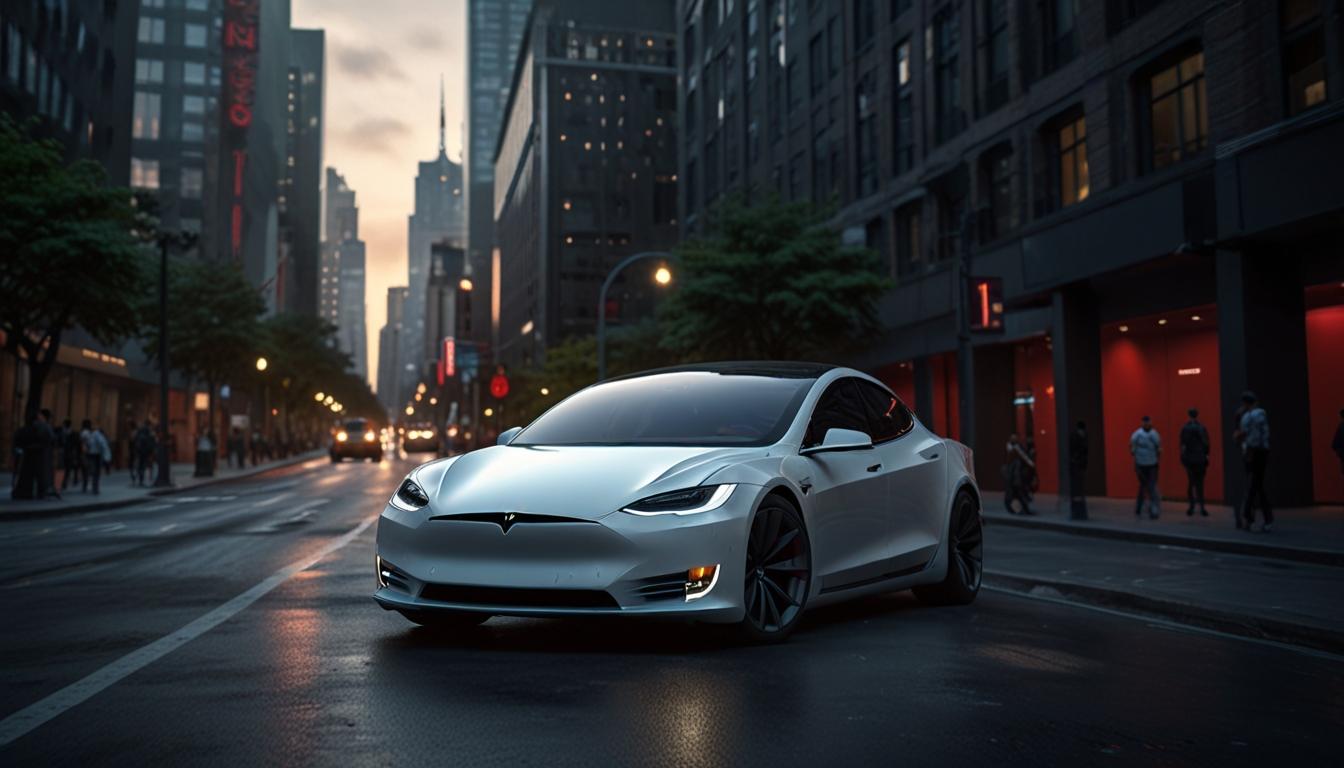
Elon Musk, the CEO of Tesla, presented a futuristic vision at a high-profile event on Thursday night, held on the Warner Bros. studio lot in Burbank, California. The event, titled “We, Robot,” showcased groundbreaking prototypes designed to revolutionise personal transport and highlighted Tesla's advances in autonomous driving technology.
At the centre of the presentation was the much-anticipated Tesla Cybercab, a fully autonomous vehicle devoid of steering wheels and pedals. This innovative design aims to reshape urban transportation by offering a self-driving experience. Musk asserted his confidence in Tesla's advancements in AI-powered technology, despite stating that the Cybercab production is not expected until 2026 at the earliest.
Alongside the Cybercab, Tesla also unveiled the Robovan, a larger autonomous vehicle capable of carrying up to 20 passengers. The aesthetic of both models featured a metallic, sci-fi inspired design, which Musk likened to a more optimistic vision of a future typically depicted in films like "Blade Runner."
Throughout his 20-minute presentation, Musk assured attendees of the impending transition from supervised Full Self-Driving (FSD) to unsupervised FSD, where passengers could technically "fall asleep and wake up at their destination." However, this vision is not yet a reality. The Full Self-Driving software, priced at $8,000, while available in many Teslas, still requires a human to supervise and intervene when needed.
The event also saw glimpses of other ambitious projects, such as the introduction of the Optimus humanoid robots, which danced for the audience, demonstrating Tesla’s foray into robotics beyond vehicle automation. Musk envisions these robots performing household tasks in the future, further emphasising his belief in an "age of abundance."
Despite the impressive demonstrations, the reception from investors was tepid, causing Tesla's stock price to drop over 8% following the announcement. This scepticism is largely grounded in Tesla's past hurdles with failing to meet ambitious timelines. Even Musk himself acknowledged his time frame predictions have often been overly optimistic, confessing, "I tend to be a little optimistic with time frames."
Tesla’s robotaxi service aims to compete not just with traditional ride-hailing services like Uber and Lyft but also with other autonomous vehicle companies. Rivals such as Waymo, a subsidiary of Alphabet Inc., and General Motors’ Cruise are already operating fully driverless services in certain U.S. cities. Musk's announcement about the Cybercab entering production by 2026 is thus seen with a degree of scrutiny, particularly given Tesla's historical delays with past vehicle releases, like the Cybertruck and the already-delayed electric semi-truck.
Experts remain cautious about the widespread deployment of Tesla’s driverless technology due to regulatory and technical challenges. Analysts like Gene Munster from Deepwater Asset Management argue that achieving a truly autonomous vehicle ready for public roads remains several years away. The challenge lies not only in perfecting the technology but also in meeting rigorous regulatory standards.
Tesla continues to face investigations by U.S. safety regulators into the safety of their Autopilot and Full Self-Driving systems, especially after incidents involving the technology, including fatal accidents. Reports of a Tesla vehicle failing to detect a moving train in FSD mode have further exacerbated these concerns.
As Tesla pushes forward with its autonomous vision, industry experts highlight the substantial work required to achieve these lofty goals. With the automotive landscape rapidly evolving and competition heating up, Tesla’s unveiling of the Cybercab and Robovan serves as both a bold glimpse into the company’s future ambitions and a reminder of the complexities inherent in transforming such visions into everyday realities.
Source: Noah Wire Services