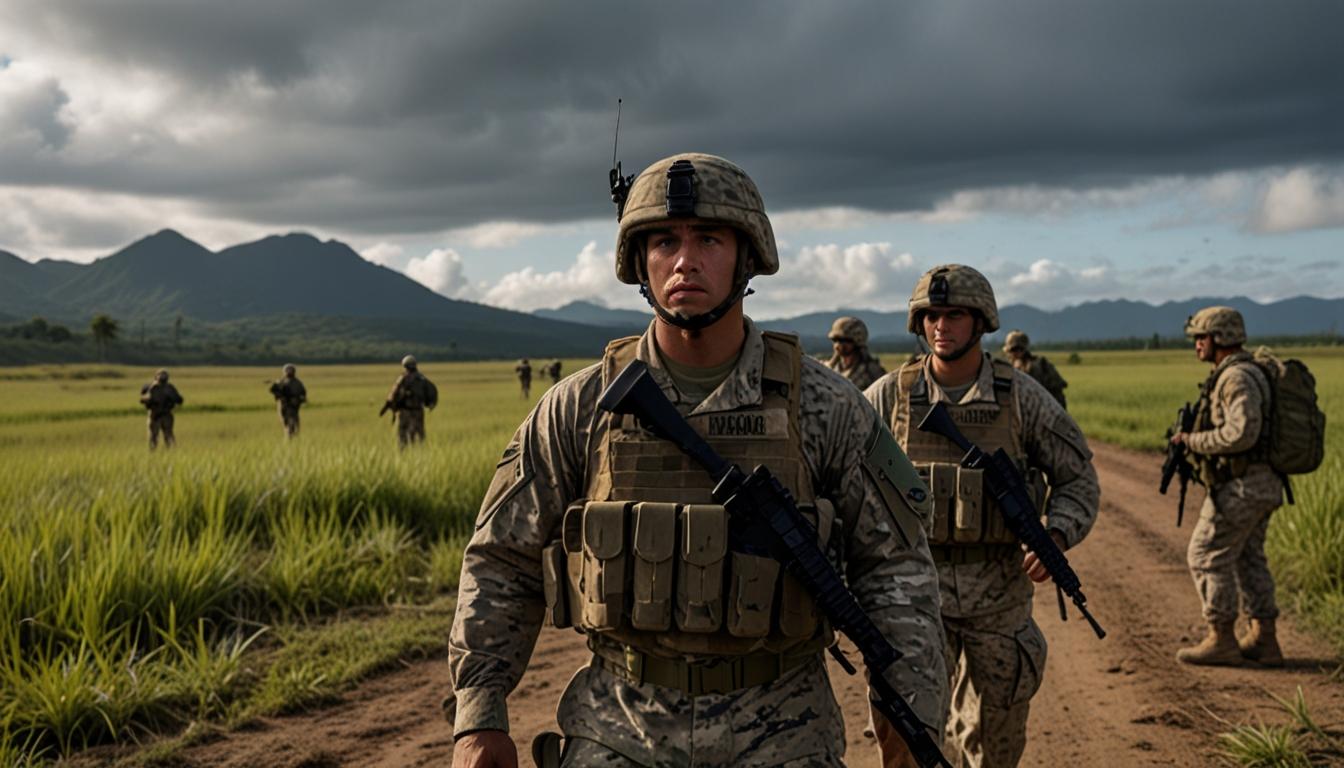
The Indo-Pacific region has become the focal point of the largest army exercise conducted by the United States, drawing participation from a host of international allies. This significant military drill, initiated on Monday, is spearheaded by the U.S. Army 25th Infantry Division in conjunction with the Joint Pacific Multinational Readiness Center (JPMRC). The geographical breadth of this exercise is vast, extending from the chill of Alaska down to the who Hawaiian islands and further west to the island nation of Palau.
The core mission for the 25th Infantry Division, based in Hawaii, is to maintain a posture of readiness within the Indo-Pacific theatre. This formation aims to deter adversarial maneuvers through a show of force in critical geopolitical hotspots. The JPMRC, on its part, offers participants an immersive training environment mimicking the challenging terrains specific to the region, including dense jungles and dispersed islands.
This year's exercise has attracted military units from a diverse consortium of nations. From Australia to Singapore, from Japan to the United Kingdom, the strategic cooperation emphasizes a collective intent to fortify military preparedness in multi-domain operations. The list of participating countries also includes a broad swath of regional players like Indonesia, Malaysia, Maldives, New Zealand, and Thailand.
These manoeuvres coincide with the recent release of a strategic document by the U.S. Army Pacific, a component of the U.S. Indo-Pacific Command. The report outlines a vision to secure a "positional advantage with decisive land power," aimed at ensuring a strategic upper hand in potential conflicts.
Conducted at the Pohakuloa Training Area in Hawaii and other strategic locales, the presence of U.S. and allied troops signals a firm dedication to regional security. General Charles Flynn, the commanding general of the U.S. Army Pacific, described the Indo-Pacific as a critical arena for sustaining security and prosperity. He noted that China's military activities pose an evolving challenge that the forces must address.
Island warfare, a strategy with historical roots tracing back to World War II, is once again in focus. The Pacific War saw U.S. Army and Marine units engage in "island hopping" against Japanese forces. This tactical approach involves bypassing heavily fortified positions, seizing strategically advantageous islands, and disrupting enemy supply chains.
In recent demonstrations of this revived capability, the U.S. Army's Multi-Domain Task Forces have been at the forefront. These units have showcased their strategic value by employing precision missiles against China's military defenses designed to restrict U.S. naval and air operations in the Western Pacific.
Meanwhile, Russia continues to enhance its military capabilities amid the ongoing conflict in Ukraine, with a significant focus on artificial intelligence (AI)-powered drone technology. Russian Defence Minister Andrei Belousov emphasised the importance of advancing troop training to maximise the effectiveness of these drones in military operations.
During a visit to a drone technology centre, Belousov witnessed a simulation demonstrating how AI-enhanced drones can autonomously engage targets in conflict scenarios. Russian forces have already deployed these advanced units in eastern Ukraine, as well as in the Russian regions of Belgorod and Kursk.
According to Russian sources, there are plans to expand drone operations with five additional units of AI-equipped drones. This expansion underscores Russia's commitment to leveraging advanced technology to gain an edge in the conflict.
The production of drones in Russia is reportedly scaling up significantly, with expectations of producing 1.4 million units by the year's end. This exponential growth in drone manufacturing highlights the strategic importance Russia places on AI technology in military contexts.
Conversely, Ukraine has also harnessed drone technology, focusing on impactful strikes on key Russian targets. Notable incidents include a drone attack causing a significant explosion at a Russian weapons depot in Tver, demonstrating the potent capabilities wielded by this technology in modern warfare. This underscores the evolving role of AI-driven drones on both sides of the conflict.
Source: Noah Wire Services