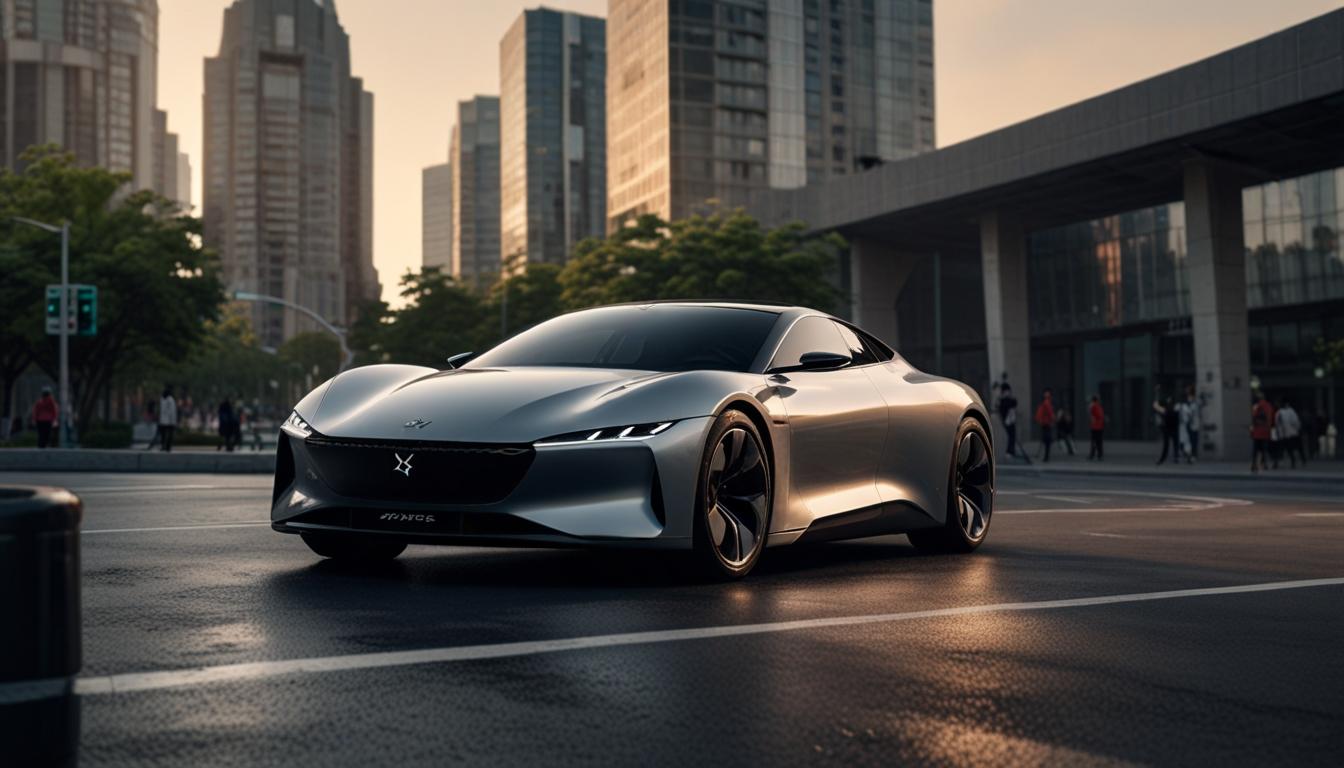
XPeng Motors has officially unveiled the P7+, the latest iteration of its flagship electric vehicle (EV) that marks a significant technological shift for the company. The P7+, which debuted in Shenzen, China, earlier today, is touted as the "world's first AI car" and abandons the use of LiDAR sensors in favour of pure vision cameras, a move inspired by Tesla’s approach to autonomous driving technology.
The P7+ is a progression of the P7 model, first introduced in 2022, and further refined in early 2023 as the P7i when it entered new markets, including Europe, alongside the G9 SUV. The development and release of the P7+ come amid widespread industry rumours, confirmed by spy images in early 2024 that suggested XPeng would eliminate LiDAR sensors in its new models. These rumours were put to rest in July when XPeng confirmed the P7+ name and its specifications.
Engineered with a strong emphasis on AI integration and advanced autonomous driving capabilities, the P7+ features a design that combines the dynamics of a coupe, the interior space similar to an SUV, and the comfort akin to a multi-purpose vehicle (MPV), all while providing a high-end, executive feel. This new model measures 5,056 mm in length, 1,937 mm in width, and 1,512 mm in height, standing on a 3,000 mm wheelbase, making it slightly larger than its predecessor.
The P7+ is available with two lithium-iron-phosphate (LFP) battery pack options, providing capacities of 60.7 kWh and 76.3 kWh. These offer respective ranges of approximately 620 km (385 miles) and 710 km (441 miles) according to Chinese Light-Duty Vehicle Test Cycle (CLTC) standards. Designed with aerodynamics in mind, the P7+ achieves a remarkably low drag coefficient of 0.206 and utilises only 11.6 kWh of power per 100 km (62 miles).
The vehicle’s interior is also a standout, capable of holding up to 33 20-inch suitcases, positioning it as having the largest cargo capacity for a vehicle under RMB 300,000 ($42,370) in its class.
XPeng’s new "Eagle Eye" approach to driver assistance and automation harnesses pure vision camera technology to gather visual data with superior precision. This system can monitor areas equivalent to 1.8 football fields. The cameras are optimised for varying city or road conditions and are equipped with autonomous driving features capable of "door-to-door" and "parking space-to-parking space" operation.
AI is integrated throughout the vehicle's core systems, including advanced driver-assistance systems (ADAS), power and energy management, and thermal control. While the pricing details for the P7+ have yet to be fully disclosed, the starting price is expected to hover around RMB 300,000.
XPeng Motors plans to launch the P7+ in China this November, with deliveries commencing immediately thereafter. Pre-sales are set to begin on October 14, 2024, during the Paris Auto Show, marking XPeng’s strategic push to gain a foothold in the competitive global electric vehicle market.
Source: Noah Wire Services