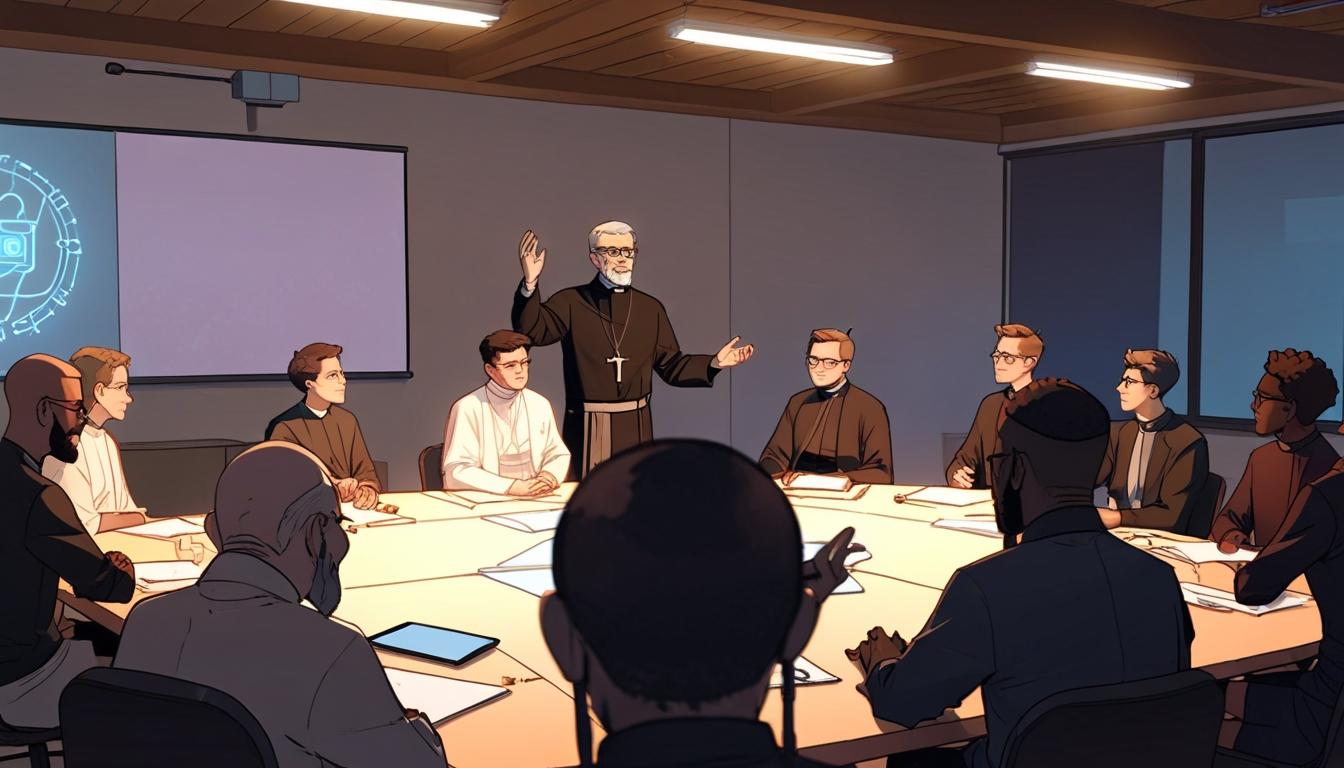
Title: Father Philip Larrey: Bridging Faith and Technology in the Age of AI
Boston, USA — In an era where technology and spirituality often seem worlds apart, one man is working tirelessly to bridge that divide. Father Philip Larrey, born in Mountain View, California, before it became synonymous with the tech behemoth Google, has emerged as an influential figure at the intersection of Catholicism and artificial intelligence (AI). Although raised as a priest in various cities like Madrid, Rome, and now Boston, Larrey’s origins are rooted in the now bustling hub of Silicon Valley.
Father Larrey, now regarded as one of the Catholic Church's leading authorities on AI, serves as a kind of spiritual guide for some of Silicon Valley’s most notable figures. With a history in philosophical inquiry and dialogues spanning over two decades with tech innovators, CEOs, and religious leaders, Larrey has become a critical voice in shaping the Church’s understanding of technological advancements, particularly in AI. He offers a unique perspective that melds faith with futuristic dialogue, aiming to bring a Catholic lens to what Pope Francis calls an "exciting and fearsome tool".
Despite some criticisms for his moderate stance towards technology giants such as Eric Schmidt and Sam Altman, Larrey believes in the potential of AI to further human flourishing. His relationships with tech leaders are built on trust, aiming for dialogue rather than confrontation. "I try to be very careful because I don’t want to alienate people," he mentioned, emphasizing the importance of mutual respect and understanding.
Father Larrey has orchestrated several high-profile conferences at the Vatican, focusing on AI and its implications. These events, frequented by key industry figures and clergy alike, aim to incorporate the Catholic Church’s rich tradition into conversations surrounding the future of AI. Bishop Oscar Cantú of San Jose, located at the heart of Silicon Valley, often participates in these discussions, highlighting their relevance to both spiritual and technological communities.
A significant topic in these dialogues is the ethical development of AI. Larrey draws on insights from influential figures such as Fei-Fei Li of Stanford University, who advocates for human-centred AI. Concerns about the risks of AI—ranging from ethical dilemmas to potential job losses—are a central theme. Before AI continues to evolve, questions around its impact on humanity remain pivotal.
The fear that AI could supplant human primacy leads to discussions with notable figures like philosopher David Chalmers and entrepreneur Elon Musk, both concerned about AI's "alignment problem". Although Larrey shows optimism in human capacity to prudently guide AI development, he acknowledges the complexity of regulating AI on a global scale. While the European Union's AI Act represents a regulatory attempt, its efficacy remains debated.
Father Larrey is pragmatic about the influence of market forces on AI's development. Conversations with AI industry leaders often highlight the tension between ethical imperatives and commercial motivations. As companies like Nvidia rise in market power through AI innovations, the challenge lies in balancing profit with conscientious technological advancement.
In a bid to mediate these challenges, Larrey recognises the need for new terminologies and frameworks to address AI's growing capabilities. Current AI technologies, despite their proficiency in simulating human traits, lack true agency and reasoning—a distinction central to preserving human uniqueness.
As the field of AI expands, Father Larrey continues to weave a narrative of collaboration between faith and technology. His efforts illuminate the path towards a future where ethical considerations and technological progress are not mutually exclusive but are entwined in a shared mission of human enrichment.
Source: Noah Wire Services