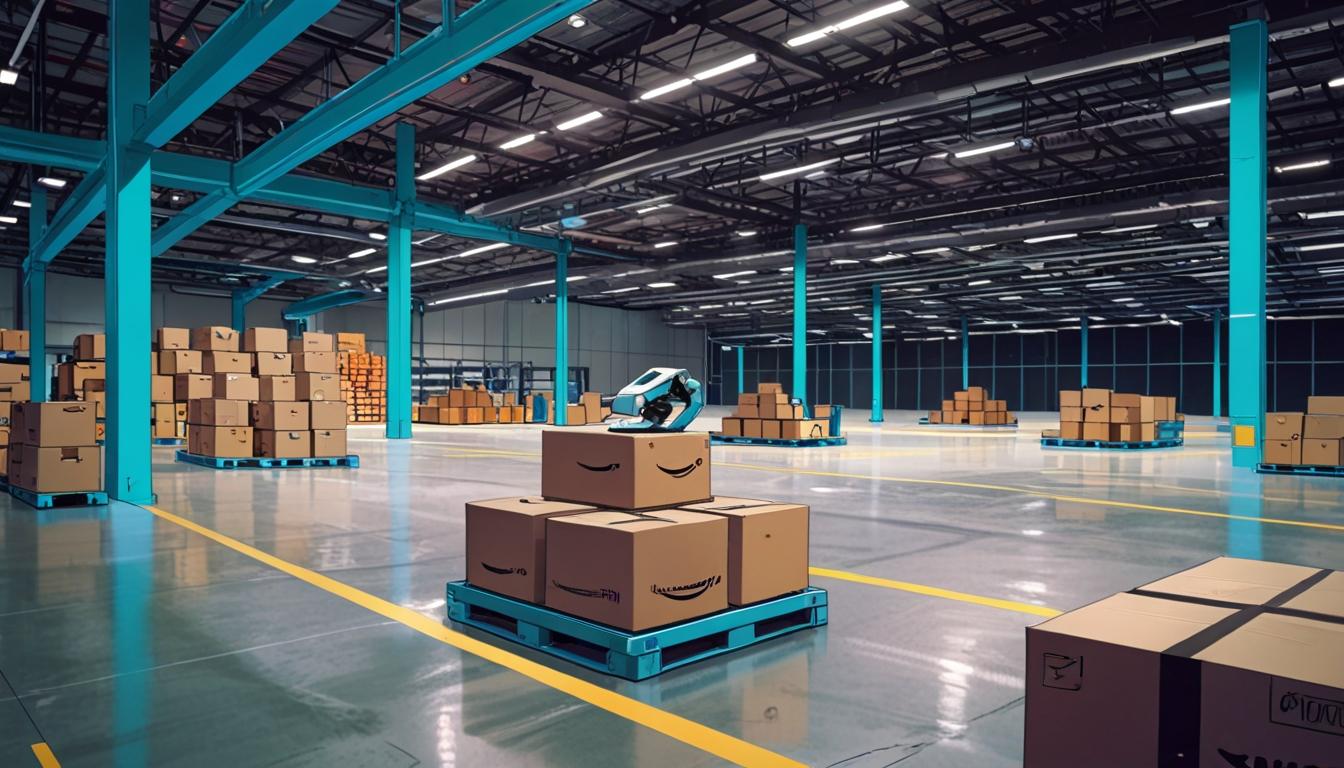
Amazon has taken a significant step into the future of retail operations with the unveiling of its new AI-powered warehouse in Nashville, Tennessee. This cutting-edge facility, spanning a vast 3.5 million square feet, showcases the tech giant's commitment to integrating artificial intelligence and robotics into its logistics and fulfilment processes.
The warehouse is populated by a variety of AI-driven robots, each with distinct functions and whimsical names. Among these robotic workers is 'Sparrow,' a robotic arm tasked with handling items to prepare them for shipping. 'Robin,' another robotic arm, sorts packages with remarkable accuracy. The fleet also includes 'Pegasus,' which swiftly navigates the warehouse floor to transport products to the correct destinations, embodying the mythical character's swiftness. Unique in its approach is 'Proteus,' a fully autonomous robot resembling a robotic hoover, designed to safely navigate around human colleagues while carrying substantial loads.
According to Julie Mitchell, director of robotic sortation technology at Amazon Robotics, Proteus aims to be "lovable," with friendly visual cues and the ability to communicate socially with workers. This reflects Amazon's intention to humanise the robotic interaction experience as they increasingly become part of the warehouse workforce.
Amazon's investment in AI extends beyond robotics, aiming to enhance the efficiency of its operations considerably. For instance, delivery drivers now utilise projectors to identify parcels quickly, reducing route times by more than 30 minutes, according to Doug Herrington, the CEO of Worldwide Amazon Stores. The company has also rolled out AI ‘shopping guides’, with over half a million sellers utilising AI-driven tools to optimise product listings. Additionally, efforts to minimise packaging waste have led to the elimination of plastic air pillows.
The financial implications of these technological advancements are crucial for Amazon. The company anticipates a revenue forecast of $157.2 billion for the third quarter, an increase of nearly 10% from the previous year. Its Amazon Web Services (AWS) remains a pivotal component, continuing to drive financial success with an expected growth of around 19%.
Despite these advancements, the impact on employment at Amazon is a topic of debate. Some labour union representatives, such as Stuart Richards from the GMB Union, express concern over the potential for job displacement and a perceived disparity in the treatment of human workers versus machines. While Amazon asserts that automation will not lead to job losses and may even create new roles, scepticism remains among labour groups. Richards highlights past site closures and suggests there may be a reduction in job availability, especially as automation increases.
There are contrasting perceptions globally regarding automation's impact on jobs, varying significantly between countries with robust social safety nets and those without. A study by the Massachusetts Institute of Technology (MIT) in collaboration with Amazon indicates that nations like Germany and France, with comprehensive welfare systems, are more optimistic about automation, whereas countries like the US and UK harbour more scepticism.
As Amazon continues to innovate with AI and robotics, a transformation is underway in both logistics capabilities and workforce dynamics. The full effects of these changes on the company's operations and employee structure remain to be seen as Amazon progresses with its technological integration.
Source: Noah Wire Services