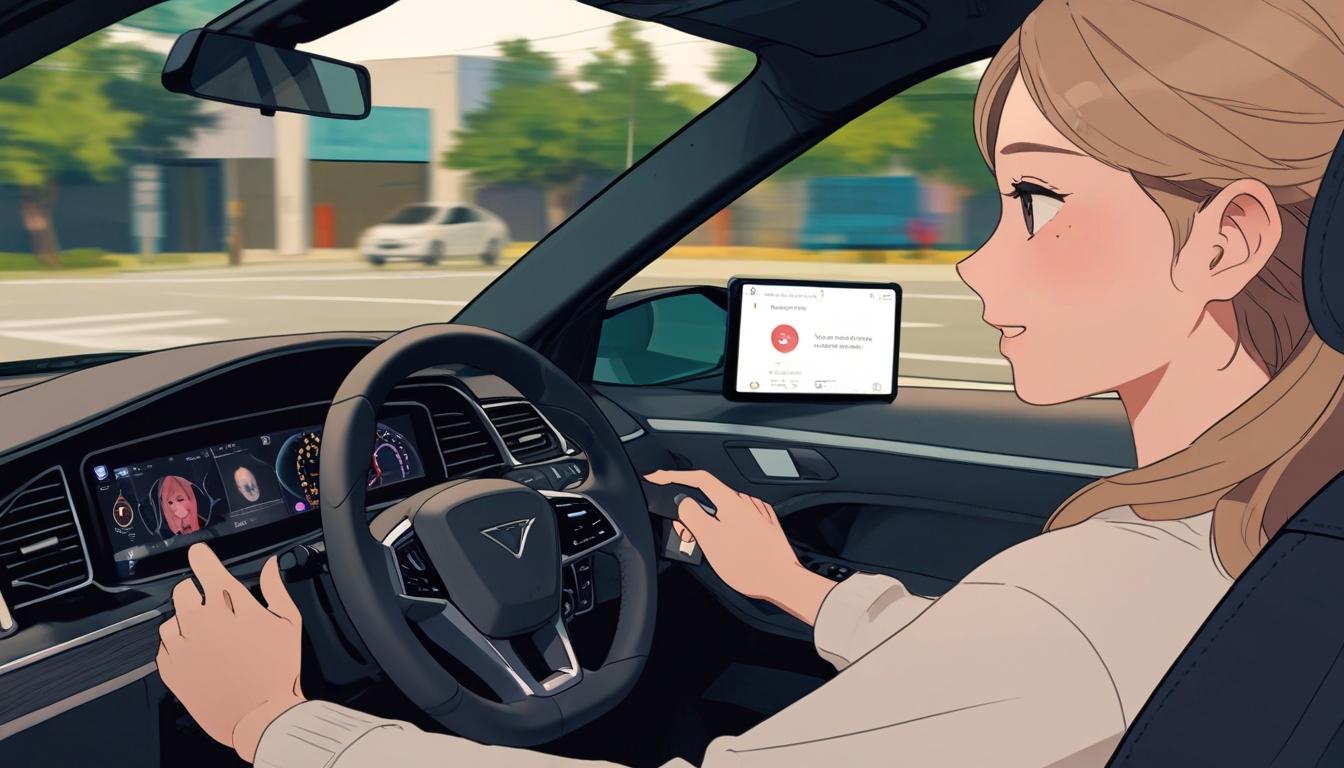
In a groundbreaking development in the field of autonomous vehicles, researchers from Purdue University have showcased a novel application of artificial intelligence which could significantly transform how humans interact with self-driving cars. The research was presented at the 27th IEEE International Conference on Intelligent Transportation Systems, highlighting the potential of large language models (LLMs) integrated into autonomous vehicles.
The primary focus of this innovative research is a conversational AI framework, dubbed Talk2Drive, which leverages an LLM to interpret human commands and guide autonomous vehicles. The project was undertaken by a team of researchers, including Can Cui, Ziran Wang, Zichong Yang, Yupeng Zhou, Yunsheng Ma, Juanwu Lu, Lingxi Li, Yaobin Chen, and Jitesh Panchal, all affiliated with Purdue University. The researchers successfully conducted a multi-scenario field experiment, marking it as the first of its kind to utilise LLMs in real-world autonomous vehicles.
To explore Talk2Drive's capabilities, the researchers integrated it with a 2019 Lexus RX450h and employed GPT-4, a state-of-the-art large-scale transformer-based model developed by OpenAI. GPT-4 can generate text outputs from both images and text inputs, capable of processing text contextually with a span exceeding 25,000 words. Numerous companies like Stripe, Duolingo, and Morgan Stanley wealth management are already integrating GPT-4 technology into their operations.
The experiments conducted by the Purdue team involved a range of drivers executing various driving scenarios, such as manoeuvring through a stadium parking lot, navigating a three-way highway, and operating at a two-way intersection. The research demonstrated how the system could interpret human intentions, from explicit instructions such as "can you drive faster" to more ambiguous statements like "I am really in a hurry now."
The results revealed a notable decrease in the driver takeover rate across different driving situations. On highways, a reduction of up to 78.8% was observed; at intersections, the reduction was up to 66.7%, while in parking scenarios, the reduction peaked at 100%. The impact was more pronounced with direct commands. Additionally, incorporating a memory module within the AI framework further reduced the driver takeover rate by up to 65.2%, compared to systems lacking this feature.
The burgeoning potential of AI and LLMs is evident in commuter landscapes worldwide. Already, autonomous vehicles are operational in cities like San Francisco, Beijing, Phoenix, and Wuhan. Industry forecasts predict that by 2027, nearly 30% of all new vehicles sold will feature partial autonomy. By 2040, this figure is expected to rise substantially, with an estimated 65% of cars in the United States and 80% in Europe being advanced autonomous vehicles.
The global autonomous vehicle market, currently valued at $41 billion USD in 2024, is projected to expand to $115 billion USD by 2029. This growth is mirrored within the UK, where Statista forecasts that 73% of all cars will possess some degree of autonomous capabilities by 2025.
Major automakers such as Tesla, Ford, Audi, Mercedes, Toyota, Nissan, and Volvo are advancing self-driving technologies. Recently, Tesla revealed its autonomous vehicle offerings, including the Tesla Cybercab prototype and the 20-seater Tesla Robovan, at the “We, Robot” event in Los Angeles.
As the transportation industry stands on the verge of a significant transformation driven by AI, the research by Purdue University underscores a pivotal moment. The integration of conversational AI in autonomous vehicles suggests a future where the concept of talking cars, once a mere figment of television's imagination, could become a conventional reality on our roads.
Source: Noah Wire Services