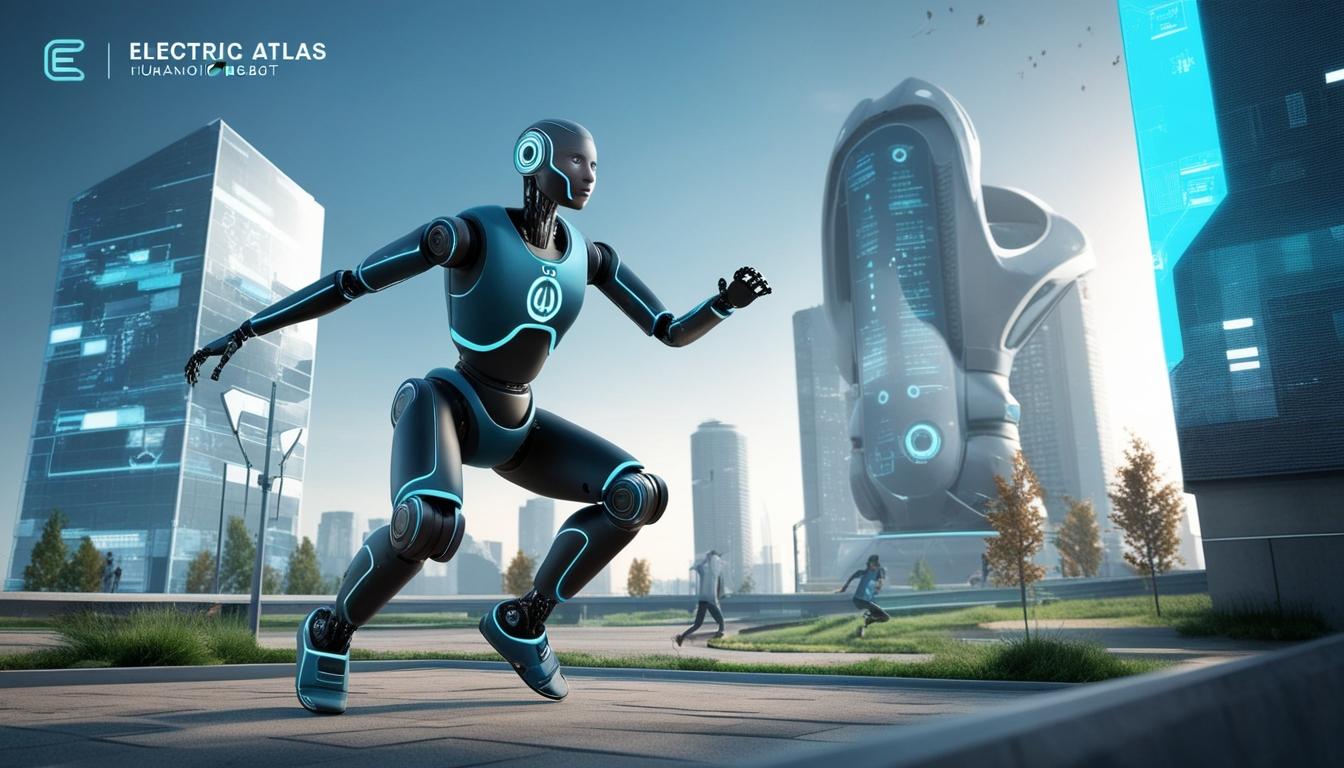
Boston Dynamics and the Toyota Research Institute (TRI) have officially embarked on a collaborative venture to develop advanced general-purpose humanoid robots. This partnership was announced on Tuesday, building anticipation for a future intertwining artificial intelligence with robotics in unprecedented ways. The project will see Boston Dynamics contributing its newly unveiled electric Atlas robot, while TRI will leverage its cutting-edge Large Behavior Models (LBMs).
Boston Dynamics, a staple in the robotics field since its inception in 1992, operates as a significant offshoot from the Massachusetts Institute of Technology (MIT). The company made a notable breakthrough in 2009 with the introduction of its quadrupedal robots, BigDog and LittleDog, and further progressed in 2013 with the first iteration of its bipedal Atlas robot. Over the years, the Atlas platform has witnessed steady evolution, proving capable of performing intricate acrobatics and challenging navigation tasks such as parkour, illustrating its considerable advancement in dexterity.
In April 2024, Boston Dynamics retired its long-standing hydraulic Atlas in favour of a new, more advanced version powered by electric servos. This new electric Atlas is touted by the company as "one of the most advanced humanoid robots ever built." It is claimed to possess movement capabilities exceeding those of human beings. Such innovation reflects the company’s persistent push toward enhancing robotic agility and usefulness across various fields.
Conversely, TRI leads in the development of Large Behavior Models, bringing artificial cognition to mechanical frameworks much in the same way Large Language Models (LLMs) do for chatbots. LBMs, in particular, are sophisticated tools that teach robots to mimic and learn from vast datasets of human behaviour. This technology allows robots to perform a range of tasks and learn new behaviours, enhancing their adaptability and utility in different settings.
Gill Pratt, Toyota’s chief scientist and CEO of TRI, expressed significant enthusiasm for the partnership. He stated, “Recent advances in AI and machine learning hold tremendous potential for advancing physical intelligence. The opportunity to implement TRI’s state-of-the-art AI technology on Boston Dynamics’ hardware is game-changing for each of our organisations as we work to amplify people and improve quality of life.”
This collaboration enters a competitive arena where numerous companies aspire to integrate robots into the workforce. Products such as Agility Robotics’ Digit and the first and second models of Figure have already found applications in industrial environments, including BMW’s Spartanburg plant in South Carolina and a Spanx facility in Flowery Branch, Georgia. Tesla’s Optimus also remains in contention, although it still requires remote operation for tasks beyond basic operations.
This alliance between Boston Dynamics and TRI marks a significant leap towards realising robots that can perform complex tasks autonomously, truly embodying human-like understanding and actions. As the landscape of AI and robotics continues to evolve, the impact of such collaborations could reshape workforce dynamics in the future.
Source: Noah Wire Services