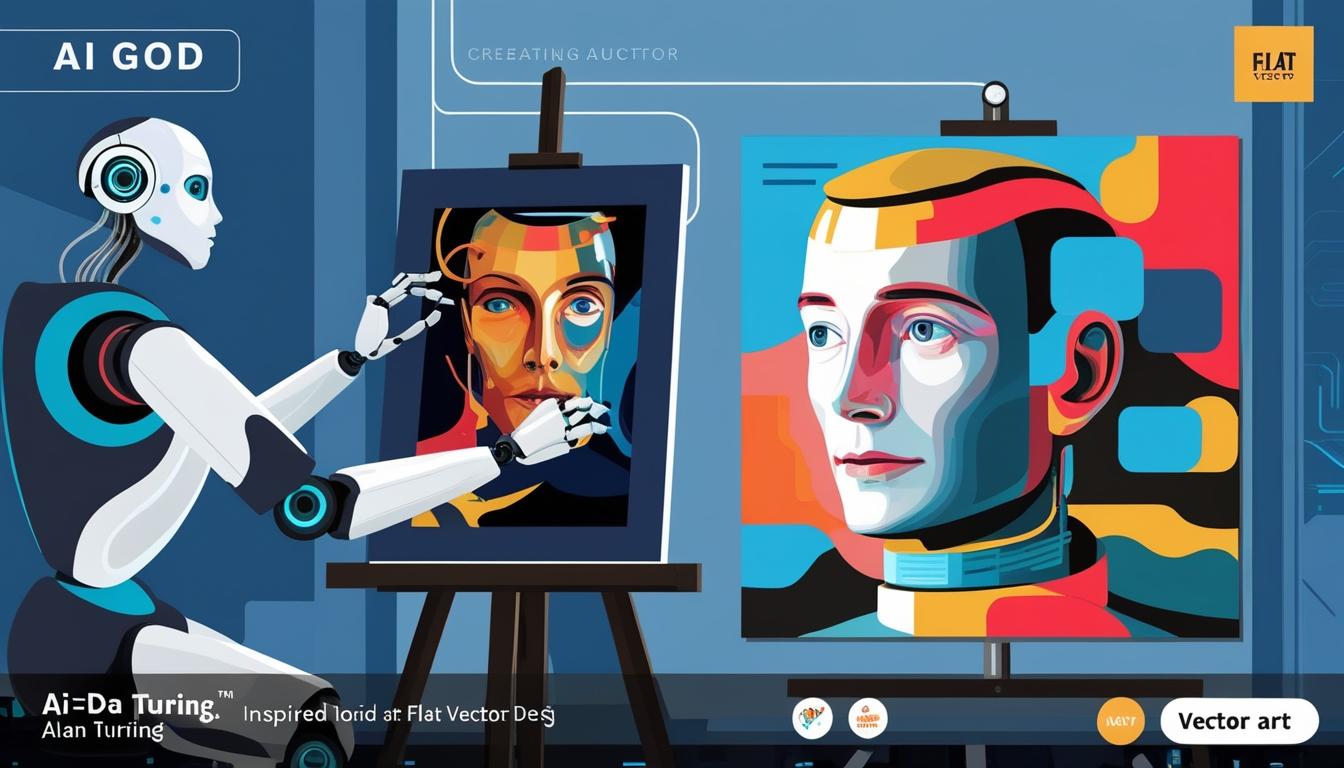
In a pioneering event for the art world, a humanoid robot named Ai-Da is poised to become the first of its kind to have its artwork auctioned by a major auction house. Sotheby’s announced on 16 October that it will begin accepting bids for an abstract portrait titled "AI God" starting at $120,000. The auction will take place from 31 October to 7 November.
Ai-Da, a unique project led by gallerist Aidan Meller in collaboration with researchers from Oxford University and the robotic technology company Engineered Arts, is a sophisticated AI-powered robot designed to create art. The portrait "AI God," completed in 2019, captures the likeness of Alan Turing, a seminal figure in the fields of computing and artificial intelligence. Ai-Da utilises cameras to collect visual data, which is processed through graphics algorithms to create generative images. These images are then reproduced on paper using paintbrushes manoeuvred by the robot's bionic arms.
The Ai-Da project, named to pay homage to Ada Lovelace, the 19th-century mathematician recognised as the first to conceptualise machine applications beyond basic calculations, embodies a fusion of AI and human artistry. Lovelace collaborated on Charles Babbage’s design for a mechanical computer before her death at 36 due to uterine cancer in 1852.
While the robot itself is engineered to resemble a white woman with brown eyes and a bob haircut, its creators frequently dress Ai-Da in various outfits and occasionally accessorise it with jewellery. Since its inception, Ai-Da has appeared at numerous high-profile events, including a TED Talk and in front of the UK’s House of Lords, utilising a large language model (LLM) to respond to pre-written questions. Its artworks have been exhibited worldwide, such as a five-panel polyptych showcased at the United Nations during its AI for Global Good Summit in May 2024.
The painting "AI God" reflects the disjointed visage of Alan Turing, known for his significant contributions to computing and AI and revered as a WWII codebreaker. Turing was one of the earliest to recognise and discuss the potential and pitfalls of artificial intelligence. In a BBC broadcast in 1951, Turing expressed his scepticism over the belief that machines could not imitate human characteristics, a statement echoing through time as AI continues to evolve.
Alan Turing's legacy includes the renowned Turing Test, which assesses a machine's capability to exhibit human-like intelligence. Over the years, various AI technologies, including generative systems powered by large language models such as Ai-Da and ChatGPT, have demonstrated their ability to convincingly replicate human conversation, blurring the lines between machine and human interaction.
The creators of Ai-Da explain that the project explores themes rooted in "Donna Haraway’s cyborg," inspired by Haraway’s 1985 essay, The Cyborg Manifesto. Haraway's work challenges the boundaries between humans, animals, and machines, promoting a perspective where identities are viewed through the lens of a "cyborg," highlighting the interconnectedness of modern existence.
In commemoration of Alan Turing, Ai-Da, through its LLM, conveyed, “By creating this portrait, I encourage a discussion about creativity. As the human/machine edges blur, I help bring these questions into focus." The upcoming Sotheby’s auction could mark a significant milestone in the integration of AI and the arts, reflecting contemporary discourses around technology and creativity.
Source: Noah Wire Services