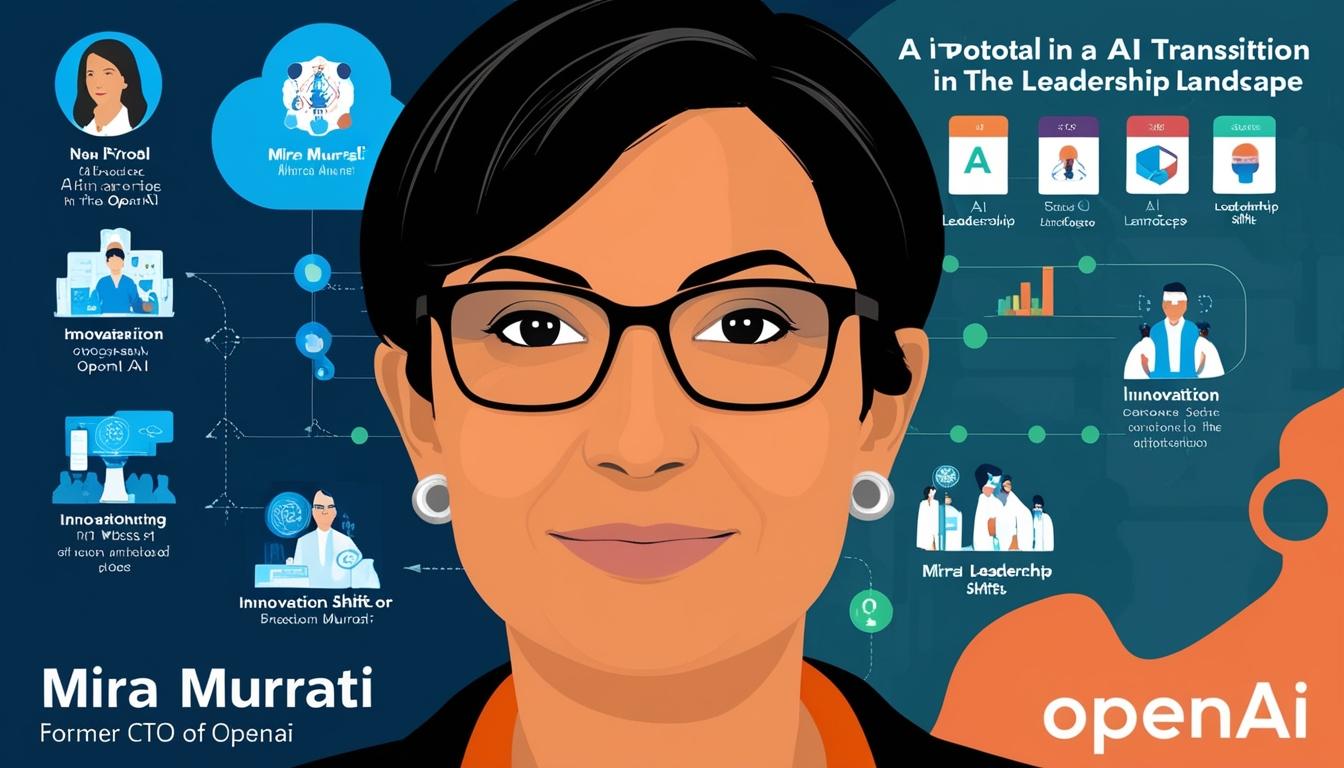
Mira Murati, the Chief Technology Officer at OpenAI, has announced her departure from the esteemed artificial intelligence company, marking a notable turning point. Murati, who briefly assumed the role of interim CEO during a challenging period for the organisation, shared her decision on Wednesday, highlighting her intent to pursue personal exploration after her integral role at OpenAI. Her exit marks a significant moment for the company as it experiences a wave of high-profile resignations, indicative of significant shifts within the AI sector.
Murati's statement reflects her admiration for the company and its CEO, Sam Altman, which she praises as being at the forefront of AI innovation. Her short tenure as interim CEO in late 2022 followed the unexpected dismissal of Altman, a decision that sent ripples across the AI industry. Despite Altman’s quick reinstatement, Murati played a crucial role in stabilising OpenAI during a period of internal and external uncertainties.
The announcement of Murati’s exit coincides with the resignations of other key figures at OpenAI, including Chief Research Officer Bob McGrew and Vice President of Research Barret Zoph. This pattern of leadership exits follows the earlier departures of co-founders Ilya Sutskever in May and John Schulman in August. Additionally, OpenAI’s president and co-founder Greg Brockman is currently on an extended leave. These changes leave Sam Altman with a leadership team significantly altered from what it was a year prior.
Murati joined OpenAI in 2018, having previously held roles at Tesla and the augmented reality firm Ultraleap. During her tenure, she was instrumental in advancing OpenAI’s marquee projects, notably influencing the development of major AI models such as ChatGPT and DALL-E. Her contributions were pivotal in propelling OpenAI to the forefront of the artificial intelligence race, driving innovation and sparking competitive developments in Silicon Valley. Under her leadership, OpenAI released GPT-4o, enhancing conversational AI to simulate human-like interactions, as well as OpenAI o1, aimed at tackling complex scientific and mathematical challenges.
OpenAI is currently navigating a significant transformation, having evolved from its origins as a non-profit research body into a major for-profit entity. Discussions are reportedly underway for a new funding round that could potentially value the company at an astounding $150 billion. This period of rapid growth and restructuring raises the prospect of consolidating power under Altman, as he pushes forward with OpenAI’s ambitious expansion strategies.
In light of the recent resignations, Altman expressed gratitude for the contributions of Murati and her colleagues via X (formerly Twitter), noting the independent and amicable nature of their decisions. To address the leadership void, Mark Chen has been appointed as the new Senior Vice President of Research, succeeding McGrew. Chen had a significant role in the public debut of GPT-4o earlier this year. Additionally, Josh Achiam and Josh Knight have been tasked with mission alignment and serving as Chief Information Security Officer, respectively.
OpenAI's recent executive departures underscore a broader pattern of leadership changes within the AI industry, which sees prominent figures transition between companies like Anthropic and DeepMind in search of environments striving for safer and ethically aligned AI practices. The departures reflect the dynamic and rapidly evolving nature of the AI sector, where innovation is closely intertwined with ethical and societal considerations.
As OpenAI strides into this new phase, it faces the crucial task of finding new leaders who can uphold its innovative momentum while addressing the complex challenges posed by these rapid industry changes. Concurrently, Murati's next career moves remain undisclosed, though her significant contributions to the AI field will resonate widely as she pursues new opportunities.
Source: Noah Wire Services