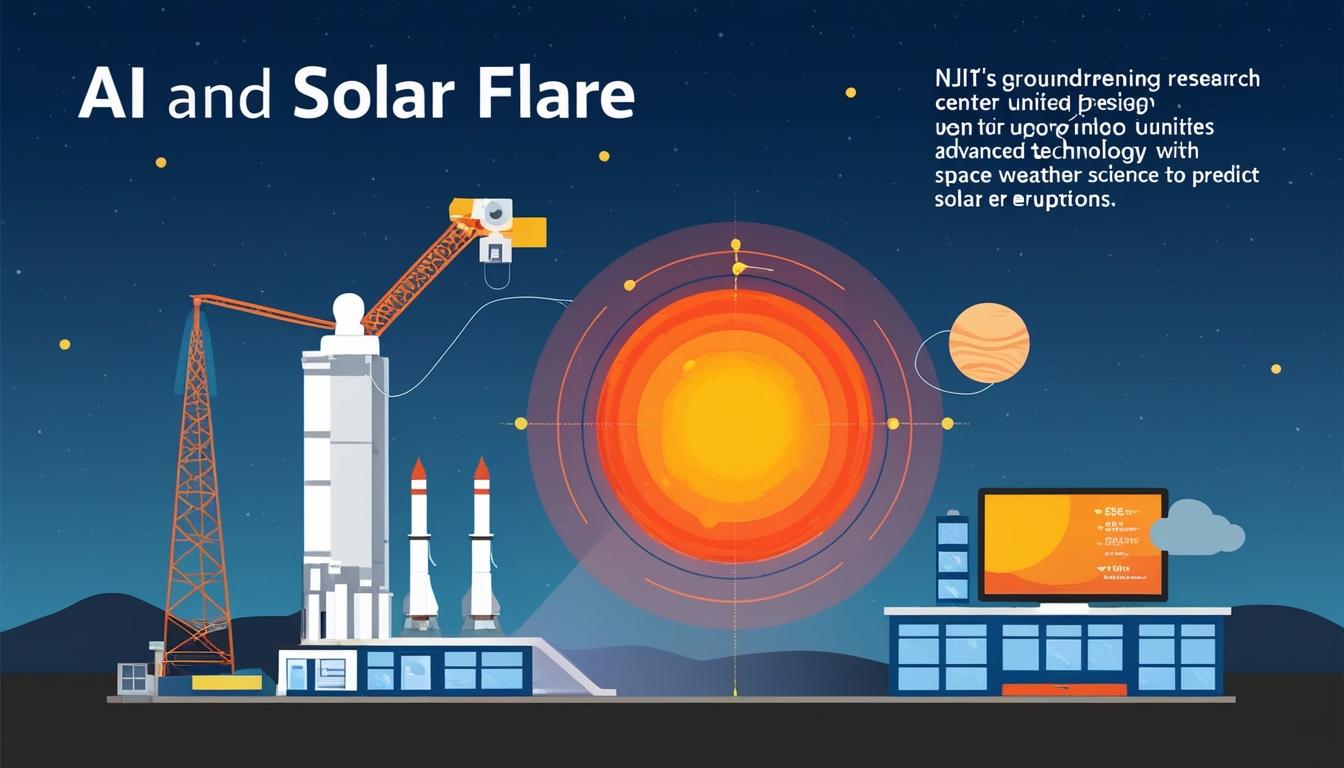
New Jersey Institute of Technology (NJIT) has successfully secured a $5 million grant from NASA, dedicated to pioneering advancements in the field of solar eruption prediction through the utilisation of artificial intelligence. The grant will facilitate the establishment of the AI-Powered Solar Eruption Center of Excellence in Research and Education (SEC), as announced on 17th October 2024. This initiative will take place under the auspices of NJIT’s Institute for Space Weather Sciences (ISWS), located in Newark, New Jersey.
The new research centre is set to work in collaboration with prominent institutions, namely NASA, New York University, and IBM. The primary objective is to develop sophisticated artificial intelligence and machine learning tools that will aim to enhance the prediction accuracy of solar flares and coronal mass ejections (CMEs). These celestial phenomena are significant as they can trigger solar geomagnetic storms, which, in turn, have the potential to disrupt satellite operations and power grids on Earth.
A noteworthy aspect of this initiative is that the $5 million funding is part of NASA's larger $45 million endeavour, the Minority University Research and Education Project (MUREP) Institutional Research Opportunity (MIRO). This project is intended to bolster research across 21 universities in the United States, with NJIT being one of the seven minority-serving institutions selected to receive a share of the funds.
Leading the project, Professor Haimin Wang, director of ISWS and a prominent figure in physics at NJIT, remarked on the centre's mission to fuse cutting-edge AI technology with space weather research. Professor Wang emphasised that the capability to interpret observational solar data and forecast significant solar eruptions in near real-time represents a milestone not achieved until now.
Bo Shen, Associate Director of SEC and an engineering professor at NJIT, highlighted the project's ambition to merge physics-informed learning with advanced AI tools, aiming for models that are both predictive and grounded in core physical principles. This dual focus is intended to extend the frontiers of both interpretable AI and the understanding of solar physics.
Given the current challenges in predicting solar eruptions owing to limited knowledge about their initiation within the Sun's atmosphere, the centre will leverage NASA's solar observation data combined with AI methodologies to gain deeper insights into magnetic energy buildups in active solar regions. These insights could significantly enhance the forecasting of solar disturbances such as X-class flares and CMEs.
Another critical undertaking of the SEC will be the creation of an extensive dataset on solar activity, incorporating data from multiple 11-year solar cycles. This comprehensive compilation is expected to provide unprecedented resolution and insight into the precursors of solar flares and CMEs.
The implications of this research extend into educational realms as well. The SEC will initiate a range of education and outreach programs to engage students across various educational levels, from K-12 to postgraduate studies. Collaborative efforts with local Minority-Serving Institutions (MSIs), such as Kean University and Essex County College, will include workshops and STEM-focused summer boot camps, offering substantial research opportunities and fostering the next generation of scientific talent in space weather studies.
Source: Noah Wire Services