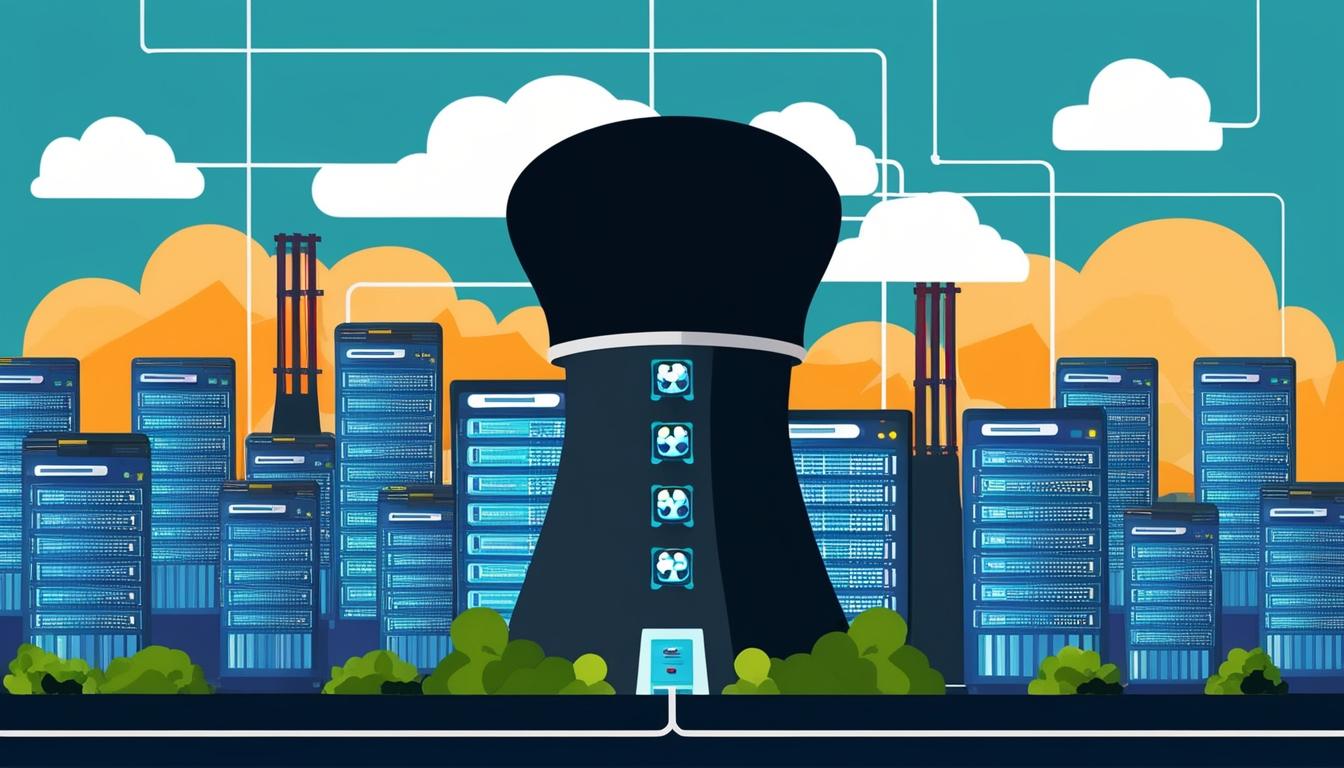
In a significant development within the technology and energy sectors, leading US technology firms Amazon, Microsoft, and Google are making strategic moves to incorporate nuclear power into their operations. This initiative is seen as part of their efforts to address the escalating energy demands of artificial intelligence (AI) technologies which are consuming electricity at an unprecedented rate.
The context for these moves lies in the massive expansion plans for data centres globally, driven by the tech giants' commitment to pioneering AI advancements. A recent Goldman Sachs report reveals that data centres in the United States are expected to account for 8 percent of the country's total power consumption by 2030, a marked increase from 3 percent in 2022. In Europe, projections suggest that by this time, their energy requirements could equate to the present combined electricity consumption of countries like Portugal, Greece, and the Netherlands.
As the demand for robust AI systems intensifies, so does the need for substantial electricity supplies, which in turn fuel significant carbon emissions. Consequently, Amazon, Google, and Microsoft are exploring nuclear power as a viable path to sustain their energy needs while adhering to zero-carbon emission goals. Despite nuclear power's high construction costs and political sensitivity, it offers an uninterrupted, carbon-free energy source once operational. Jacopo Buongiorno, Professor of Nuclear Science and Engineering at MIT, underscores the reliability and predictability of nuclear energy, saying, "The cost may be high, but it's predictable for 60 years."
Nuclear reactors, although more costly to erect compared to solar or wind energy facilities, have become an economically feasible option for major tech corporations with significant annual profits. Rob Bittencourt of Apollo Global Management has highlighted the extensive financial commitment involved, estimating the industry's data centre buildout at approximately one trillion dollars, necessitating an enormous power supply. "These are huge numbers, but Amazon, Meta, Microsoft, and Google can afford to play the long game," he remarked.
In terms of strategy, the tech companies are evaluating various approaches. One such approach involves revitalising ageing nuclear plants. Microsoft has entered into a 20-year agreement with Constellation Energy to reactivate Unit 1 at Three Mile Island in Pennsylvania, which ceased operations five years ago due to economic considerations. This site is historically significant, having witnessed a partial meltdown in 1979 that incited widespread fear and halted nuclear energy expansion in the United States. Amazon Web Services is similarly engaging with the Susquehanna Steam Electric Station reactor, in service for four decades, to provide energy for a nearby data centre hub.
In parallel, investments in Small Modular Reactors (SMRs) are gaining attention, though these remain largely in the experimental phase. Amazon has announced investments in SMR undertakings, including a stake in start-up X-energy. Google, partnering with Kairos Power, is exploring the development of SMRs, with potential deployment by 2030. Yet, there are challenges: the reliability of SMR technology is in question, and tech companies typically lack the experience necessary to navigate nuclear projects, which could lead to unforeseen complications, as noted by Buongiorno.
Despite safety concerns stemming from historical nuclear accidents such as those at Chernobyl and Fukushima, industry leaders are pressing forward with confidence. Bill Gates, the founder of Microsoft, is steering substantial resources—billions of dollars—into his SMR venture, Terrapower. Construction of this project has commenced in Wyoming, although it is still pending approval from US nuclear authorities. At a recent event in New York, Gates expressed his belief in the potential of nuclear power to serve as a cornerstone for a future dominated by AI. "I'm putting billions into it because I'm quite confident we can make that case," he stated.
Such developments reveal the shifting landscape of energy consumption in the tech industry, as pioneers like Amazon, Microsoft, and Google navigate the intricacies of integrating nuclear energy into their substantial and growing operational frameworks.
Source: Noah Wire Services