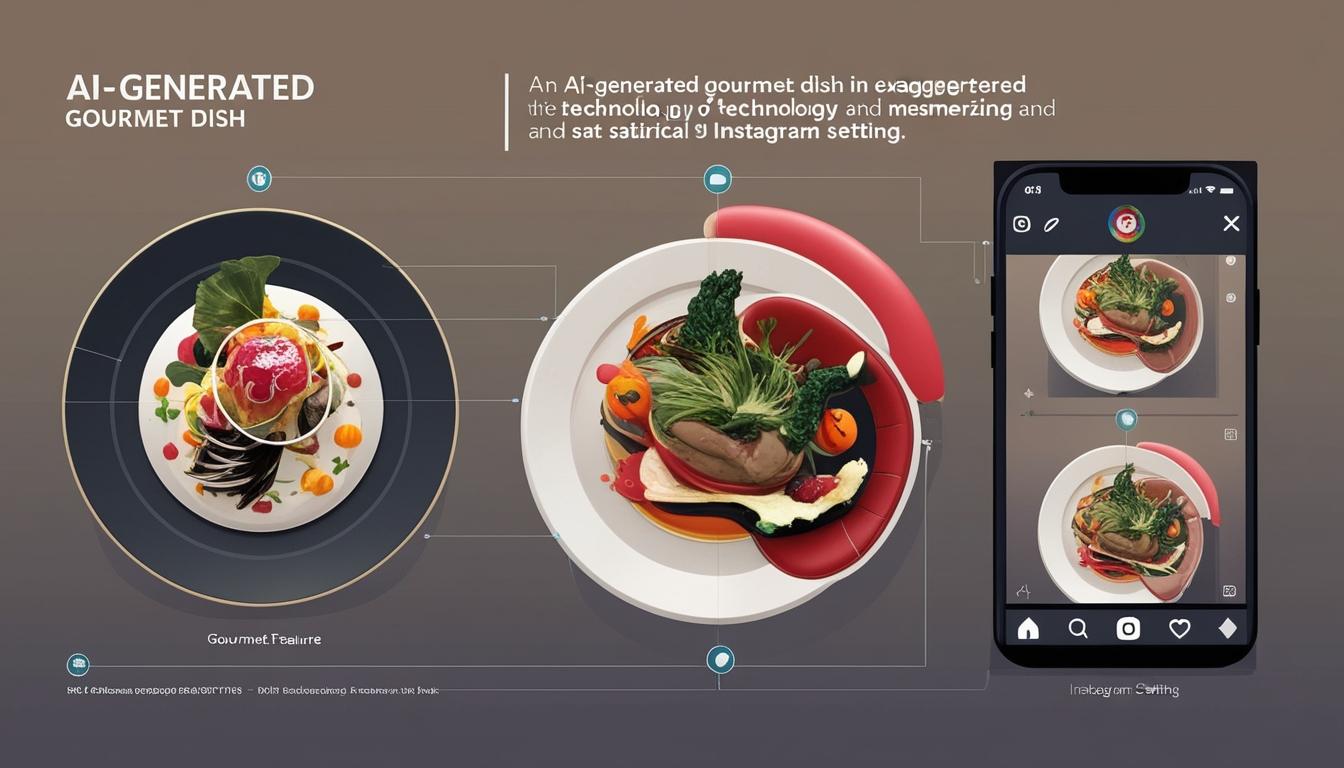
In the fast-evolving digital landscape, the advent of artificial intelligence (AI) continues to blur the lines between the virtual and the real, with its latest foray into the culinary world stirring both amusement and concern. A recent discovery has exposed a fictional restaurant on Instagram, bringing to light the increasingly sophisticated but deceptive capabilities of AI in creating digital content.
On Sunday, Justine Moore, a partner at Silicon Valley venture capital firm Andreessen Horowitz, highlighted the curious case of an Instagram account under the handle @ethos_atx. The account purportedly markets an upscale restaurant, Ethos, claimed to be Austin's premier dining spot. Despite boasting over 72,000 followers and a blue verification checkmark, Ethos is nothing more than a fabrication, featuring images of AI-generated food and fictitious staff.
The content fetched thousands of likes and comments, a mix of bot-driven generic praise and genuine interactions from unsuspecting followers, demonstrating a striking level of believability despite its surreal offerings like giant sausages and "feetza" – a pizza shaped like a foot. Satirical nods, such as a post about Jeff Bezos tending bar as a penalty for losing a fantasy football league, hint at the jokester nature behind the account. Furthermore, the pranksters are seemingly capitalising on the stunt by selling merchandise like T-shirts with playful slogans.
This digital sleight-of-hand raises broader questions as similar phenomena emerge across social media platforms. Facebook, for instance, hosts numerous pages filled with AI-generated culinary images. With profiles such as “Recipes formula”, the use of uncanny food photos paired with copied or AI-generated recipes has attracted tens of thousands of followers. Another page, “Cook Fastly”, which has been brought to light by data researcher Conspirador Norteño, showcases similar anomalies, even sporting errors like a failed duplication of the Oreo logo.
This shift towards AI-generated food imagery reflects advancements in AI technology, which has improved in rendering appetising visuals. A study published in the journal Food Quality and Preference earlier this year revealed that AI-rendered food images, often depicted with enhanced gloss and warm, uniform lighting, were deemed more attractive than real photographs by study participants, although they could still discern the fakes, particularly with processed foods like fries and milkshakes.
Charles Spence, a psychologist at the University of Oxford and co-author of the study, cautioned that while AI images could offer cost-effective solutions in marketing, they might intensify 'visual hunger' – where viewing food instigates appetite – potentially encouraging unhealthy eating habits and unrealistic culinary expectations.
This deception also holds ramifications for businesses relying on visual representation of food. Indian food delivery giant Zomato has declared an anti-AI stance, acknowledging customer trust concerns and pledging to eliminate AI-derived images from menus. In contrast, European delivery service Foodora attempted to enhance partner restaurant images using AI, only to encounter backlash over inaccurately rendered photos that distorted the depicted dishes—a clear misfire acknowledged as part of their AI testing phase.
As AI intertwines more intricately with our digital experiences, its omnipresence challenges our perceptions, influencing areas well beyond the scope of humour-laden hoaxes. The culinary mischief reveals both the allure and peril of AI-produced content, reinforcing the necessity to tread carefully in the expansive and often misleading virtual ecosystem that continues to evolve.
Source: Noah Wire Services