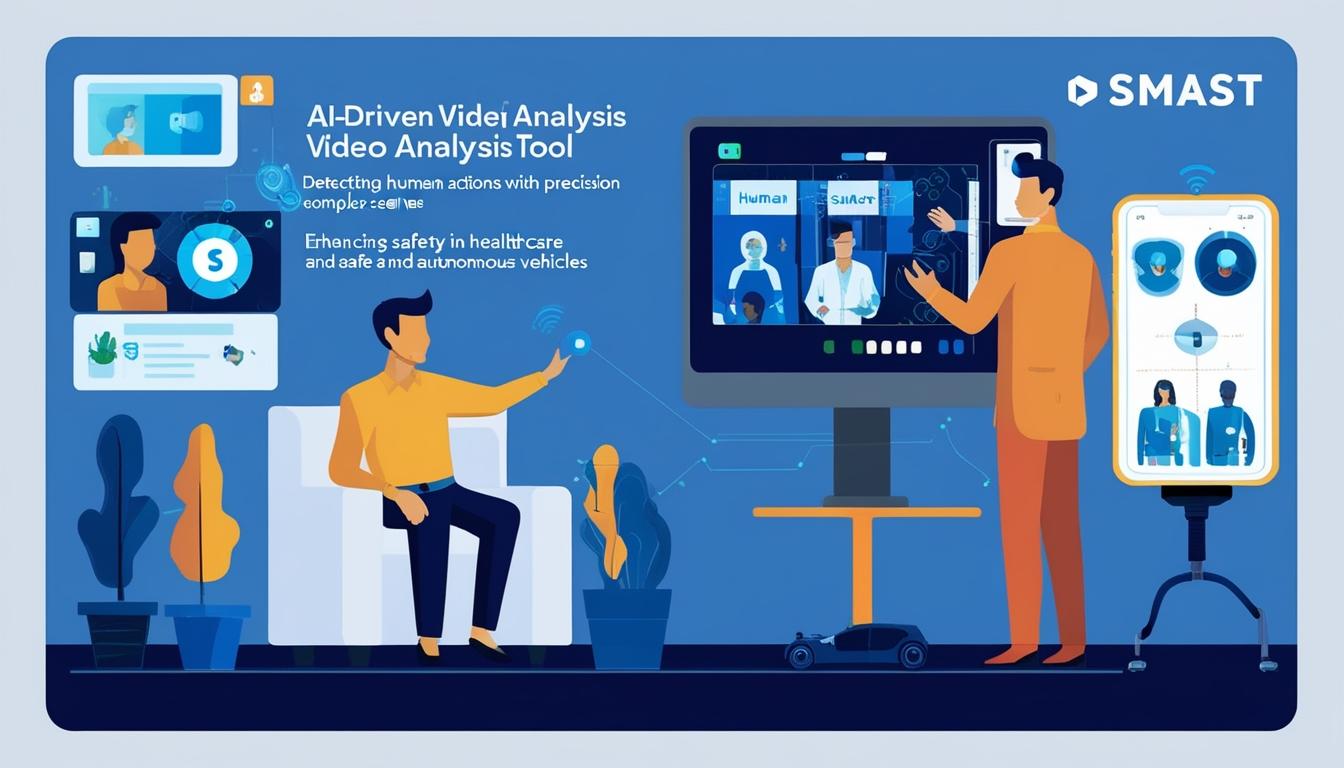
Researchers at the University of Virginia's School of Engineering and Applied Science have unveiled a groundbreaking AI-driven video analysis tool that promises to revolutionise the way human actions are detected and interpreted in video footage. This innovative system, known as the Semantic and Motion-Aware Spatiotemporal Transformer Network (SMAST), was developed with the intention of enhancing current surveillance methodologies, increasing public safety, refining motion tracking in healthcare, and advancing autonomous vehicle navigation.
The core team behind this technology comprises Professor Scott T. Acton, chair of the Department of Electrical and Computer Engineering, who spearheaded the project, along with postdoctoral research associate Matthew Korban and researcher Peter Youngs. Their work is documented in a paper published in the prestigious IEEE Transactions on Pattern Analysis and Machine Intelligence.
SMAST distinguishes itself from existing video analysis tools through its ability to process and understand video content with unprecedented precision. The system utilises two main components to achieve this feat. Firstly, the multi-feature selective attention model enables the AI to concentrate on significant elements within a scene by filtering out extraneous information. This allows it to accurately identify specific actions, such as recognising a person throwing a ball, rather than merely detecting hand movements.
Secondly, the motion-aware 2D positional encoding algorithm facilitates the tracking of dynamic movements over time, where continuous positional changes are a norm. This ability to contextualise motion over sequences allows the AI to comprehend and predict interactions within busy, unedited video footage.
The dual components of SMAST permit it to decipher and adapt to complex behaviours in real-time, setting it apart from its predecessors. This capability is of potential benefit in various high-pressure contexts, including ensuring security at public gatherings, aiding hospital diagnostics, and guiding autonomous vehicles on congested streets.
In trials, SMAST has exceeded the performance of leading action detection systems on academic benchmarks such as AVA, UCF101-24, and EPIC-Kitchens. These successful demonstrations are indicators of SMAST's potential to set new standards for accuracy and efficiency in the realm of video analysis technology.
Professor Acton commented on the potential of the system, describing it as an innovative breakthrough capable of preventing accidents, enhancing diagnostic accuracy, and ultimately, safeguarding lives. Matthew Korban echoed these sentiments, expressing optimism about SMAST’s transformative capabilities across various industries.
The development of SMAST was made possible through support from the National Science Foundation (NSF) under Grant 2000487 and Grant 2322993. As SMAST continues to evolve, it represents the cutting edge of how AI technologies can interpret human actions with greater intelligence, potentially reshaping the future landscape of video analysis in numerous sectors.
Source: Noah Wire Services