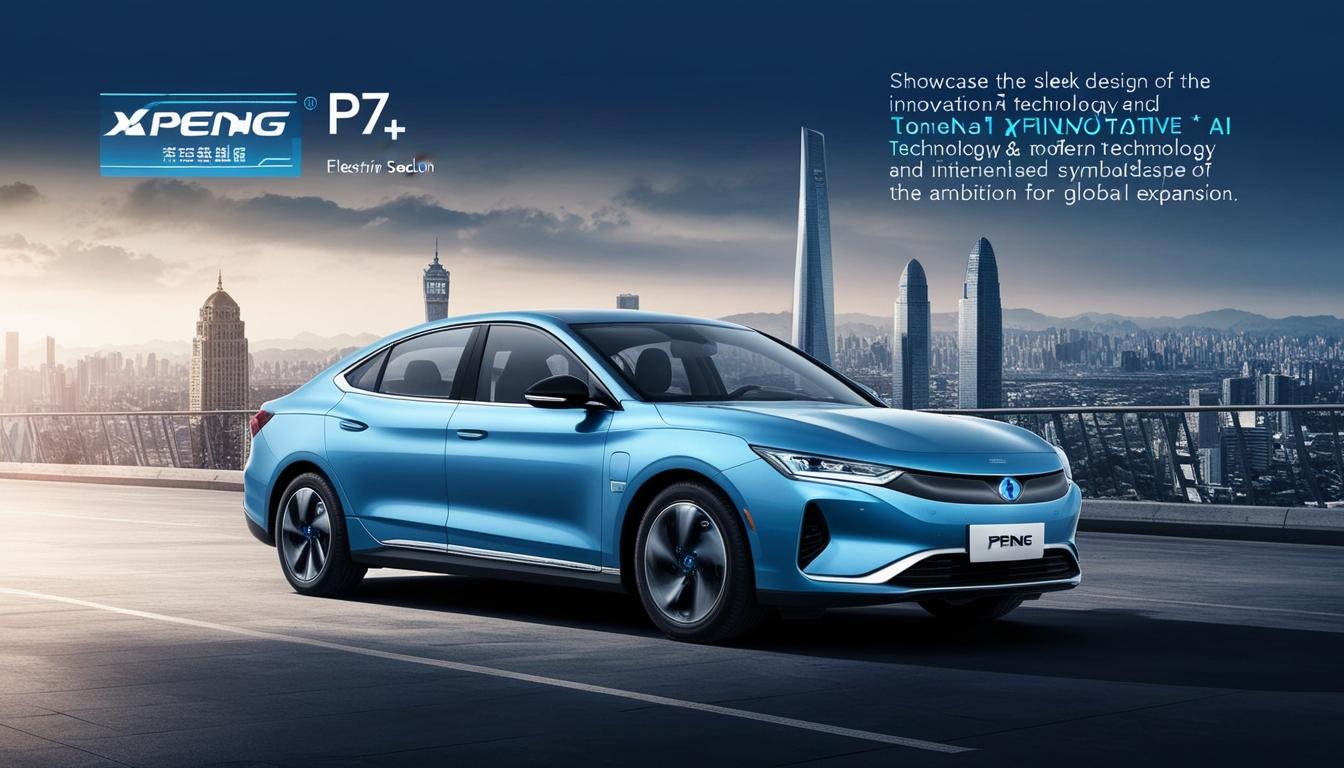
Chinese electric vehicle manufacturer XPeng Motors has unveiled its latest model, the P7+, a family-oriented electric sedan that has captured significant attention with over 30,000 pre-orders within the first two hours of its release, as reported by CNEV Post. This promising start underscores XPeng’s growing influence in the electric vehicle (EV) market, particularly in its home base of China.
The P7+ boasts impressive specifications that place it in competitive standing within the EV industry. It has a substantial range of up to 441 miles on a single charge, coupled with a peak power output of 308 horsepower. These technical attributes are complemented by the car’s interior features, which include a 15.6-inch infotainment system powered by the Qualcomm Snapdragon 8295P chip and an additional 8-inch screen located in the rear seating area, offering a sophisticated user experience.
XPeng Motors emphasises that the defining feature of the P7+ is its ‘AI-defined’ architecture, which distinguishes it from competitors, notably Tesla. A key component of this approach is the AI Hawkeye Visual Solution, an autonomous driving system designed to enhance visibility, speed of reaction, and accuracy in adverse weather and low-light conditions. This system integrates advanced AI technology into various elements of the vehicle, including the chassis, powertrain, driving systems, smart cockpit, and autonomous safety systems.
The P7+ is equipped with high-definition ‘8M’ cameras situated at both the front and rear, supplemented by millimeter-wave and ultrasonic radars. This configuration allows the vehicle to function without reliance on Lidar systems or high-definition mapping, echoing a strategy similar to that of Tesla, which also aims to eliminate Lidar in favour of camera-based systems.
Another technological advancement in the P7+ is its ability to adapt its infotainment system based on user behaviour and external conditions such as journey details and time of day, made possible by XPeng's proprietary ‘Turing Chip’. This chip is set to be a foundational element in future XPeng technologies, including not only their vehicle range but extending to robotic and eVTOL (electric Vertical Take-Off and Landing) craft.
XPeng is not just focusing on its domestic market; it is eyeing expansion with plans to launch additional models in Europe. The company’s chairman, Xiaopeng He, has articulated ambitions to grow the brand’s international footprint significantly, aiming for half of its sales to come from overseas markets eventually. This expansion strategy targets the €40,000 and above price segment, rivalling established manufacturers like Tesla.
However, the company faces challenges, particularly in convincing regulators and consumers of the safety and efficacy of its AI-powered autonomous systems. While XPeng’s decision to forgo Lidar in favour of a camera-based system mirrors Tesla’s approach, it remains to be seen if this will satisfy regulatory requirements, especially in markets like Europe, where such technologies are scrutinised heavily. Presently, in Europe, only a few manufacturers like BMW and Mercedes-Benz have achieved SAE Level 3 automation under tightly controlled conditions.
Moreover, the dimensions of the P7+, which measures over five metres in length, could present practical challenges on Europe’s often narrow and congested roads, raising questions about its market suitability despite its advancements.
Overall, the XPeng P7+ represents a significant development in the electric vehicle sector, showcasing cutting-edge AI technology and ambitious international aspirations, albeit with substantial hurdles to overcome in its bid to gain a competitive edge in the global automotive market.
Source: Noah Wire Services