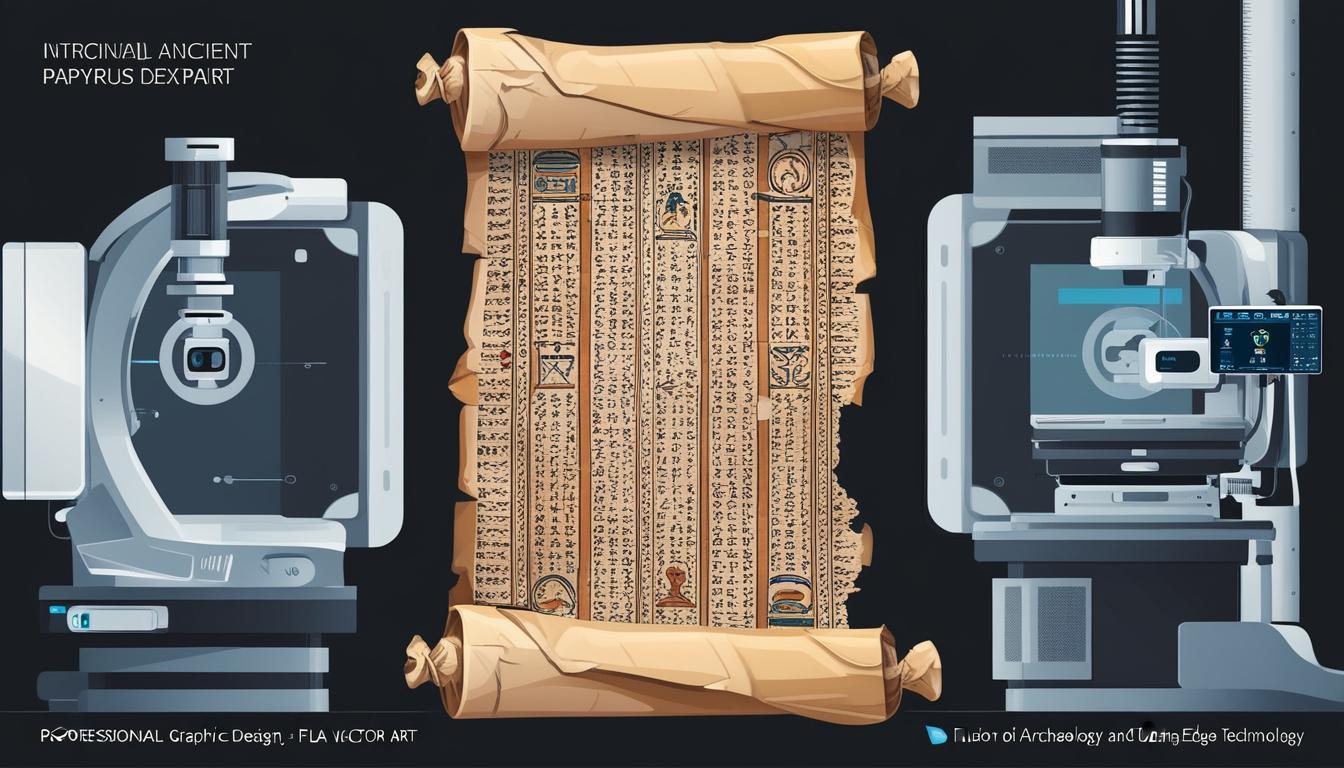
In a breakthrough melding of archaeology and technology, scientists have advanced the decoding of ancient texts carbonised by the catastrophic eruption of Mount Vesuvius in AD 79. This momentous eruption buried the Roman cities of Pompeii and Herculaneum under a thick shroud of pumice and ash, turning them into time capsules of the ancient world. Among the myriad fascinating sites unearthed, the Villa of the Papyri in Herculaneum stands out with its unique treasure—a library housing nearly 1,800 papyrus scrolls, considered the only surviving collection of its kind from antiquity.
These scrolls, largely destroyed or fragmented due to the heat and force of the eruption, are slowly surrendering their secrets thanks to modern technological advancements. The scrolls were written by followers of the Greek philosopher Epicurus, whose tenets greatly influenced Roman intellectual life. Previous attempts to open these delicate scrolls led to further fragmentation or complete destruction, rendering them unreadable.
However, a team led by Brent Seales, a computer scientist from Kentucky University, has been pioneering a novel technique utilizing computerised tomography (CT) scans coupled with artificial intelligence (AI) to virtually unwrap the scrolls, capturing their contents without causing physical harm. This groundbreaking procedure recently yielded a text written by an Epicurean philosopher, marking a significant leap in the field of ancient text recovery.
Amidst this promising progress, Seales and financial backers from the United States, including entrepreneurs Nat Friedman and Daniel Gross, issued the Vesuvius Challenge. This quest invited experts from across the globe to participate in a technological race with a tantalising grand prize: $700,000 for anyone who could manage to decipher 85 percent of text passages from two scrolls. Smaller incentives were offered for deciphering individual words.
The challenge saw robust participation from around 2,000 to 3,000 contestants worldwide, and technological instruments were refined and optimised through this collaborative effort. Ultimately, a group of students from Germany, Switzerland, and the United States triumphed in February, successfully translating 15 columns and 2,000 characters thought to be penned by Philodemus, the Epicurean philosopher who established the library.
These deciphered texts delve into philosophical discussions on desirability and choice, with one passage musing, "In the case of food, we do not immediately believe things that are scarce to be absolutely more pleasant than those that are abundant."
The success of these digital endeavours has prompted Seales to embark on a second iteration of the challenge, aiming for the complete reading of entire scrolls. According to Seales, advancements in AI technology may soon permit scrolls to be decoded autonomously, analogous to the creation of self-driving vehicles. This implies a future where the scan of a scroll could be input into a system that reveals its secrets independently.
Current research efforts continue at the Naples National Library, now protected as its antiquated metal cabinets could be replaced with fireproof versions given potential volcanic threats from nearby Campi Flegrei. Meanwhile, a project with German researchers seeks to determine if the scrolls used metal-based inks, potentially rewriting the chronology of ancient writing techniques.
With a darkroom outfitted with digital microscopes and machines for infrared and thermal imaging, scholars aim to enhance the visibility and legibility of these historical texts. Graziano Ranocchia of Pisa University spearheads such efforts, utilising infrared and x-ray scanners in a bid to render the content of the charred scrolls accessible to scholars and the public alike.
The prospect of reading more scrolls not only stands to enrich our understanding of the Epicurean school of thought but also to possibly unearth unexpected literary works, perhaps from authors like Pliny the Elder, a renowned Roman scholar.
As operations look towards further excavation and technology use, future discoveries stand to shed light on the intellectual and cultural history preserved beneath the volcanic ash—a captivating amalgamation of ancient wisdom and modern ingenuity.
Source: Noah Wire Services