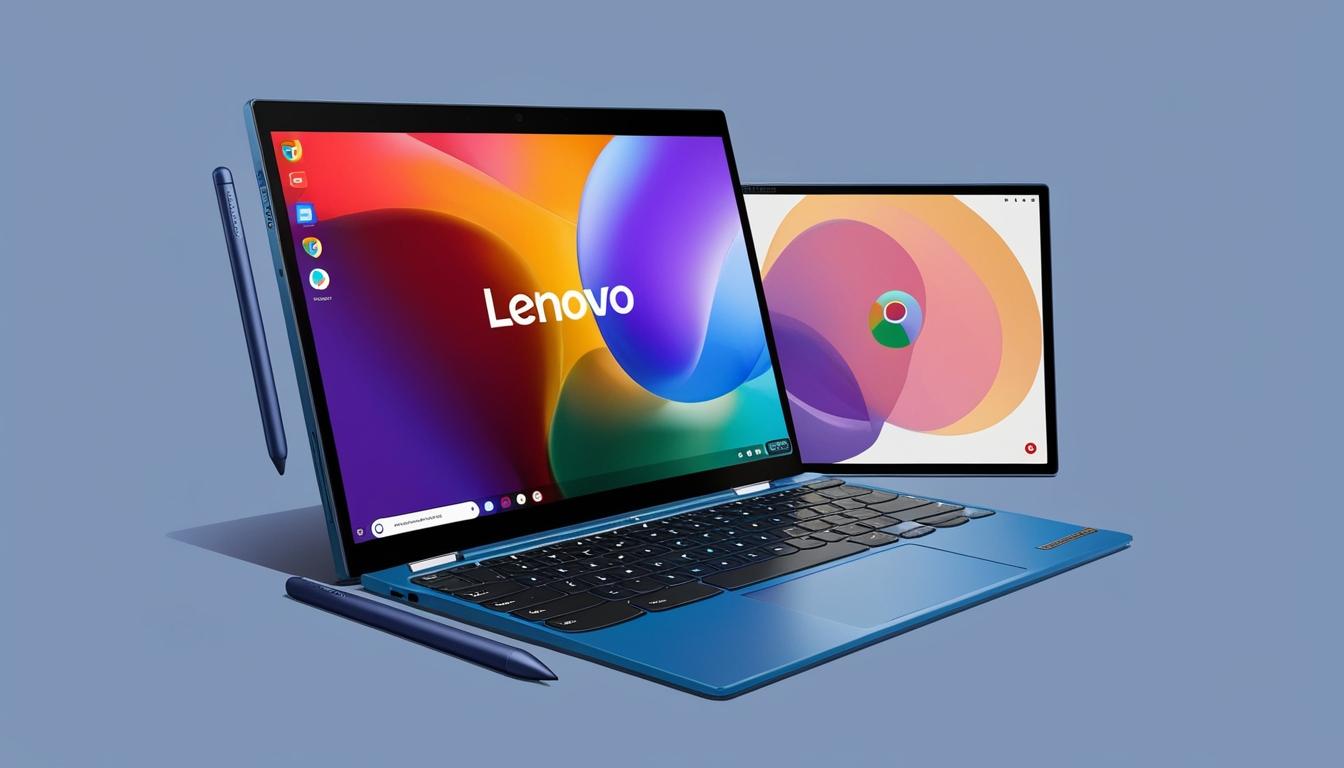
Lenovo has officially joined the artificial intelligence domain with the launch of its latest generation Chromebook, the Duet 11, further developing its impressive reputation in the ChromeOS space. Despite its absence at Google's unveiling of the Gemini Advanced-powered Chromebook Plus models earlier this year, Lenovo has made a significant impact with its recent October update announcement, revealing the integration of AI features in the Chromebook Plus line, starting with the Duet 11.
The Lenovo Chromebook Duet 11 is designed as a 2-in-1 device, offering versatility in both productivity and creativity. This model is equipped with a MediaTek Kompanio 838 processor and a dedicated neutral processing unit (NPU), enabling it to support a variety of Google's AI functions, including the recently developed Gemini Chat.
Commonly recognized for their lightweight and affordable design, Lenovo Chromebooks like the IdeaPad Duet 5 receive praise for their sleek looks and functionality. The Duet 11 continues this trend, showcasing a premium metal frame and Corning Glass cover that provides durability and a high-end feel. The tablet-oriented device comes bundled with a keyboard, a folio stand, and a USI 2 stylus, making it particularly adaptable for both work and leisure tasks.
Starting at a competitive price of $359, the Lenovo Chromebook Duet 11 is available for purchase at Lenovo.com and Best Buy, where various models offer differing RAM and storage capacities. Lenovo's configuration options begin with 4GB RAM and 64GB internal storage, upgrading to an 8GB RAM and 128GB storage version for $399. Best Buy offers a variation with 4GB RAM and 128GB storage priced at $379.
The Lenovo Chromebook Duet 11 features a 10.95-inch WUXGA 1920x1200 resolution display with touch capabilities, set at a bright 400 nits, designed for optimal streaming and ergonomic ease. It is bolstered by TÜV Blue Light specifications, supporting extended use comfortably. The display's Corning Glass protection enhances its suitability for cinematic experiences, while its compatibility with the USI Pen 2 adds artistic flexibility for creators.
Despite the sophisticated design and AI integration, the Duet 11 faces minor setbacks. The keyboard's compact size may prove challenging for users accustomed to larger layouts, and its functionality can be unpredictable on soft surfaces. Still, the keyboard snaps on with ease, ensuring quick transitions between tablet and laptop modes. Trackpad functionality is mostly seamless, although a slight lag has been reported during intensive use.
The device promises up to 10 hours of battery life, but real-world usage suggests it sustains around 7 to 8 hours of mixed activity, sufficient for typical daily tasks. The dual-camera setup includes an 8MP rear camera capable of vibrant colour capture and a 5MP front camera often criticized for blurriness under less than optimal lighting conditions. Video call clarity seems enhanced when the device is plugged in, aided by AI improvements introduced for better visual quality.
ChromeOS serves as the OS of choice for the Duet 11, enriched by new AI capabilities integrated from the Chromebook Plus line, including a dedicated Chat with Gemini button on the taskbar. The Chromebook Duet 11 packages these AI features along with a three-month trial of Google One AI Premium, highlighting innovative functions like the Focus feature – a desktop version of do-not-disturb – designed to aid concentration with calming music and backgrounds.
Lenovo's decision to integrate AI capabilities into the Duet 11 emphasizes its commitment to enhancing user experience through intelligent innovations, making the Chromebook Duet 11 a noteworthy contender in the market alongside alternatives like the less pricey Asus Chromebook CM30. As Chromebook devices continue to evolve with AI functionalities, Lenovo's Chromebooks remain a competitive option, particularly for those who are keen on experimenting with advanced AI features while maintaining practical usability.
Source: Noah Wire Services