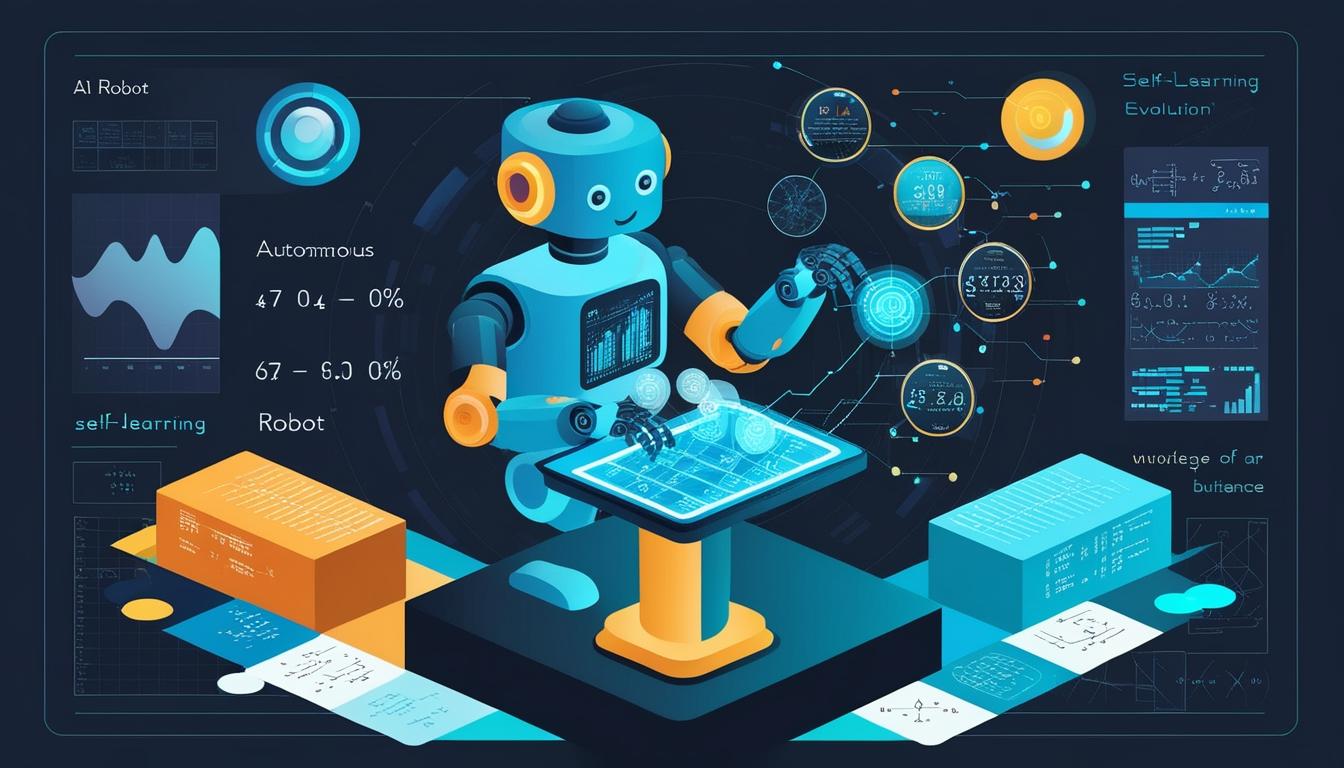
Meta Platforms, the parent company of social media giants Facebook and Instagram, has announced a significant advancement in artificial intelligence with the introduction of its "Self-Taught Evaluator" model. This innovative AI system stands out as part of a series of groundbreaking models unveiled by Meta’s research division, marking a strategic move towards developing autonomous systems capable of self-improvement without extensive human involvement.
The Self-Taught Evaluator employs a "chain of thought" reasoning approach, akin to the technique found in OpenAI's latest model, OpenAI o1. This methodology enables the AI to break down and resolve complex issues by tackling them as a series of simpler, manageable sub-tasks. The resulting improvement in decision-making and efficiency during problem-solving illustrates a promising leap forward in AI technology.
A notable feature of Meta’s Self-Taught Evaluator is its reliance on AI-generated data instead of traditional human-annotated datasets. Historically, the evolution and training of AI models have relied heavily on data labelled by human annotators. Meta’s shift away from this reliance signals a move towards creating more autonomous and self-sufficient AI systems. The ability of the model to learn from its own outputs represents a significant shift in AI development, permitting the system to detect and rectify its mistakes autonomously, thereby enhancing its performance over time. This capability is especially beneficial in fields such as mathematics, scientific analysis, and software coding, where accuracy and precision are imperative.
The advantages of leveraging AI-produced data extend beyond eliminating human annotation constraints; the model progresses at a much faster pace and with greater depth compared to human efforts, positioning it to potentially transform sectors that demand meticulous and precise analysis. As the Self-Taught Evaluator advances in proficiency, it becomes increasingly adept at handling complex tasks independently, reinforcing its value to industries that depend heavily on AI for critical operations.
Meta researcher Jason Weston has highlighted the potential of this self-monitoring and self-evolving capability, suggesting that such AI systems might eventually surpass human evaluators in effectiveness. "AI should become increasingly superhuman, checking itself better than before, which may be beyond human effort," Weston stated. This self-evaluation capability signifies a significant milestone in the progression towards more sophisticated AI systems requiring minimal human oversight. As AI technology continues to progress, these self-reliant systems could unlock new levels of efficiency and innovation across diverse industries.
Alongside the Self-Taught Evaluator, Meta has rolled out several other AI innovations. These include a successor to its successful Segment Anything image identification model, which promises enhancements in the rapidity and precision of visual data processing. Further, Meta disclosed the launch of a tool designed to enhance response times in large language models, alongside new datasets aimed at assisting researchers in the discovery of inorganic materials for scientific pursuits.
These developments underscore Meta’s full-fledged commitment to pioneering advancements in AI technology, emphasizing a trajectory toward efficiency, autonomy, and perpetual enhancement. By creating systems that can evaluate, learn, and evolve independently, Meta positions itself at the avant-garde of AI development, potentially reshaping technological innovation and problem-solving approaches across various sectors.
Source: Noah Wire Services