Swarm: A New Approach to Multi-Agent AI Systems
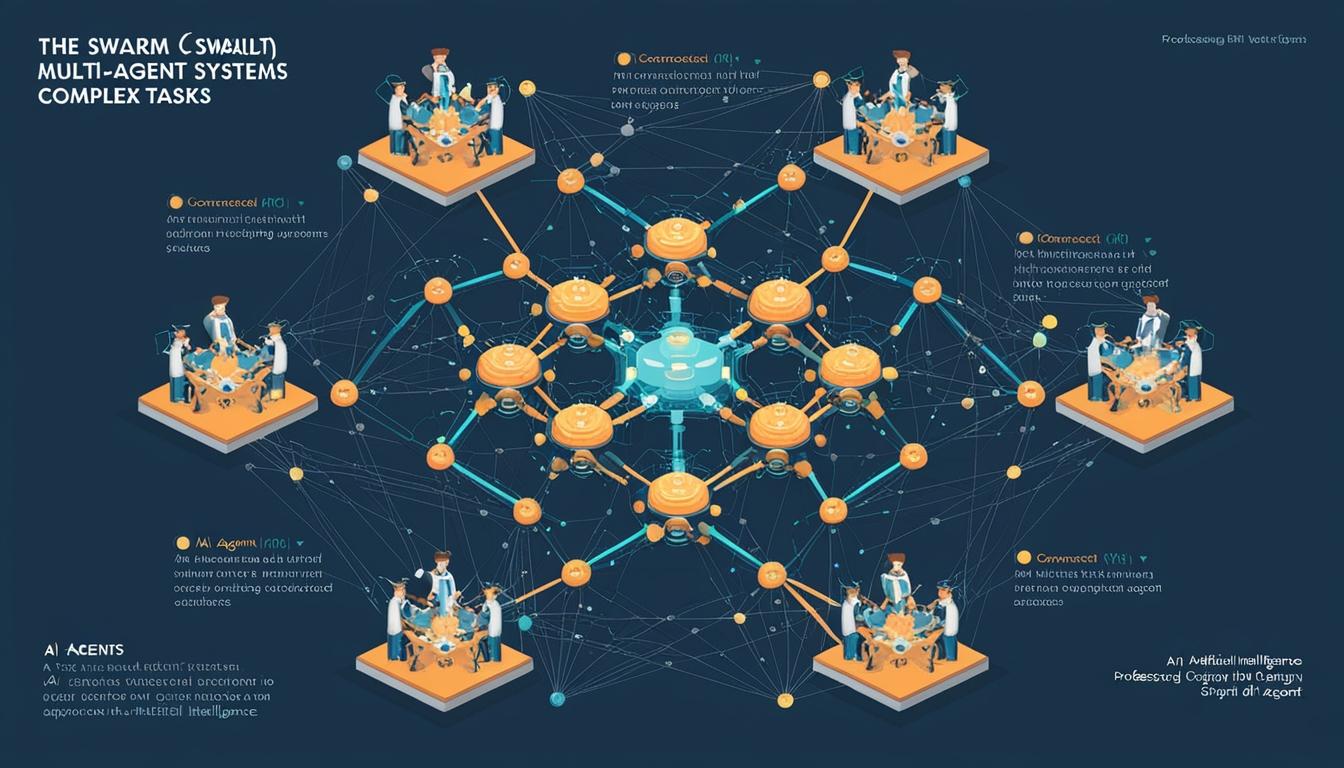
In the evolving field of artificial intelligence, a new experimental tool known as Swarm has been developed to assist developers in exploring the potential of multi-agent systems. This tool seeks to facilitate the integration of multiple agents working in coordination, leveraging routines and handoffs for efficient task execution. Swarm represents a significant advancement in AI system complexity, allowing for the division of intricate tasks into smaller, more manageable subtasks that are handled by specialised agents.
Multi-agent systems like Swarm are particularly well-suited for scenarios that require diverse independent capabilities and instructions that may be challenging to encapsulate within a singular prompt. By utilising multiple agents, each with a specific role, developers can construct more sophisticated AI systems. An illustrative application could be a shopper agent that employs one sub-agent for handling refunds and another for managing sales, overseen by a triage agent that directs queries to the appropriate sub-agent.
Swarm's design is centred around the concepts of routines and handoffs. Routines refer to the established steps and the necessary tools to execute them, whereas handoffs involve transferring control from one agent to another, complete with the context acquired from previous interactions. This allows for seamless communication and task execution among various agents. For example, a refund agent and a sales assistant can be defined within a system, with a triage agent responsible for directing customer interactions to the suitable department based on the customer's needs.
The practical implementation of such a system involves defining agents with specific functions. For instance, a refund agent can be programmed to handle return requests, while a sales assistant can be tasked with processing new orders. These agents can have tools integrated into their definitions to facilitate the transfer of tasks back to a triage agent as necessary.
Swarm is just one approach among a few innovative frameworks for building multi-agent systems, with other notable examples including Microsoft's AutoGen, CrewAI, and AgentKit. Each offers unique methodologies for orchestrating the interaction between independent agents.
The use of multi-agent systems addresses some of the intrinsic limitations of Large Language Models (LLMs), such as constraints on single-turn responses, lack of long-term memory, and the depth needed for complex reasoning. However, developing such systems can be a challenging endeavour. As noted by a commenter on Hacker News, the process of breaking down complex tasks into smaller subtasks requires significant experimentation and code development to ensure that each agent operates effectively within the broader system.
Despite the potential benefits, there are concerns regarding the use of multi-agent systems. Some experts foresee complications, such as agents diverging from their intended tasks over time, potentially leading to inconsistent outcomes. Others argue that with rapidly advancing LLMs, such as GPT and Sonnet models, it might be simpler to modify existing AI models with minimal prompts rather than overhauling an elaborate multi-agent framework.
In summary, Swarm represents a promising step towards the implementation of more complex multi-agent AI systems. By leveraging routines and handoffs, it offers developers a powerful tool to coordinate multiple agents effectively. However, as the field continues to evolve, the practical application and long-term viability of such systems remain subjects of robust discussion and exploration among AI professionals.
Source: Noah Wire Services