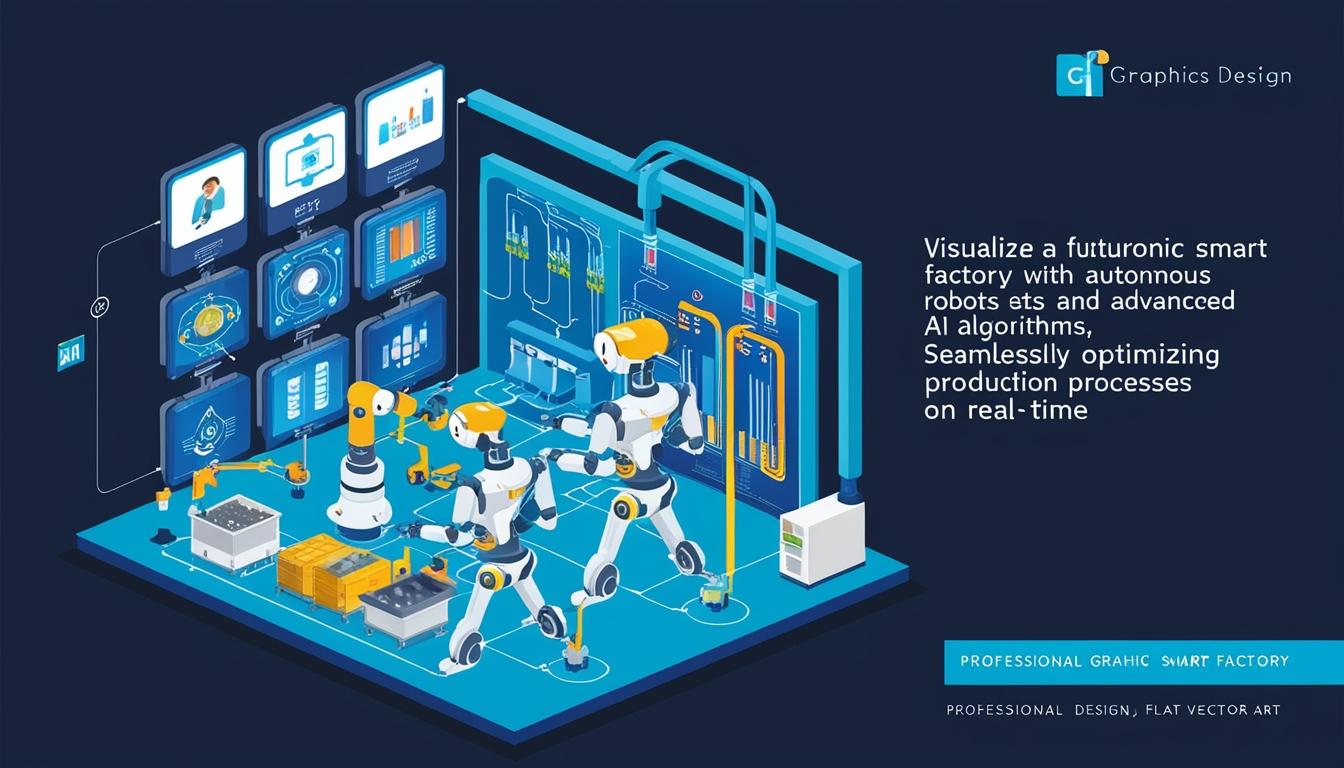
Artificial Intelligence (AI) and automation have become pivotal components of Industry 4.0, leading advancements in various sectors by enhancing decision-making, optimisation, and predictive capabilities. A surge in sophisticated computational techniques now empowers machines to perform autonomous decisions almost instantaneously. As industries evolve beyond elementary automation processes, the implementation of advanced AI algorithms, high-performance computing (HPC), and scalable automation frameworks is redefining the landscape of industrial and scientific fields.
Advanced Learning Algorithms in Automation
Deep Reinforcement Learning (DRL) is at the forefront of modern automation, combining Markov Decision Processes (MDP) with deep neural networks. This integration allows autonomous systems to make decisions sequentially in rapidly changing environments. Prominent among these is the Deep Q-Network (DQN) algorithm, notable for its applications in robotics and supply chain optimisation. DQN's ability to estimate the Q-value function and its proficiency in learning optimal policies through experience replay and target networks make it particularly valuable in high-dimensional surroundings that are common in manufacturing operations.
The Proximal Policy Optimisation (PPO) algorithm, another innovation, excels in environments with extensive state-action spaces. Its policy gradient method ensures stability, vital for robotic control and autonomous vehicle navigation, which requires ongoing adaptation to optimise movement strategies.
Federated Learning in Distributed Environments
Federated Learning (FL) offers an innovative approach, especially for decentralised systems like smart factories and logistic networks. By training AI models locally rather than relying on centralised data aggregation, FL addresses privacy concerns effectively. This method proves particularly beneficial in sensitive sectors such as healthcare and autonomous vehicle development. The Federated Averaging (FedAvg) algorithm allows AI systems to learn from dispersed data sources without sacrificing privacy or efficiency.
The amalgamation of federated learning with edge computing facilitates real-time inference and learning on devices with limited power, enhancing scalability and reducing latency. This synergy is crucial in intelligent manufacturing, where autonomous robot and sensor operations must continue seamlessly.
High-Performance Computing (HPC) and AI Integration
The immense computational demands of advanced AI-driven automation find a solution in High-Performance Computing (HPC). Techniques such as model and data parallelism are instrumental for training large models like GPT or BERT, which consist of billions of parameters. Model parallelism, in particular, enables segments of a neural network to be computed on multiple GPUs or TPUs, overcoming the limitations of single-machine processing.
Frameworks like Horovod facilitate distributed training, leveraging TensorFlow or PyTorch to manage large-scale parallelism by distributing workloads across extensive HPC clusters. This capability is imperative in fields like autonomous trading, where processing real-time data and making instant decisions are critical.
AI Automation Across Various Sectors
Autonomous Manufacturing: In the manufacturing sector, AI-driven digital twins are instrumental, integrating real-time sensor data and predictive analytics with deep learning models to generate virtual replicas of physical systems. This facilitates optimised production workflows, reduces downtime, and aids in superior product design. Predictive maintenance, empowered by Long Short-Term Memory (LSTM) networks, uses time-series data analysis to predict equipment failures, helping minimise disruptions.
Financial Trading: The finance industry benefits greatly from deep learning models like Recurrent Neural Networks (RNNs), which predict short-term market fluctuations by analysing time-series data. When combined with Bayesian Optimisation, these models dynamically adjust to changing market dynamics. Additionally, Deep Reinforcement Learning (DRL) agents leverage Double DQN and A3C algorithms for autonomous trading, thereby improving execution speed and risk management.
Autonomous Logistics: In logistics, Graph Neural Networks (GNNs) and Multi-Agent Reinforcement Learning (MARL) are transformative. GNNs enable AI models to optimise complex networked systems such as supply chains, improving routing and fleet management. Simultaneously, MARL allows multiple autonomous agents, like drones and trucks, to collaborate efficiently on tasks like reducing fuel usage or delivery times, significantly enhancing logistical operations.
Challenges and Prospective Developments
Despite the promising potential of AI and automation, challenges regarding AI model explainability persist. The opaque nature of black-box systems can create trust issues, particularly in critical sectors like healthcare. Ongoing research in Explainable AI (XAI) aims to bridge this gap, rendering AI systems more interpretable, which is essential for adoption in safety-critical applications like autonomous vehicles and financial markets.
Additionally, the considerable energy consumption associated with AI systems introduces sustainability concerns. Addressing this issue involves employing techniques such as model compression, pruning, and quantisation, alongside energy-efficient hardware like neuromorphic computing, to foster more sustainable AI deployments.
In summary, AI and automation, driven by advanced algorithms and HPC, are reshaping industries by enabling smart, autonomous systems capable of real-time optimisation. While these technologies promise remarkable efficiency and innovation, overcoming challenges related to transparency and sustainability will be pivotal in maintaining trust and ethical standards as AI continues to evolve.
Source: Noah Wire Services