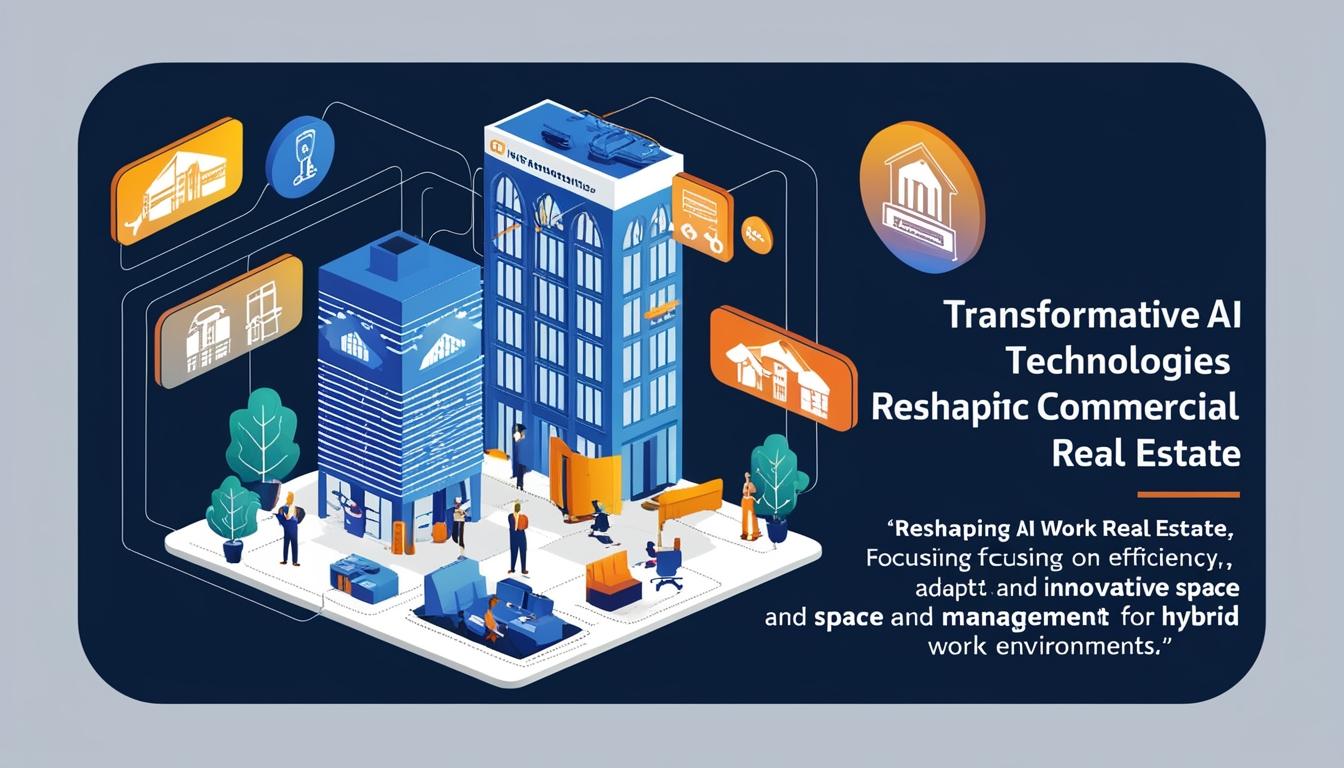
The realm of commercial real estate is undergoing significant transformation, fuelled by the rapid adoption of artificial intelligence (AI) technologies. As traditional office spaces increasingly sit empty, businesses and investors are looking towards AI not only to manage these spaces more efficiently but also to predict and navigate future trends in the market.
This transformation is particularly relevant in the context of hybrid working models, where demand for traditional office setups is on the decline. Frank Cartwright, who leads social housing investments at Yield Investing, emphasised the importance of adapting to these changes. In a conversation with PYMNTS, Cartwright noted, "AI allows us to reimagine these spaces in innovative ways, accommodating the evolving work environment more effectively."
A notable example of AI innovation comes from Butlr, an MIT spinout, where the integration of AI with body heat-sensing devices provides valuable insights into office space usage. These sensors track movements, foot traffic, and occupancy levels, delivering critical data to clients such as Verizon, Microsoft, and Netflix. CEO Honghao Deng explained how these insights can confirm whether cleaning services are being overpaid due to underused areas, and whether office layouts need reconfiguration to better balance private and public meeting spaces.
AI’s role in commercial real estate extends further, with applications in lease abstraction and facilities management becoming increasingly important. Carla Hinson, vice president at PropTech company MRI Software, highlighted AI’s efficiency in document analysis and the predictive maintenance of building systems. She mentioned how AI anticipates equipment failures, assisting in managing maintenance costs for substantial systems like HVAC units.
Yield Investing’s Cartwright further articulated how AI aids in monitoring building systems to enhance energy efficiency, thereby cutting down costs. This technological evolution is particularly leveraged in sustainability efforts, enabling the conversion of surplus office spaces into flexible housing or mixed-use developments.
AI’s prowess in analysing large datasets proves indispensable in strategic planning and risk management. Brittany Hart, CEO of Salesforce consulting firm Platinum Cubed, pointed out how AI helps businesses address market challenges by evaluating multiple scenarios, including fluctuating property demands and underutilised assets.
In terms of workspace optimisation, AI-driven tools support the creation of flexible office environments suitable for hybrid work patterns. Hart noted that these tools aid in crafting strategic decisions based on data-driven forecasts related to market trends and tenant behaviours.
The complexity of regulatory environments, such as those in social housing, benefits greatly from AI automation. Cartwright explained that AI eases administrative burdens significantly by automating lease abstraction and compliance checks, thus allowing Yield Investing to scale up social housing projects with heightened efficiency.
Despite AI's benefits in commercial real estate, issues of privacy and security are inevitable concerns. Butlr’s Deng addressed these concerns by assuring that their sensors do not capture personally identifiable information, promoting an environment of anonymity that supports a more collaborative workspace.
Furthermore, AI is enhancing service offerings such as room bookings and workspace utilisation by recommending optimal seating arrangements and highlighting areas of inefficiency. MRI Software's Hinson remarked that the integration of AI in everyday operations is becoming more accepted as technology advances align with conceptual developments, reducing the initial hesitation once associated with AI usage.
This expansion of AI into the real estate sector illustrates its potential to reshape not just how spaces are utilised and managed, but also how investors and companies strategise and plan for the future. As interest and adoption increase, AI stands at the forefront of the industry's next evolutionary phase.
Source: Noah Wire Services