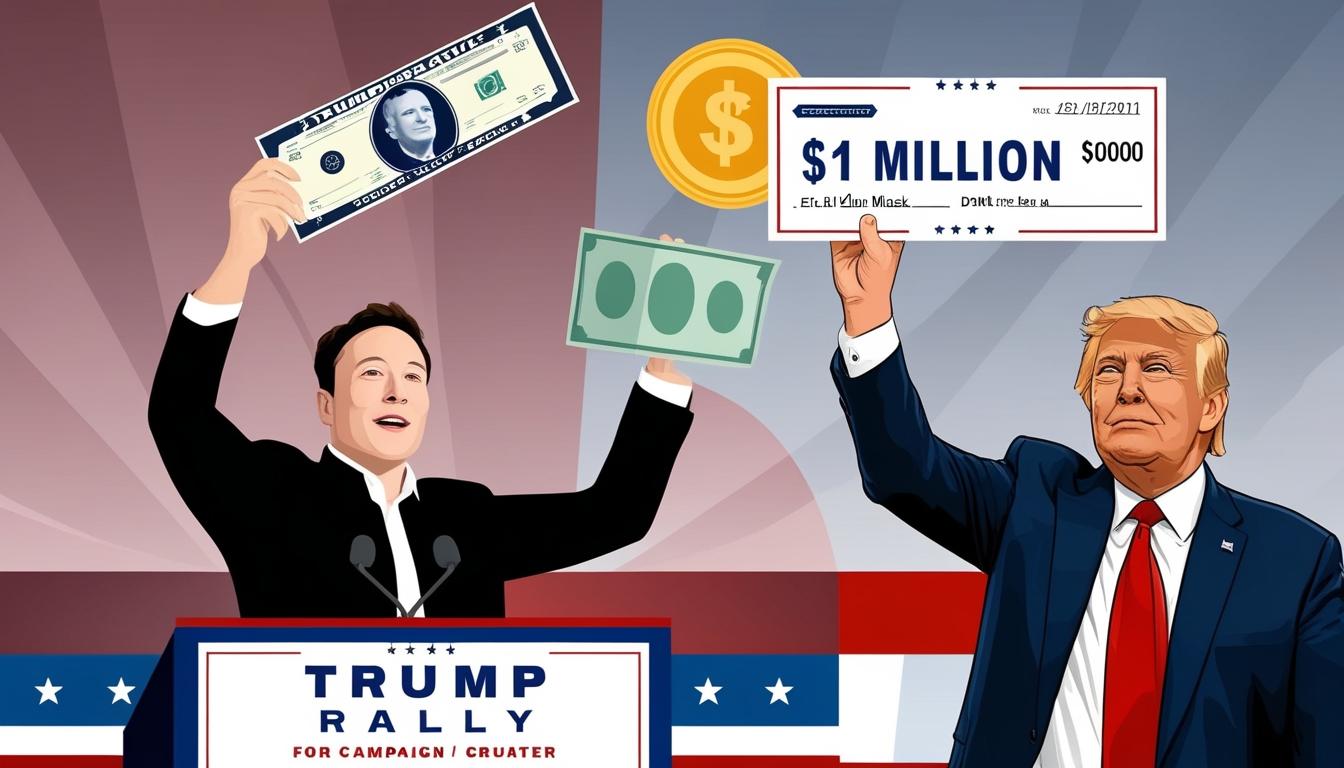
In a unique twist on a longstanding tradition in US elections, billionaire entrepreneur Elon Musk has brought a modern flair to the practice known as 'walking around money', while campaigning in Pennsylvania for Donald Trump, ahead of the upcoming November 5 United States election. Historically, 'walking around money' refers to legal funds that are allocated to party officials to galvanise voter turnout. This was famously utilised by John F Kennedy during his 1960 West Virginia primary campaign, managed by his affluent father, Joe Kennedy.
Elon Musk, known for his ventures including Tesla, SpaceX, and the platform formerly known as Twitter, now X, captivated the attention of an audience of approximately 1,500 Trump supporters by waving a cheque for $1 million. In a surprise move, Musk then randomly selected a lucky attendee from the crowd to receive the cheque, putting a new spin on the old electoral tradition.
Musk's involvement in the campaign is anchored in his advocacy for reducing government spending, aligning with his broader vision of a more streamlined government. During the event in Pennsylvania, he suggested the creation of a new ‘Department of Efficiency’ should Trump secure the presidency. Musk’s proposal seems to draw on his experience since acquiring the social media platform X for $44 billion in 2024, where he implemented significant staff reductions, substituting workers with artificial intelligence technology.
Musk's campaigning comes at a time when the International Monetary Fund (IMF), currently holding its annual meeting in Washington, has spotlighted the global $100 trillion debt as a pressing concern. The IMF recommends urgent fiscal reforms in both the US and the UK to strengthen public financial stability. According to projections from the US Congressional Budget Office, the national debt, which averaged 48.3 per cent of national wealth over the past fifty years, is poised to surge to 122.4 per cent of national output by 2034.
The cost implications of the debt are intensified by the outlined policies of both Donald Trump and Democratic candidate Kamala Harris, which are predicted to increase US debt by $7.5 trillion and $3.5 trillion, respectively, over the next ten years. A significant portion of this debt stems from their reluctance to cut back on Social Security and state-funded medical care programmes. In contrast, Musk posits that leveraging AI and focusing on efficiency could potentially curb spending and debt.
Concurrently, geopolitical concerns are contributing to economic uncertainty, influencing global markets. These concerns will likely be a topic of discussion during this week’s IMF-World Bank sessions in Washington. Economically strategic gatherings such as the BRICS summit in Kazan, Russia, attended by key figures like China’s President Xi Jinping and India’s Narendra Modi, are looking into mitigating the dominance of the US dollar in global reserves.
In the backdrop of these events, the enduring global gold market has seen prices soar to an unprecedented $2,740 an ounce, while US ten-year bond yields fell to 4.1 per cent. Moreover, Britain's decision to release £2.26 billion from frozen Russian assets is part of a broader European initiative to funnel $50 billion toward supporting Ukraine amidst ongoing geopolitical tensions.
Additionally, the current economic climate sees market players focused on interest rates, with the Bank of England facing scrutiny over its 5 per cent bank rate. Analysts from Goldman Sachs project a potential reduction to 2.75 per cent within the next year.
Elon Musk’s involvement in US politics, along with his advocacy for revamped government structures, adds a new dimension to the already complex landscape of the 2023 presidential campaign. His innovative use of traditional campaigning tactics and focus on fiscal responsibility may influence discourse as the election approaches.
Source: Noah Wire Services