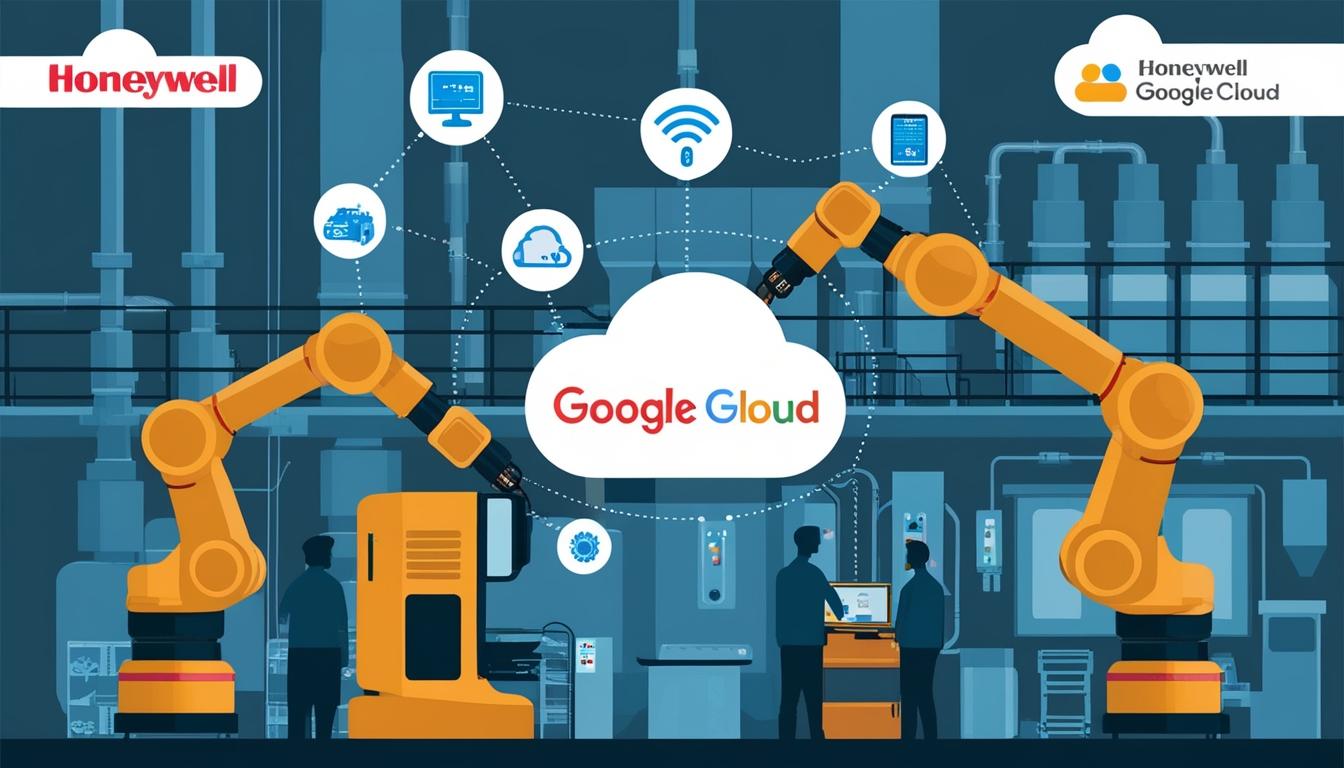
Honeywell, a leader in industrial solutions, and Google Cloud have announced a strategic partnership to revolutionise operations within the industrial sector by integrating advanced artificial intelligence into various processes. The collaboration aims to address a myriad of challenges, including improving efficiency and tackling labour shortages, by utilising sophisticated AI agents.
Revealed in a joint press release on Monday, 21st October, the partnership will combine Honeywell's Internet of Things platform, Honeywell Forge, with Google Cloud's AI proficiency, particularly leveraging the Gemini platform on Vertex AI. The solutions crafted from this synergy are expected to be available by 2025.
This venture between Honeywell and Google Cloud is poised to create a transformative impact on the industrial landscape by enhancing the connectivity between assets, personnel, and processes. One major goal is to address significant labour shortages, which have become more pronounced with the retirement of the baby boomer generation. Honeywell’s 2024 Industrial AI Insights report highlights the urgency of this issue, noting that while a large majority of industrial leaders (82%) consider their organisations to be early adopters of AI, a mere 17% have fully implemented their initial AI strategies.
The partnership's approach to bridging this gap includes the deployment of AI agents designed to support workforce upskilling. As Honeywell Chairman and CEO Vimal Kapur stated, “The path to autonomy requires assets working harder, people working smarter, and processes working more efficiently.” This encapsulates the partnership's vision of creating a more autonomous and efficient industrial environment.
Beyond workforce upskilling, Honeywell and Google Cloud plan to introduce specialised industrial AI agents intended to automate aspects of project design cycles and streamline routine maintenance tasks. These agents will employ Google’s advanced language models to aid technicians, enabling them to resolve issues more effectively by processing diverse data inputs such as images, videos, text, and sensor readings. This is anticipated to enhance decision-making processes on the factory floor significantly.
Cybersecurity is another pivotal aspect of this partnership. Google Threat Intelligence will be incorporated into Honeywell’s cybersecurity offerings, fortifying threat detection capabilities for industrial clients and bolstering the security of crucial infrastructure.
The collaboration also opens new avenues for exploration, including the usage of Google’s Gemini Nano model to augment the intelligence of Honeywell’s edge AI devices. This would apply to various scenarios across different verticals, including scanning performance and voice-based guided workflows, maintenance, and alarm assistance, without depending on internet connectivity.
As the industrial sector faces a potential dearth of young talent, reliance on automation and AI is becoming more critical. The Honeywell-Google partnership represents a pivotal step towards a future where intelligent devices and autonomous operations redefine industrial activities. As these developments unfold, further announcements from Honeywell detailing these advancements and their applications are anticipated.
Source: Noah Wire Services