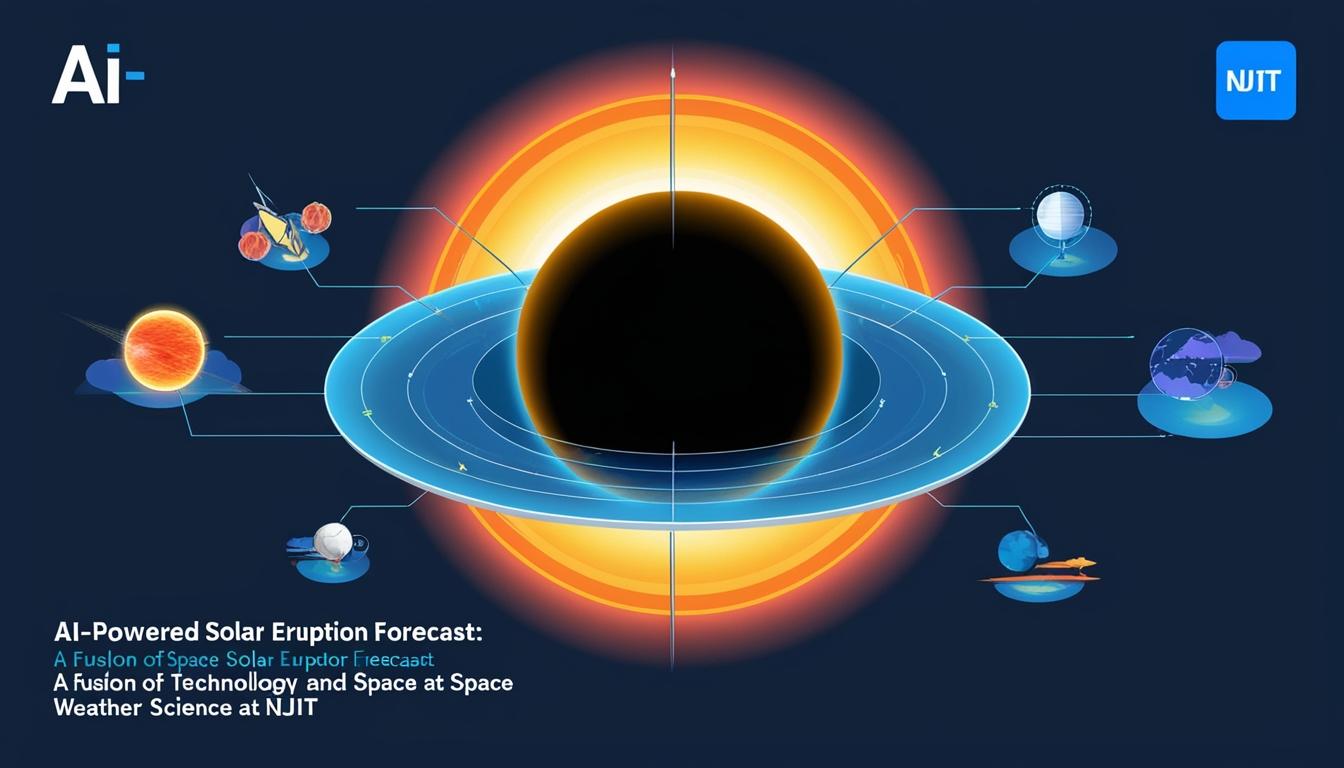
NJIT Establishes AI-Driven Solar Eruption Centre with NASA Support
Newark, New Jersey – The New Jersey Institute of Technology (NJIT) has embarked on an ambitious initiative following the receipt of a substantial $5 million grant from NASA. This funding is earmarked for the establishment of the AI-Powered Solar Eruption Center of Excellence in Research and Education (SEC), a pioneering hub designed to leverage artificial intelligence in forecasting solar eruptions. The grant is part of NASA’s Office of STEM Engagement’s Minority University Research and Education Project (MUREP), specifically the Institutional Research Opportunity (MIRO) programme, and NJIT is among 21 institutions nationwide to receive such support.
This initiative is set to advance NJIT's Institute for Space Weather Sciences (ISWS) by concentrating on improving the prediction of solar eruptions, which include formidable activities like solar flares and coronal mass ejections (CMEs). These solar phenomena can significantly disrupt terrestrial technologies, including satellites and power grids, making accurate predictions critical.
Collaborating with notable partners such as NASA, New York University, and IBM, the SEC aims to refine AI and machine learning techniques to enhance comprehension and predictive capabilities relating to these solar events. The aim is not merely to improve prediction accuracy but also to ensure that insights gained align with fundamental physical and astronomical principles.
Haimin Wang, director of ISWS and a distinguished NJIT physics professor, will lead this project. He expressed the significance of this development in bringing together advancements in AI and space weather research. "Harnessing AI-enabled tools, we will explore the intricacies of space weather to enhance our forecasting abilities for solar eruptions," Wang stated. The project promises to integrate complex data from NASA's solar observations with cutting-edge AI methodologies.
Bo Shen, the associate director of SEC and an assistant professor of engineering at NJIT, highlighted the innovative approach of integrating physics knowledge with AI. Through this synergy, the centre seeks to deliver models that provide not only accurate predictions but insightful contributions to our understanding of solar phenomena.
Solar flares and CMEs originate from the magnetic energy in the Sun's atmosphere. However, due to limited current understanding, accurately predicting these sun-born events has been challenging. Through the application of advanced AI tools, the SEC plans to produce a comprehensive dataset covering several solar cycles, offering deeper insights into the origins and development of such eruptions.
The SEC’s educational outreach includes establishing collaborations with minority-serving institutions, such as Kean University and Essex County College, to deliver programs and workshops aimed at inspiring future space weather scientists. Furthermore, the centre’s integration with various NJIT research bodies, such as the Center for Computational Heliophysics and the Center for Big Data, strengthens its interdisciplinary research capabilities.
Overall, this initiative by NJIT represents a significant step forward in the field of space weather research, promising to deepen understanding of solar activities and improve prediction capabilities for the benefit of technological systems and scientific inquiry.
Source: Noah Wire Services