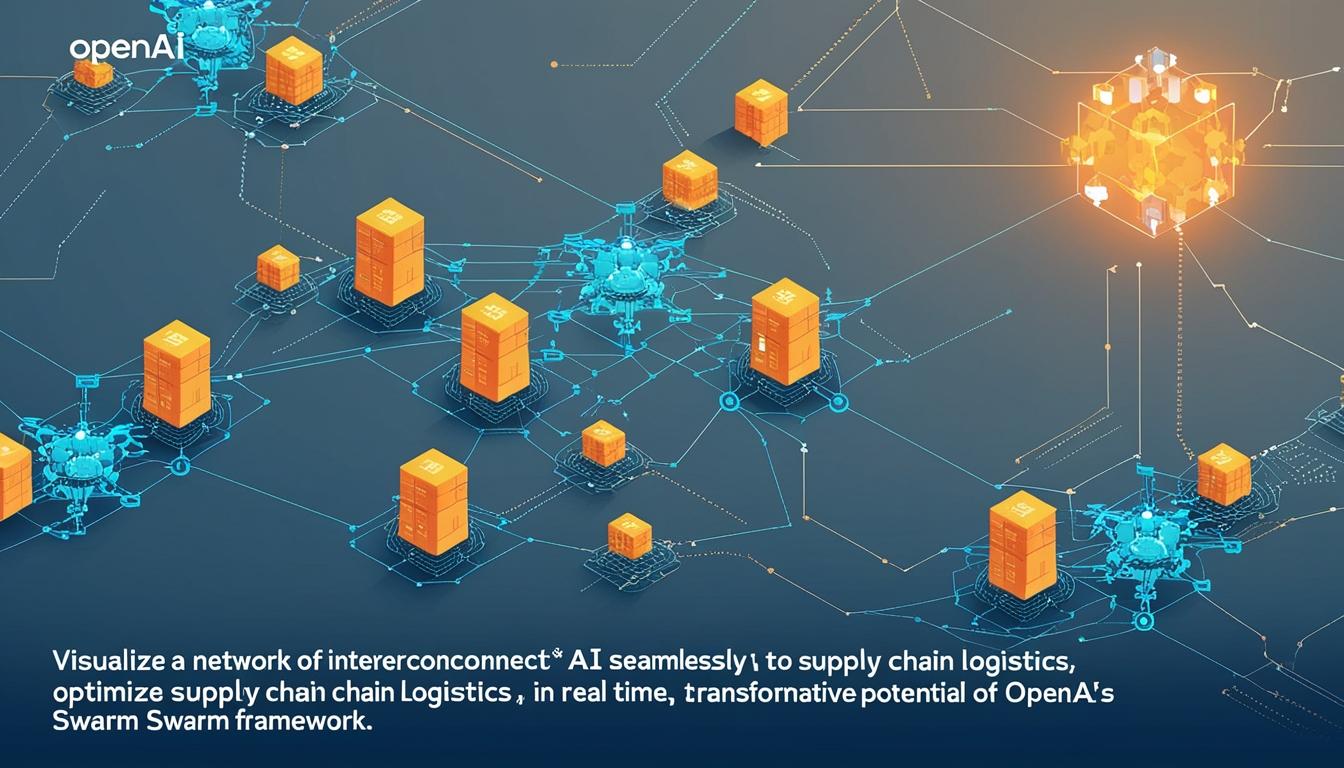
OpenAI has unveiled a new software framework named Swarm, designed to coordinate teams of artificial intelligence agents to address complex tasks, potentially ushering in significant shifts in business automation across multiple sectors. This open-source initiative enables specialised AI agents to seamlessly transfer tasks among one another, streamlining processes that require complex decision-making and rapid adaptation.
The Swarm Framework's introduction could mean transformative changes, particularly in areas like supply chain management. Michael Walker, Chief Marketing Officer at SmythOS, an AI agent company, highlighted the framework's potential: "The Swarm Framework can revolutionise supply chain management by coordinating multiple autonomous agents to handle tasks like inventory management, demand forecasting, and logistics in real time."
AI agents are sophisticated software entities programmed to autonomously execute tasks, make informed decisions, and learn from their operational environment. These agents can work solo or in collaboration, simulating complex human-like interactions and problem-solving. There is a burgeoning interest in using these agents for tasks that span customer service automation, complex supply chain management, and autonomous financial transactions.
In eCommerce and supply chain realms, the capabilities of Swarm software come into focus. Sunil Rao, CEO and co-founder of AI company Tribble, illustrated its functionality: "Imagine one agent tracking stock in a warehouse while another adjusts delivery routes based on traffic, weather, etc. They’re constantly communicating with each other, optimising everything without waiting for human input." This dynamic interaction among agents allows for real-time optimisation, reducing delays and enhancing efficiency.
Beyond logistics, Swarm's impact is anticipated in customer service enhancement. The framework allows autonomous agents to analyse customer behaviour, preferences, and market trends, markedly improving personalised product recommendations. These agents can also manage customer service inquiries, handle returns, and predict and address potential issues swiftly, as noted by Rao.
The financial services sector is another field poised to benefit significantly from the Swarm framework's capabilities. It offers a multi-agent approach that enhances algorithmic trading by enabling AI agents to concurrently process market data, news, and emerging trends. Walker explained the intricacies: "Financial institutions can use the Swarm Framework to enhance algorithmic trading by allowing multiple AI agents to analyse market data, news, and trends simultaneously."
The process involves a network of specialised agents—for instance, one agent may track stock prices while others monitor macroeconomic and news events possibly impacting these prices. By communicating and adjusting strategies collaboratively, these agents aim to minimise human error, leading to efficient trades.
Moreover, the Swarm Framework can facilitate sophisticated risk assessment models in financial institutions. Multi-agent systems assess varied risks – credit, market, and operational – collectively to integrate insights for a holistic risk profile. As Rao pointed out, this capacity to swiftly process vast data sources could enable financial institutions to identify risks more proactively, impacting decision-making processes significantly.
While the Swarm technology heralds potential paradigm shifts in automation, it also prompts examination of future work landscapes and the necessity of human oversight in AI systems. Despite Swarm's capabilities, human intervention remains vital. Rao reinforced this perspective: "There would still be a need to ensure a human-in-the-loop approach to ensure accuracy and transparency across the system." This aligns with broader discussions in the tech community about responsibly implementing AI and considering its implications on employment.
As companies experiment with multi-agent systems, the ramifications could be extensive, spanning diverse operations from customer service to supply chain management. The framework's open-source nature makes it accessible to both established technology firms and startups, possibly heightening competition in the AI sector.
Currently, Swarm is positioned primarily as an experimental platform, serving as a test bed for developing simple AI agents rather than a full-scale production tool. Shyamal Anadkat, a researcher at OpenAI, contextualised its role: "Think of it more like a cookbook. It’s experimental code for building simple agents. It’s not meant for production and won’t be maintained by us."
While Swarm is not yet positioned for direct production deployment, its development could mark the beginning of a new era in business automation, leveraging collaborative AI agents to optimise and innovate in various sectors.
Source: Noah Wire Services