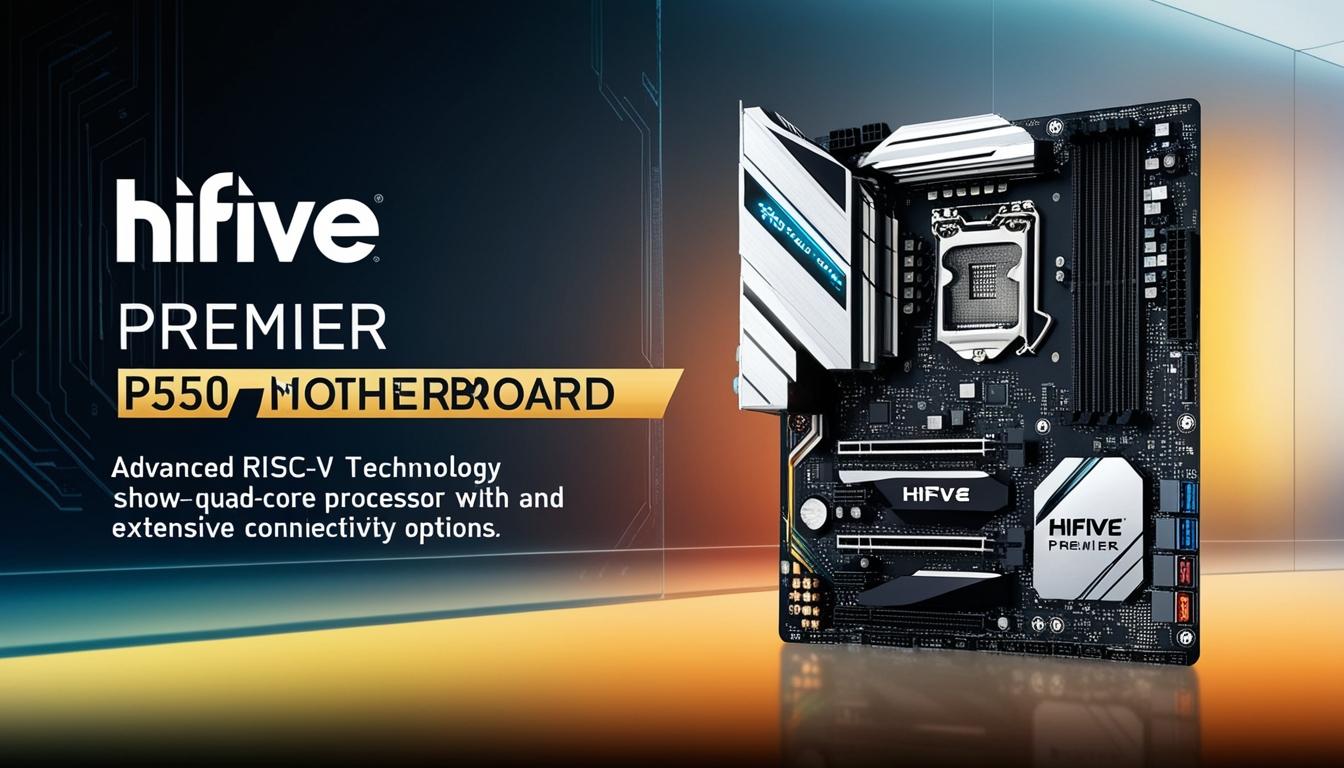
SiFive Unveils HiFive Premier P550: New Generation of RISC-V Mini-DTX Motherboard
The landscape of development boards just expanded with the announcement of SiFive's HiFive Premier P550, a mini-DTX motherboard that promises to push the boundaries of performance in RISC-V architecture. Revealed at the recent RISC-V Summit North America, this board is geared towards developers, providing a versatile and high-performance platform for various applications.
Key Specifications and Features
At the heart of the HiFive Premier P550 is the ESWIN EIC7700X system-on-chip (SoC), featuring quad-core SiFive Performance P550 RISC-V processors running at 1.4GHz, with the capability to overclock to 1.8GHz. Notably, the 64-bit architecture offers a performance level comparable to ARM's Cortex-A75, enhancing its utility for computation-heavy tasks. The SoC integrates a sophisticated cache hierarchy, with support for Error-Correcting Code (ECC), including 32KB L1 Cache per core, a 256KB L2 Cache, and a shared 4MB L3 Cache.
One of the standout features of the SiFive HiFive Premier P550 is its substantial AI capability, boasting up to 19.95 TOPS of AI performance in INT8 operations. This makes the board particularly suitable for tasks involving machine learning and artificial intelligence. However, it's important to note that while these capabilities are present in hardware, software support for the Neural Processing Unit (NPU) and Vision Processing Unit (VPU) is still forthcoming.
The board also includes an Imagination AXM-8-256 3D GPU, supporting modern graphical interfaces such as OpenGL-ES 3.2 and Vulkan 1.2, although the media codec support is yet to be fully exploited due to the current software limitations.
Connectivity and Expansion Options
For those looking to expand their system, the HiFive Premier P550 offers a plethora of options. It comes equipped with a PCIe Gen3 x16 slot operating in x4 mode, providing ample bandwidth for additional peripherals. Networking capabilities are robust, featuring dual gigabit Ethernet ports, and there's provision for wireless connectivity via an M.2 Key E socket for an optional Wi-Fi/Bluetooth module.
Storage options are versatile, with a built-in 128GB eMMC flash memory and a SATA III connector for additional storage devices. USB connectivity is also well-catered with multiple USB 3.2 Gen 1 ports and a USB Type-C interface on the front panel.
Video output is achieved through an HDMI 2.0 port, supporting 4K resolution, and audio interfaces are facilitated via a rear panel stereo jack and an audio header for front panel connections.
Collaboration with Canonical
In terms of software, SiFive is working closely with Canonical to ensure the HiFive Premier P550 is well-supported by Ubuntu 24.04, running Linux 6.6 or later. This collaboration is expected to enhance the board's utility by integrating tools such as GCC and LLVM for development and optimisation purposes.
Release and Availability
SiFive has begun offering an initial pre-release batch of 100 Yocto-ready boards through Arrow Electronics, targeting early adopters and developers. These units are headless unless paired with a discrete GPU. The full release, which will include Ubuntu-supported boards with provisions for the integrated GPU and NPU, is anticipated in the final quarter of 2024. Existing Yocto boards will have upgrade pathways to Ubuntu, ensuring continuity in hardware design and functionality.
A Step Forward for RISC-V
The HiFive Premier P550 represents a significant stride forward for RISC-V technology, offering a platform that is not only faster by a factor of three over its predecessor, the HiFive Unmatched, but also more versatile and integrated, aligning with the growing demand for open-source hardware solutions. As SiFive continues to develop its capabilities, the advent of complete software support will further position the HiFive Premier P550 as a formidable contender in the development board domain.
Source: Noah Wire Services