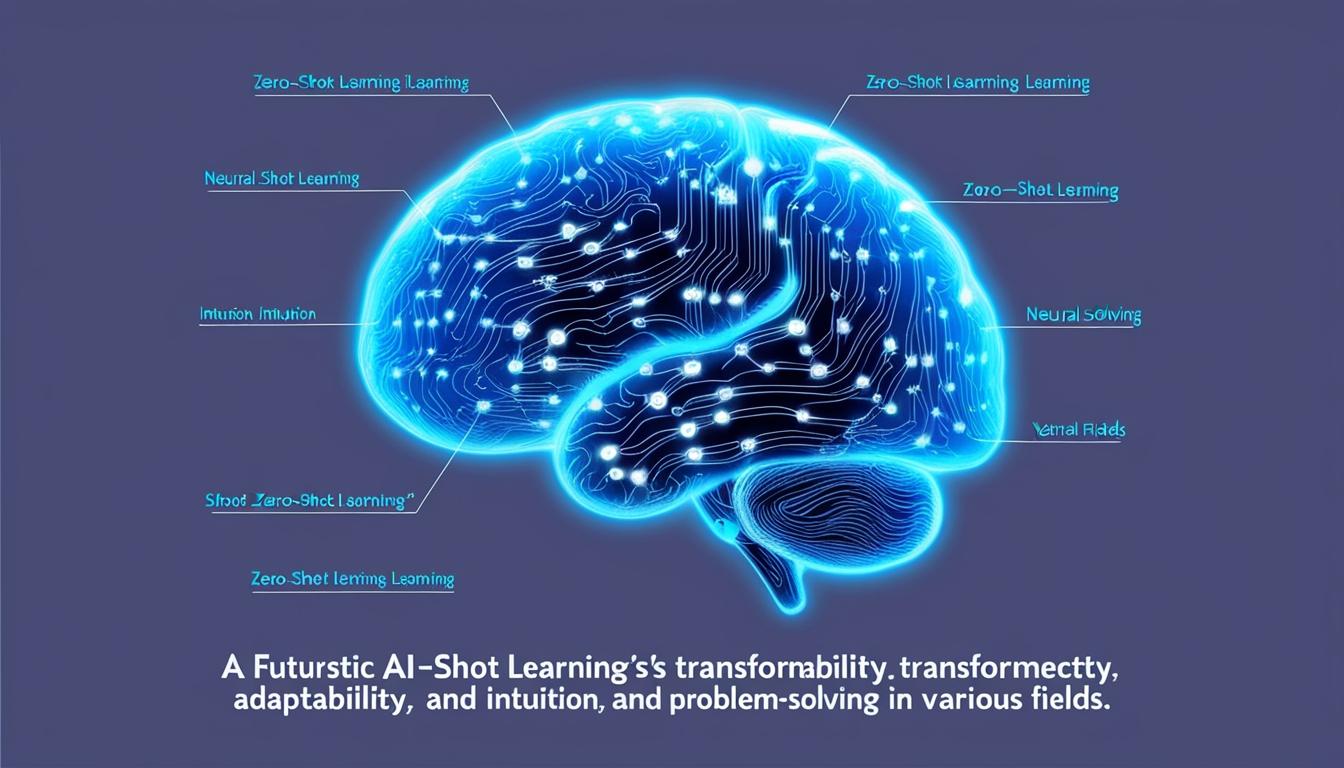
The world of artificial intelligence (AI) is experiencing a notable transformation with the advent of zero-shot learning, a technology that allows AI to perform tasks without having been explicitly trained for them. This groundbreaking advancement is expanding the capability of AI systems, enabling them to tackle problems with a human-like intuition that was previously unattainable.
One of the most prominent examples of zero-shot learning is OpenAI's GPT-4 language model. Although not trained in the field of law, GPT-4 achieved a remarkable score in the 90th percentile on the Uniform Bar Exam. Furthermore, the model has demonstrated impressive zero-shot translation skills, accurately translating languages for which it had no prior specific training, such as Slovenian to Swahili.
Zero-shot learning in AI involves applying existing knowledge to new, unrelated tasks. This approach contrasts with traditional machine learning models, which require extensive datasets and training for each new task. In essence, zero-shot learning is an imitation of human inferential reasoning, harnessing generalized information to make sense of novel scenarios.
The concept of zero-shot learning was introduced in a 2009 Carnegie Mellon University paper titled "Zero-shot Learning with Semantic Output Codes." Since then, the domain has witnessed rapid advancements, particularly in the last five years, as researchers and technologists push the boundaries of what AI can achieve.
The implications of zero-shot learning extend far beyond language and translation applications. In the healthcare sector, a study in Nature Biomedical Engineering highlighted CheXzero, an AI model capable of detecting a range of diseases from chest X-rays. Remarkably, it identified conditions such as pneumothorax without having been explicitly trained on them, by leveraging an understanding of related medical concepts and physiological patterns.
Google DeepMind's Gato agent further illustrates zero-shot learning potential. This generalist AI has demonstrated adaptability across various domains, such as gaming, where it successfully played an unfamiliar Atari game by applying strategies learned from other games within a short exposure period.
Existing processes also show potential benefits in drug discovery. At MIT, researchers applied a zero-shot learning model to predict new antimicrobial properties in molecules it had never analysed, discovering a novel antibiotic compound effective against drug-resistant bacteria—a crucial advancement amid global healthcare challenges.
The influence of zero-shot learning is becoming apparent in the realm of computer vision. Facebook AI, now part of Meta, developed Contrastive Language-Image Pre-training (CLIP), a system that can classify unseen images using only textual descriptions. This capability enables it to categorise images of rare animals, unseen in its training data.
Microsoft Research is also pioneering zero-shot learning in computer vision with its VL-GPT system, which generates detailed captions for images it has not previously encountered. This includes in-depth descriptions of complex scenarios like unfamiliar sports or newly invented technologies.
Zero-shot learning is poised to revolutionise robotics, as evidenced by MIT’s Computer Science and Artificial Intelligence Laboratory, where robots manipulate previously unseen objects. In practical experiments, robots adeptly handled and used tools they had not encountered before, applying their existing understanding of tool use to determine functionality.
The emergence of zero-shot learning represents a paradigm shift in AI development, with implications for creating more adaptable and efficient AI systems. Experts at DeepMind have identified zero-shot learning as potentially crucial to realising artificial general intelligence (AGI), signifying machines that possess cognitive abilities equivalent to a human across diverse tasks.
The advancing capabilities of zero-shot learning are being progressively integrated into various industries, from healthcare and finance to language processing and robotics. This transformative technology is poised to redefine how complex problems are approached and reframe interactions with AI systems. As development continues, so too will discussions about the broader societal, privacy, and occupational implications of AI’s newfound adaptability.
Source: Noah Wire Services