AI Advances in Space Weather Forecasting: A New Era with MAGFiLO v1.0
Los Angeles, CA, 22 October 2024 – In the dynamic field of space weather forecasting, a significant leap forward has been made through the harnessing of artificial intelligence (AI) and machine learning techniques. This advancement centres on understanding the intricate solar filaments on the Sun's surface, which play a crucial role in predicting Coronal Mass Ejections (CMEs), a major space weather phenomenon.
Unveiling Solar Filaments' Secrets
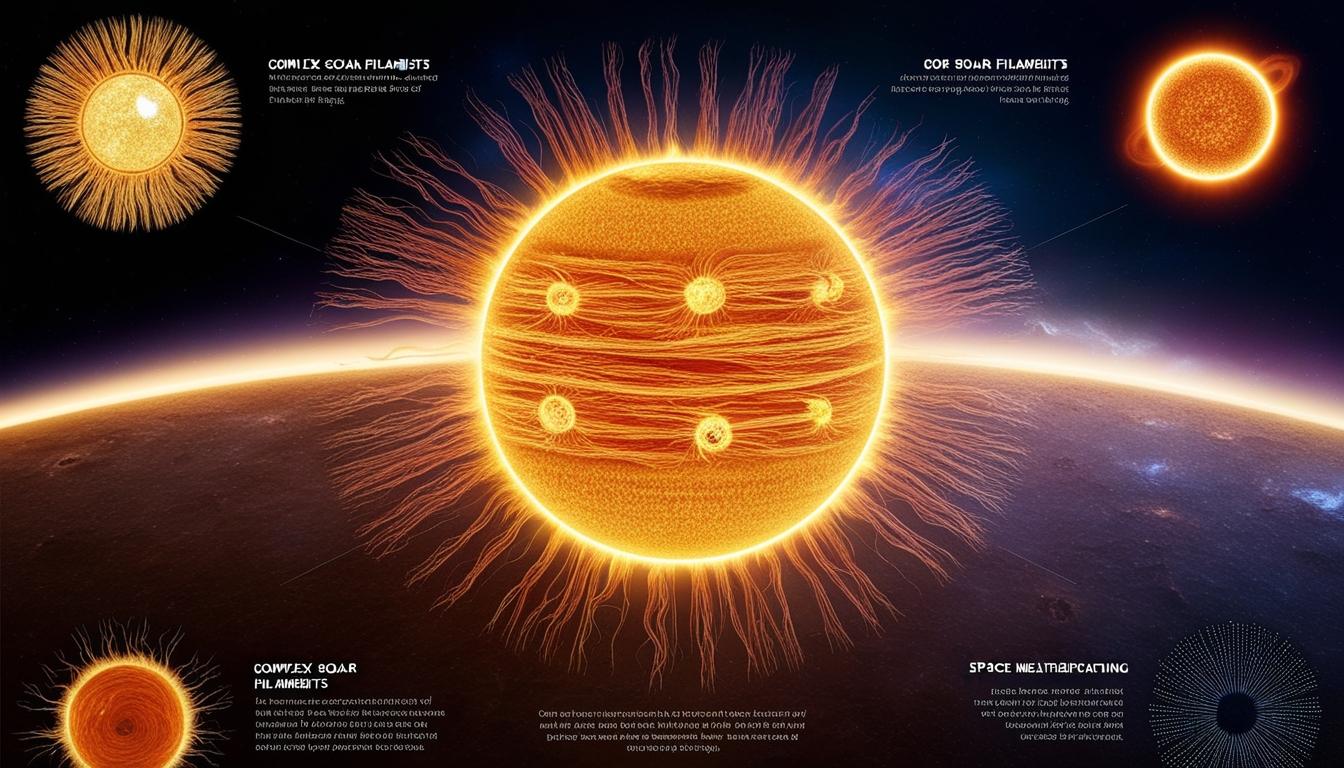
Solar filaments are complex, thread-like structures visible in the Sun's chromosphere. During eruptions, these filaments can evolve into CMEs, which have the capability of carrying billions of tons of solar material across space. Upon reaching Earth, CMEs can initiate geomagnetic storms with the potential to disrupt various terrestrial technologies, including satellites, power grids, and communication networks. Understanding the magnetic properties of these filaments, especially their chirality or handedness, is crucial in assessing the potential impact of CMEs on Earth.
MAGFiLO v1.0: A Revolutionary Dataset
In a groundbreaking development, the Manually Annotated GONG Filaments in H-alpha Observations (MAGFiLO v1.0) dataset has been introduced. This dataset is the result of meticulous work led by Azim Ahmadzadeh from the University of Missouri-St. Louis in collaboration with National Solar Observatory (NSO) scientists Alexei Pevtsov, Luca Bertello, and NSO engineer Alexander Pevtsov. The data comprises 10,244 annotated solar filaments observed across 1,593 solar sessions from 2011 to 2022, embracing an entire solar cycle.
The datasets are collected by the National Science Foundation's (NSF) Global Oscillation Network Group (GONG), which, in partnership with the National Oceanic and Atmospheric Administration (NOAA), operates a worldwide network delivering extensive solar coverage. Each filament’s detailed annotation, achieved through over 1,000 hours of dedicated manual work followed by a double-blind review process, ensures the precision required for effective AI training.
Blending Solar Physics with AI Technology
MAGFiLO not only provides an enriched resource for AI development but also validates established solar physics observations, like hemispheric variations in filament chirality. These filaments show a preference for one magnetic orientation in the northern hemisphere while exhibiting the opposite orientation in the southern hemisphere. This vast dataset now serves as an essential cornerstone for future research, benefitting from nearly three decades of unfaltering GONG observations.
Enhancing Space Weather Forecasting
Integrating AI/ML methodologies into solar filament analysis signifies a transformative shift in space weather prediction capabilities. With MAGFiLO, machine learning models can be trained to automatically detect and interpret solar filaments from real-time GONG data. Such automated analysis will provide researchers with timely, precise data essential for predicting geomagnetic storms.
This collaboration between solar physicists and AI engineers is setting the stage for a future where space weather predictions are not only more accurate but also faster, yielding improved protective measures for critical infrastructure against solar disturbances. As the intersection of solar physics and AI continues to evolve, the implications for space weather forecasting are profound, heralding a new era of enhanced preparedness against the Sun's mighty eruptions.
Source: Noah Wire Services