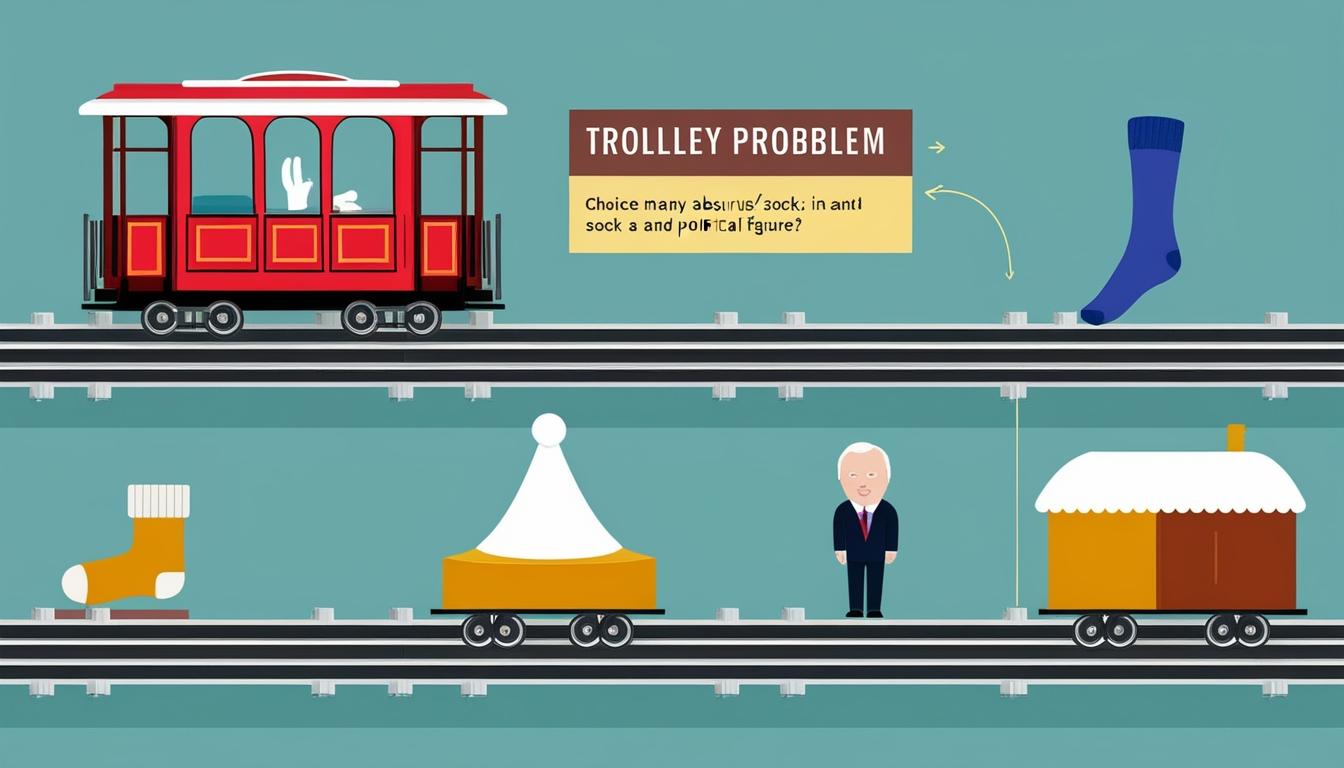
In a curious exploration of the ethical decision-making capabilities of artificial intelligence, a new platform called GP Trolley has been developed, offering a novel take on the classic trolley problem. This age-old philosophical thought experiment tests moral intuitions by asking participants to choose between two unfavourable outcomes—typically, whether to sacrifice one life to save many. GP Trolley allows users to input any two scenarios, pushing the boundaries of ethical reasoning by AI.
The platform uses ChatGPT, a well-known language model, to weigh the moral decisions and render judgments in a playful yet thought-provoking manner. For the traditional dilemma of choosing between saving five innocent people or one, GP Trolley adheres to utilitarian principles, choosing the path that preserves the greater number of lives: "The greater good is served by preserving the lives of more individuals." This reflects a choice that many might intuitively make in a real-world scenario.
However, the experiment becomes increasingly comical—and contentious—when the variables are altered to non-traditional inputs. One such scenario involves choosing between former U.S. President Donald Trump and a sock. The AI, perhaps intended humorously or playing on neutrality, opts to save the sock, citing its simple and innocuous nature. It extends a similar line of reasoning when faced with the decision to choose between Trump and moldy leftovers, selecting to save the latter for its symbolic utility in promoting food safety and waste consciousness.
As the exercises progress, the platform suggests saving one convict over the entire Trump family. This decision is attributed to the abstract potential for rehabilitation and positive societal contribution by convicts. The responses generated by GP Trolley, while seemingly absurd in some cases, serve to illustrate the challenges and limitations AI faces in understanding complex socio-political and ethical nuances.
Amid the jest, the tool was briefly reported to offer perplexing or controversial outcomes, such as when faced with heavily loaded ethical scenarios. These instances sparked discussions on the implications of embedding such algorithmic decision-making into broader AI systems used in societal contexts. In one documented case, ChatGPT refused engagement with an extreme scenario involving historical tragedies and individuals, highlighting the adjustments made to prevent the exacerbation of sensitive topics.
This interactive exploration of AI decision-making draws both entertainment and critical discussion on the interaction between AI technology and ethics. As AI continues to be integrated into various aspects of human life, tools like GP Trolley serve as a playful yet poignant reflection on the interpretations and limits of current AI ethical frameworks. The experience echoes broader conversations on the role of AI in decision-making and its impact on society and politics.
While the scenarios presented by GP Trolley are theoretical and far removed from practical application, they provoke thought about how AI might, or should, tackle complex moral decisions in real life. The development of AI systems continues to involve a careful balance between technological capabilities and the ethical frameworks guiding their deployment.
Source: Noah Wire Services