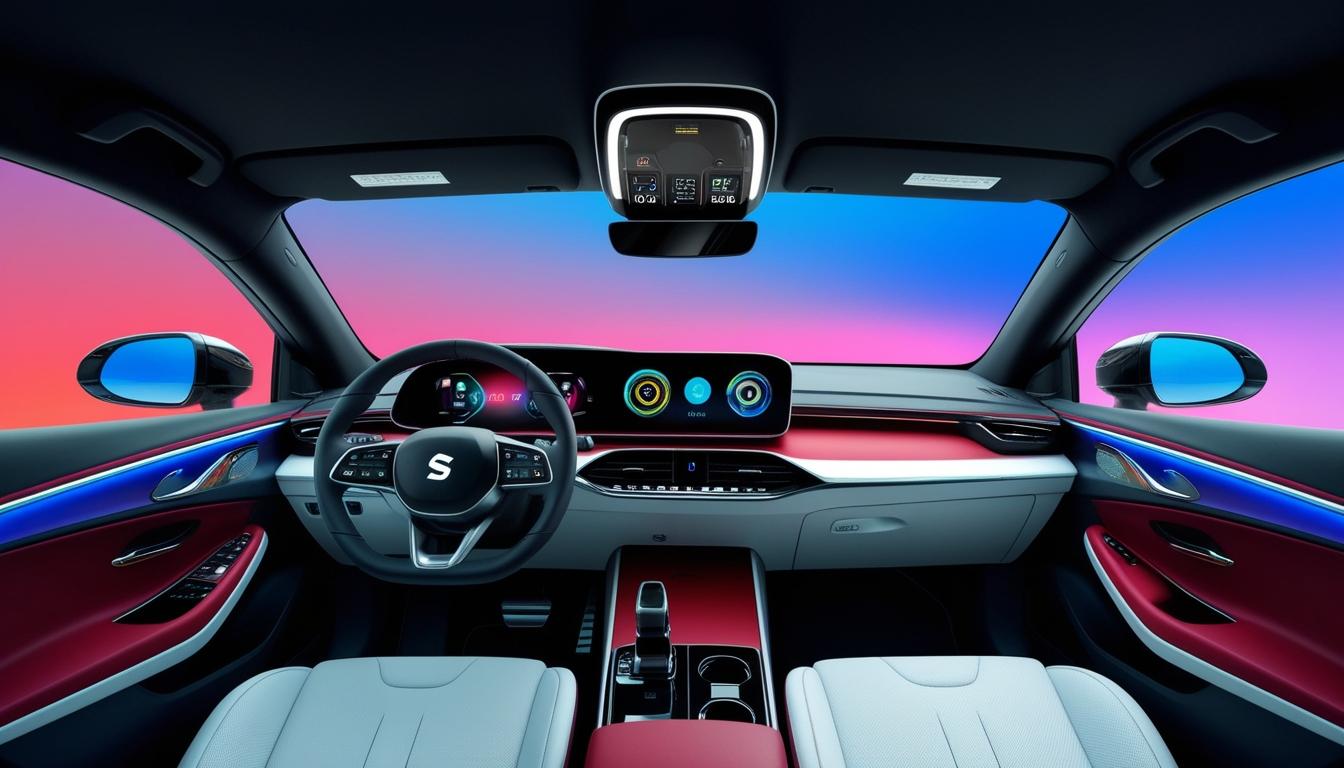
Qualcomm has unveiled its latest advancements in automotive technology with the introduction of the Snapdragon Cockpit Elite and Ride Elite platforms. Equipped with the Oryon CPU technology, these platforms promise a significant enhancement in CPU and AI performance, aiming to revolutionise the in-car experience and promote the development of self-driving vehicles.
The Snapdragon Cockpit Elite is designed to offer an immersive technological experience, enabling AI functionalities that enhance driver and passenger interactions within the vehicle. According to Qualcomm, this new platform provides a threefold increase in CPU performance compared to its predecessor. The integration of the Hexagon Neural Processing Unit (NPU) delivers a twelve-fold improvement in AI capabilities, coupled with an advanced Adreno GPU capable of managing an impressive 16 4K displays simultaneously. This ambitious development seeks to transform the standard dashboard into a vibrant, interactive display while maintaining performance for passenger entertainment options such as televisions on seatbacks and augmented reality enhancements on mirrors.
The AI capabilities of the Snapdragon Cockpit Elite include handling large language models, allowing the virtual assistant to be trained using a car's manual. This enables drivers to quickly access critical information by simply querying the assistant about matters such as dashboard warning lights. Qualcomm suggests the AI will be able to learn from user preferences, such as frequently travelled routes or typical parking spots, and automatically adjust its assistance based on changing conditions, such as suppressing phone notifications when there are additional passengers in the car.
Further exploring the realm of autonomy, Qualcomm has introduced the Snapdragon Ride Elite platform, designed to complement Cockpit Elite functionalities and support self-driving technology. This platform is capable of integrating up to 40 sensors, including high-definition cameras and radar/lidar systems, to deliver comprehensive 360-degree field of view coverage. The AI technology onboard is designed to accurately interpret the environment, recognising road signs, lane boundaries, and obstacles, as well as interpreting passenger gestures.
The Ride Elite platform's features extend to processing radar and lidar data, ensuring security while the vehicle is parked, and automating routine tasks such as rerouting in case of traffic incidents, self-parking, and even sunroof adjustments based on weather conditions.
Both platforms are set to be available from 2025, marking a step towards the future with sophisticated AI-driven technology in vehicles. Qualcomm's advancements aim to cater to automakers' desires to integrate more AI features, supporting both autonomous and non-autonomous vehicle models and setting a new benchmark in the automotive industry.
Qualcomm's recent announcements follow the unveiling of Snapdragon 8 Elite CPUs, and with this addition of automotive platforms, the company underscores its commitment to driving innovation across multiple technology sectors. The impact of these developments, both in terms of cost and real-world application, remains to be seen as more automakers adopt these new technologies for both economic and luxury vehicle lines.
Source: Noah Wire Services