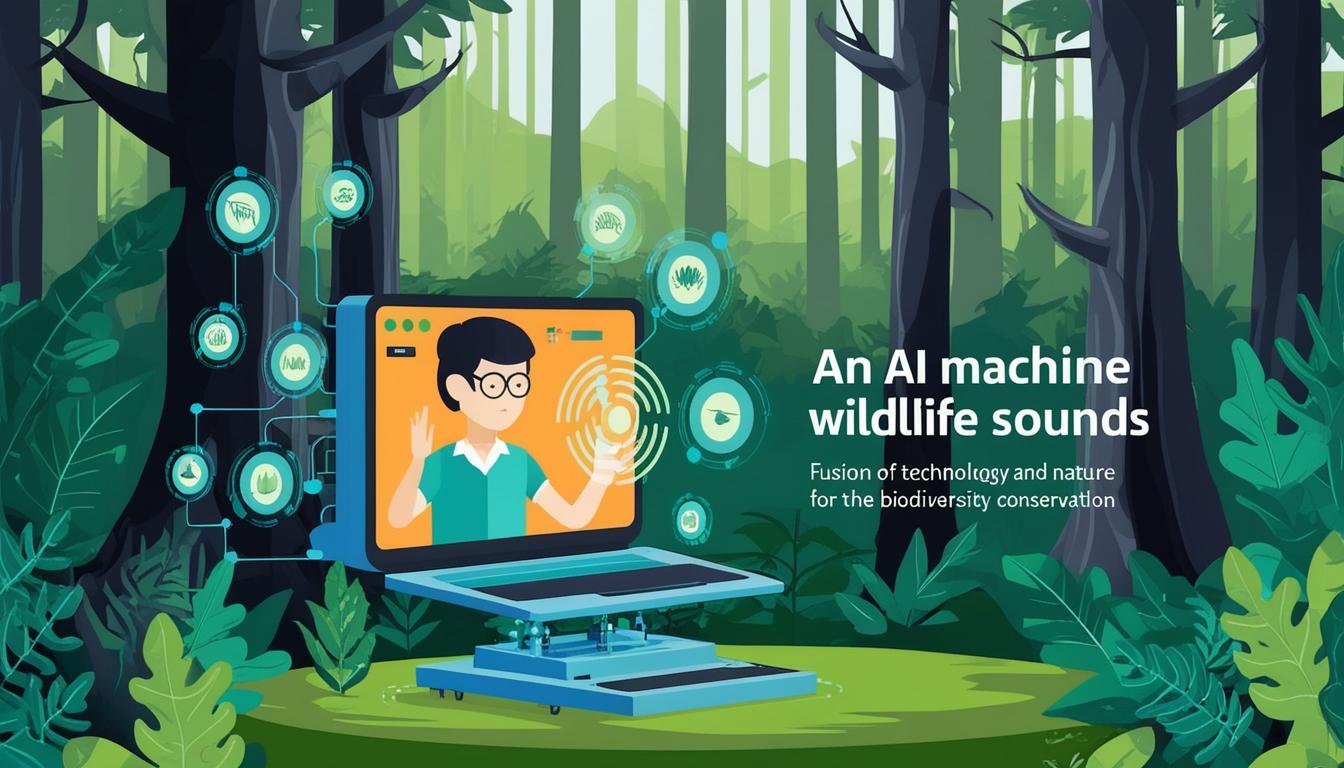
AI and Animal Sounds: A New Era in Biodiversity Monitoring
Researchers from the University of Copenhagen have unveiled a transformative approach to wildlife monitoring through the integration of artificial intelligence (AI) and bioacoustics. This innovative method has the potential to significantly enhance the accuracy and efficiency of biodiversity assessments on both terrestrial and aquatic fronts. As the world grapples with the profound challenges of the sixth mass extinction, these advancements could be instrumental in efforts to preserve endangered species.
The recent study, published in the prestigious journal Science, highlights the groundbreaking work of the university's Department of Biology. By utilising AI to analyse the sounds produced by wildlife, researchers can now identify species with unprecedented accuracy. This method offers deep insights into animal behaviours and their natural habitats, reducing the need for invasive monitoring techniques that could disturb ecosystems.
Bioacoustics, which involves the study and analysis of animal sounds, emerges as an effective tool in this context. The research team, renowned for their AI application that decodes the vocalisations of pigs, presents this technique as a game-changer for tracking various species in the wild. Their AI algorithm is tailored to manage voluminous sound data efficiently, providing a precise gauge of wildlife population dynamics across diverse ecosystems worldwide.
Postdoctoral researcher Jeppe H. Rasmussen explains the practical utilisation of the technology: "The method allows us to differentiate between distinct animal calls and identify species even in challenging environments like dense forests or oceans, where visual methods such as cameras often prove ineffective."
To operationalise this, scientists deploy autonomous audio recording devices in target areas, capturing continuous animal sounds over extended periods. These audio files are subsequently processed by AI, which converts them into a format akin to visual images. The algorithm, proficient in recognising and categorising patterns, can then identify specific animal calls, enabling a non-intrusive count and classification of species present.
Rasmussen states that the AI needs initial training to recognise desired species, using genuine recordings as reference data. The adaptability of this method, demonstrated in tests involving bird and frog species in Malaysia, revealed an impressive recognition rate where it successfully identified 34 out of 39 species in dense tropical forest settings.
The potential applications of this technology are vast. Rasmussen is collaborating with the University of California to monitor the critically endangered Hawaiian monk seal, with a population of merely 1,400 individuals. The method also holds promise in tracking the resurgence of the endangered gray seal in Danish waters and is slated for deployment in monitoring protected bat species in Denmark.
According to Associate Professor Elodie F. Briefer, this advancement heralds a new phase in conservation science. "The ability to detect and monitor species without intruding on their natural habitats represents a significant leap forward. This technology has been successfully implemented in marine ecosystems and urban settings, underscoring its vital role in future biodiversity protection strategies," Briefer remarks.
In essence, the integration of AI and bioacoustics presents a powerful and non-invasive method for wildlife monitoring, setting the stage for enhanced conservation efforts that are crucial in addressing the current biodiversity crisis.
Source: Noah Wire Services