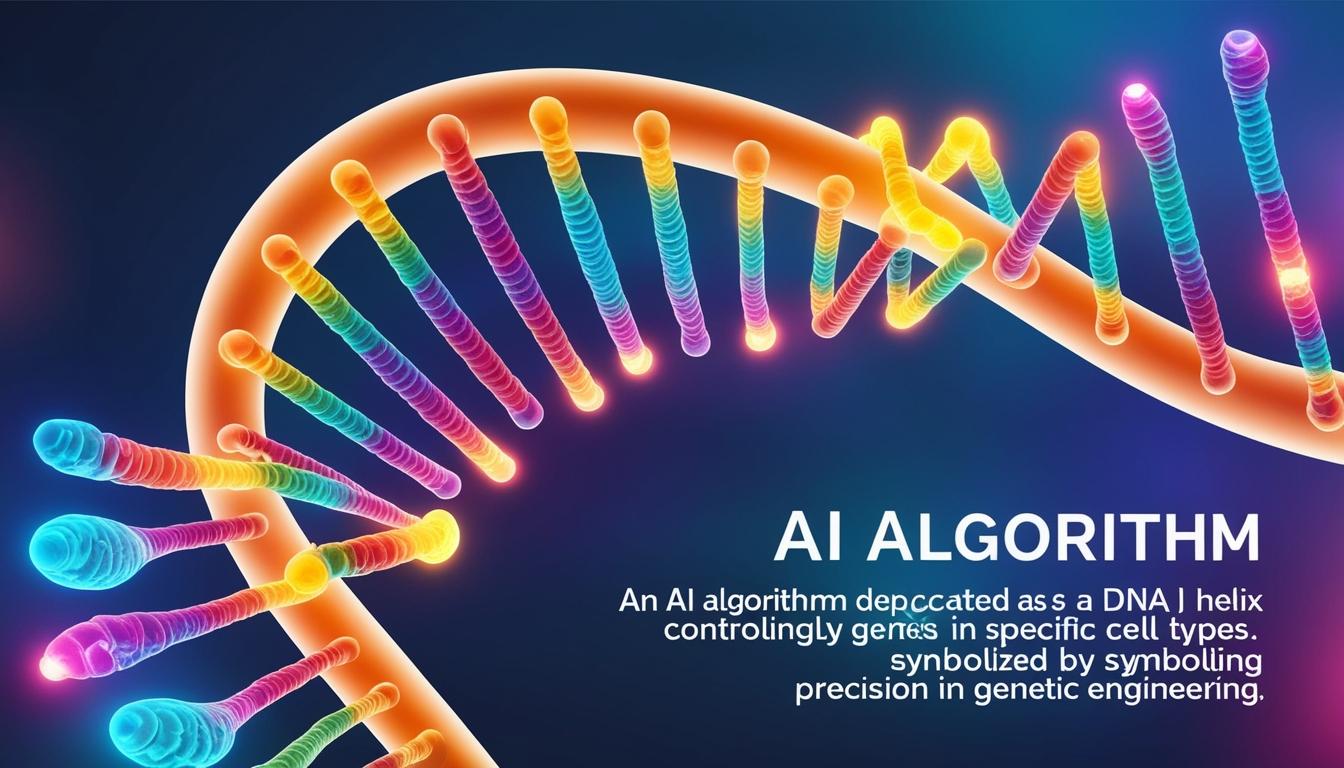
In a groundbreaking study published in the prestigious journal Nature, a team of researchers from the Jackson Laboratory (JAX), the Broad Institute of MIT and Harvard, and Yale University, have made significant strides in genetic engineering by employing artificial intelligence (AI) to craft unique DNA switches. These switches, also referred to as cis-regulatory elements (CREs), offer unprecedented precision in controlling gene expression across various cell types.
The collaborative research project is hailed for its potential to transform the field of biotechnology by enabling the fine-tuned activation or suppression of genes in specific tissues, thereby mitigating the broader, unintended effects seen in the whole organism with current gene editing technologies. This innovation particularly addresses a long-standing challenge for scientists: how to activate or deactivate a gene in a targeted manner without impacting other parts of the body.
Ryan Tewhey, PhD, an associate professor at the Jackson Laboratory and a leading figure in the research, highlights this advancement by stating, “What is special about these synthetically designed elements is that they show remarkable specificity to the target cell type they were designed for.” This specificity opens new paths for controlling gene expression tailored to particular tissues such as the brain, liver, or blood cells, avoiding unexpected gene activation elsewhere in the body.
Central to their approach was the use of deep learning, a sophisticated AI method that got its training from vast datasets of DNA sequences measured for CRE activity in human blood, liver, and brain cells. The AI model proved instrumental in deciphering the complex "grammar" of these sequences, allowing the researchers to predict the functional impact of virtually any DNA sequence. Using these predictions, they discerned patterns affecting RNA production, thereby enhancing understanding of CRE activity.
Pardis Sabeti, MD, DPhil, a core institute member at the Broad Institute and a professor at Harvard, co-led this initiative, developing an AI platform named CODA (Computational Optimization of DNA Activity). This tool has adeptly crafted thousands of synthetic CRE sequences tailored for specific genetic expressions, such as initiating a gene in liver cells but restraining its expression in blood or brain cells. This platform not only refines the model’s predictive capabilities but also expands the understanding of sequence function beyond the constraints imposed by natural evolution.
In practice, these synthetic CREs were tested in both cellular and living organism models, including zebrafish and mice. The experiments demonstrated impressive results, with the designed elements precisely activating genes in targeted tissues while maintaining strict control over gene expression in non-targeted areas. One example involved successfully activating a fluorescent protein in the livers of developing zebrafish, illustrating the tangible potential of these synthetic elements.
Steven Reilly, PhD, an assistant professor of genetics at Yale and a senior contributor to the study, expounded on the broader implications of the work. He explained that the research pushes the boundaries of existing knowledge, allowing scientists to 'read and write' the regulatory code with a level of understanding akin to decoding a new language.
The synthetic CREs produced through this method have demonstrated greater cell-type specificity than any naturally occurring counterparts, suggesting that the AI-designed sequences can provide more effective solutions for precise biochemical applications. Such developments are of immense scientific and potentially therapeutic value, promising advancements in both fundamental research and the creation of precision medicines.
As the study unfolds, the potential implications span a range of fields, from enhancing biomanufacturing processes to developing targeted therapies that operate within specific cellular environments. The success of this pioneering research marks a significant step forward in the quest to master genetic regulation at a cellular level.
Source: Noah Wire Services