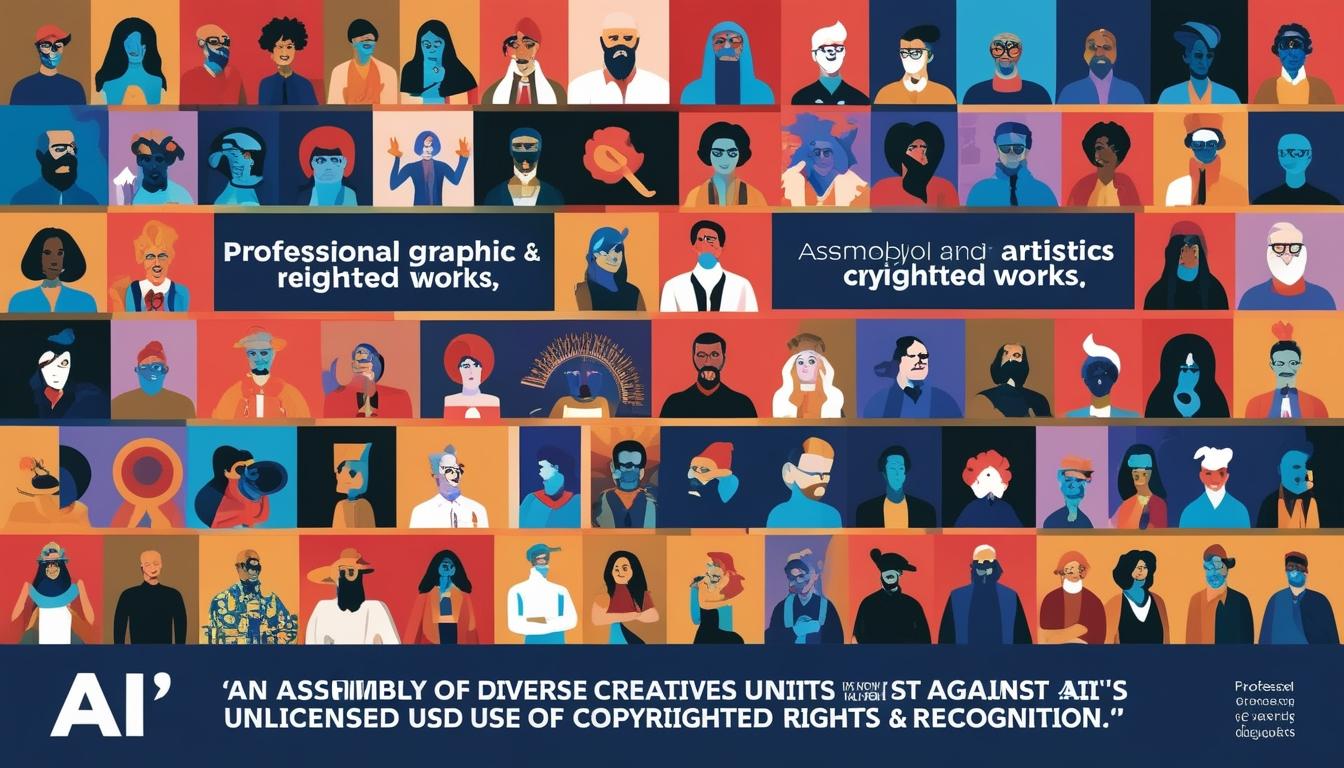
A growing coalition of creatives from diverse fields, including art, literature, music, and film, have unanimously voiced their opposition against the unlicensed use of copyrighted material for training generative artificial intelligence (AI) models. The movement has witnessed endorsement from influential figures such as artists Amoako Boafo, Kennedy Yanko, and Shantell Martin, novelists Margaret Drabble and Kazuo Ishiguro, musician Robert Smith, members of the band Radiohead, and actors Julianne Moore and Kevin Bacon. The essence of their collective stance is encapsulated in a brief yet powerful statement: “The unlicensed use of creative works for training generative AI is a major, unjust threat to the livelihoods of the people behind those works, and must not be permitted.”
The campaign was initiated by Ed Newton-Rex, a British composer based in the United States. Newton-Rex was a co-founder of Jukedeck, an AI music generation company established in 2014, which was later acquired by ByteDance, the parent company of TikTok, in 2019. Newton-Rex subsequently took a prominent role at ByteDance’s European AI Lab, before moving on to oversee the audio division at Stability AI. Dissatisfaction with the company's approach towards the use of copyrighted work without appropriate licences led him to resign in 2023. He condemned the reliance on "fair use" as a justification for such practices, a legal argument currently at the heart of numerous AI-related lawsuits.
In his communication with The Guardian, Newton-Rex described the sentiment among the approximately 20,000 signatories to the statement as “very worried." He highlighted the three essential resources required by generative AI companies: labour, computational power, and data. While the first two are heavily invested in financially, he noted that companies expect to obtain the third—often consisting of copyrighted creative works—at no cost.
Newton-Rex criticised the term “training data” for its depersonalising effect, arguing that it disregards the human contribution involved, comprising people’s art, music, and literary works. This ethical contention is coupled with significant legal challenges presented by the rise of AI in both the US and UK. High-profile authors including John Grisham, Jodi Picoult, and George R.R. Martin are among those pursuing legal action against OpenAI, which develops ChatGPT, for alleged copyright infringements. Similarly, lawsuits have been filed by illustrators such as Sarah Andersen, Kelly McKernan, and Karla Ortiz against several AI companies under comparable allegations.
In the UK, Google recently advocated for relaxed limitations on “text and data mining.” While current UK regulations permit the use of copyrighted content for non-commercial means like academic research, the government is evaluating a controversial “opt-out” proposal. This would allow AI companies to utilise content from artists and publishers unless those creators actively opt out, a process Newton-Rex has criticised for its impracticality and potential to be overlooked by most creators.
This initiative has also garnered support from notable organisations within the creative industry, including the Artist Rights Alliance, the Artists Rights Society, the Concept Art Association, and the Human Artistry Campaign. The latter notably campaigns against the unauthorised use of deepfakes, further highlighting the broader implications of AI on creative industries. As the debate continues, the convergence of technology and creativity unfolds, presenting complex challenges and regulatory considerations on both sides of the Atlantic.
Source: Noah Wire Services