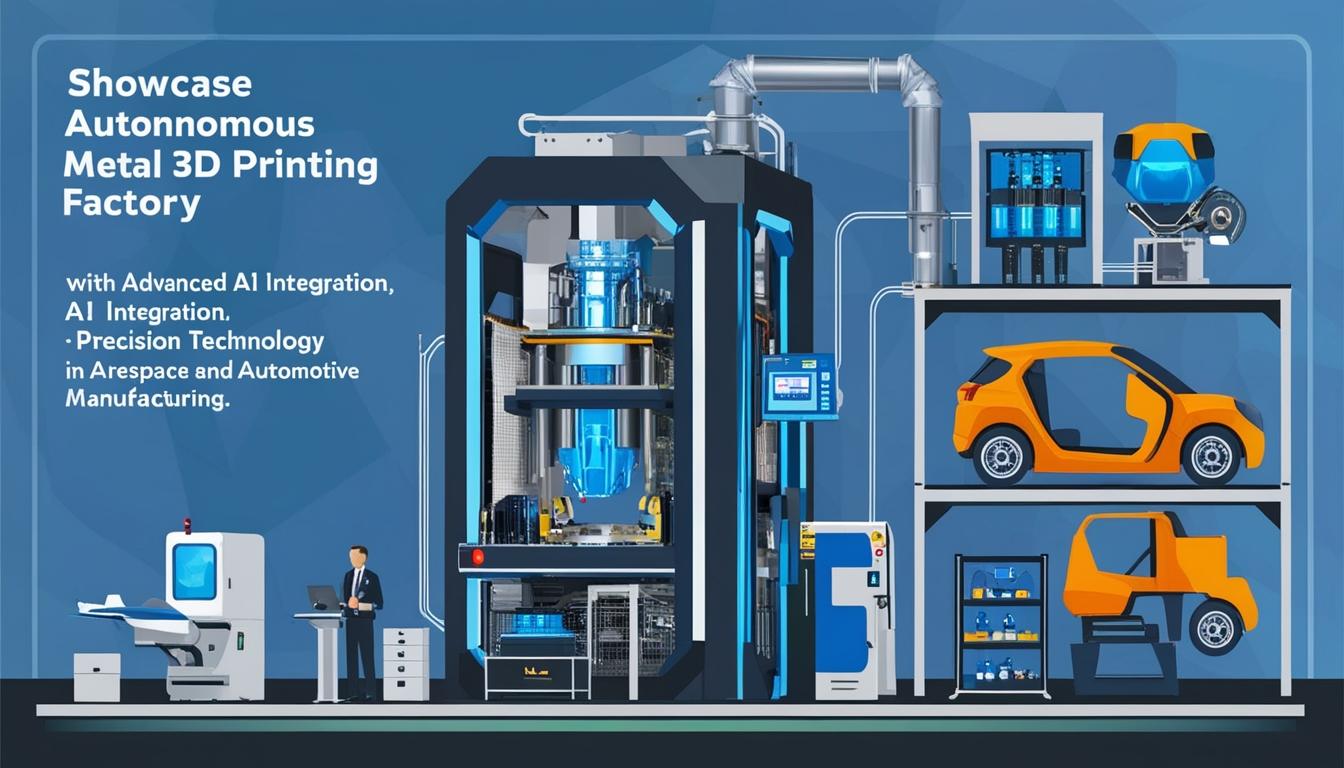
Freeform, an innovative company founded by former SpaceX engineers, is making waves in the manufacturing sector by integrating artificial intelligence into metal 3D printing. Recently, the company secured a notable investment from NVentures, NVIDIA's venture investment arm, and AE Ventures. This funding underscores a significant move towards advanced manufacturing solutions, particularly in how metal components are produced for critical industries such as aerospace and automotive.
Freeform's collaboration with NVIDIA will see the company joining NVIDIA's Inception program, an initiative that supports cutting-edge startups. Leveraging NVIDIA's powerful computing platform, Freeform intends to upgrade its AI-driven 3D printing platform, enhancing real-time predictive control over the complex physics inherent in metal additive manufacturing. This technological advancement is expected to overcome the constraints of traditional manufacturing processes.
Pioneering the first AI-native autonomous metal 3D printing factory, Freeform is utilising NVIDIA’s technology to integrate advanced sensing, machine learning, and adaptive process control. This integration promises unparalleled precision and scalability in manufacturing high-quality, digitally verified metal parts at rapid speeds. Mohamed “Sid” Siddeek, corporate vice president at NVIDIA and head of NVentures, praised Freeform's capabilities, highlighting their transformational approach to autonomous manufacturing.
Freeform tackles a persistent challenge in conventional metal 3D printing, which frequently yields inconsistent results and delays, necessitating extensive verification processes. Their AI-powered platform can continuously learn from each printing cycle, allowing it to predict and fine-tune outcomes in real-time. This ensures precise and swift production, heralding a new era in metal additive manufacturing.
With the recent influx of funds, Freeform plans to broaden the application of its technology across the vast landscape of the manufacturing market, valued in the trillions. The company is keen on expanding its material capabilities and scaling its production to meet the demands of sectors where precision and speed are paramount, such as aerospace, defence, energy, and automotive. Boeing, a leader in the aviation industry, is reportedly investigating Freeform's potential in certifying and scaling metal parts for both commercial and defence uses.
Eugene Kim of AE Ventures expressed enthusiasm about Freeform's trajectory, noting its potential to offer a scalable manufacturing solution that meets industry standards from prototype to full production. This development is particularly appealing to the aerospace sector, which has long sought such innovations.
Freeform's unique platform integrates cutting-edge machine learning with hardware-accelerated computing, enabling a software-like scale in physical production. The company's factory architecture is designed to learn and evolve with each print, fundamentally altering the traditional concepts of metal part design, production, and delivery. Erik Palitsch, CEO and co-founder of Freeform, remarked on their ambitious vision, noting that by merging AI with supercomputing and advanced sensing, industries can now transition from idea to production with unprecedented speed and efficiency.
This investment and collaboration mark a pivotal moment in manufacturing, signifying a shift towards more intelligent and efficient production systems. As Freeform advances, their impact on the industry will likely be closely watched by many sectors eager to adopt breakthrough technologies.
Source: Noah Wire Services