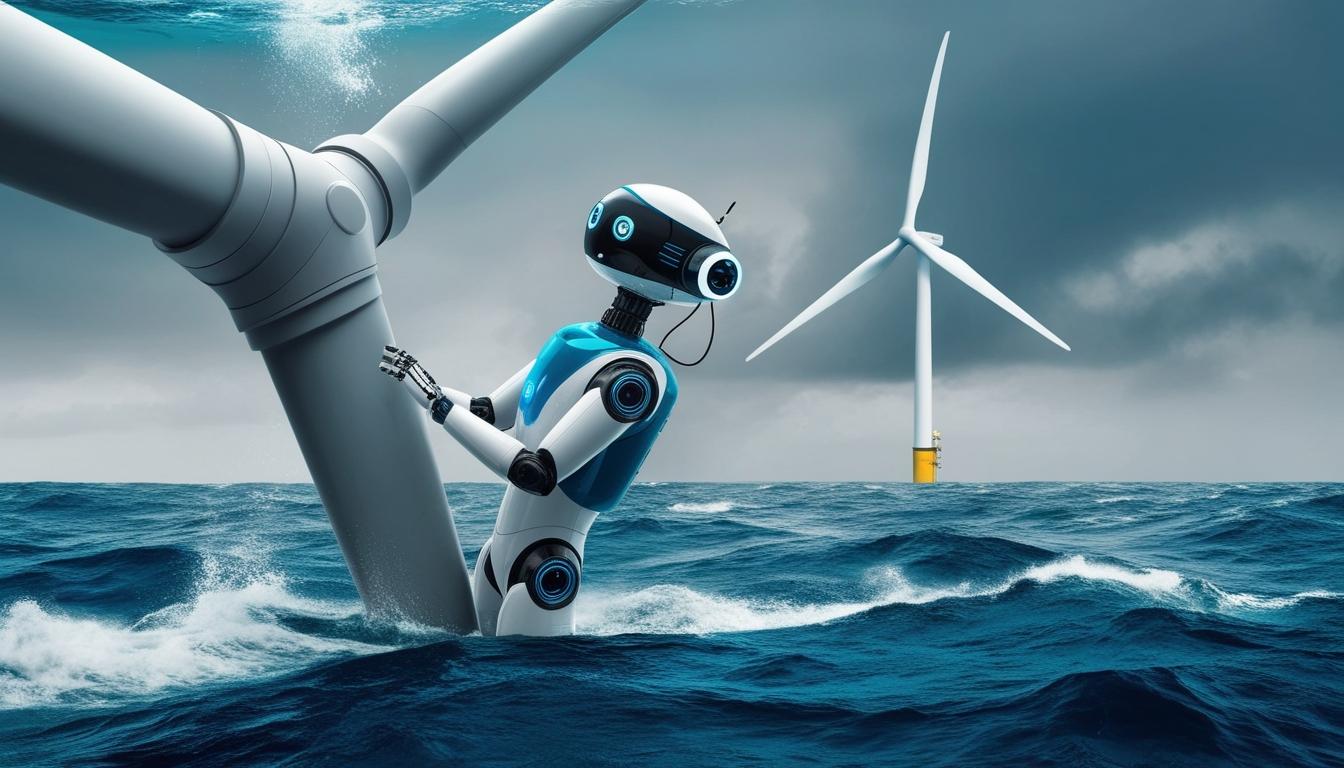
The National Robotarium in the UK is at the forefront of a pioneering project aimed at enhancing the autonomy and precision of underwater robots, promising to transform maintenance and repair operations for offshore wind turbines. This development is part of the UNITE project, an EPSRC Prosperity Partnership programme led by Heriot-Watt University alongside Imperial College London, geo-data specialist Fugro, and underwater software development company Frontier Robotics.
The National Robotarium is supporting the initiative to develop artificial intelligence and control systems enabling underwater robots to operate autonomously in the challenging conditions of turbulent seas. The implications for offshore wind turbine maintenance are significant, with the potential to reduce the reliance on large maintenance vessels. Such advancements could not only improve safety by minimising the need for personnel in hazardous offshore environments but also support a transition to fully remote operations.
David Morrison, project manager at the National Robotarium, commented on the promising results of the trials, which focus on the robots maintaining stable contact with offshore structures even in challenging sea conditions. If successful, the technology is poised to transform the approach to offshore wind maintenance, notably reducing the fuel consumption of maintenance missions by up to 97%—lowering it from 7,000 litres to approximately 200 litres per day. This would result in both decreased operational costs and a significantly reduced carbon footprint.
The project aims to empower autonomous underwater robots to handle a variety of critical maintenance tasks, from taking precise measurements and conducting visual inspections to cleaning structures and performing repairs. To reach such a level of autonomy, the project is tackling the complex "chicken head problem," which involves keeping a robotic tool steady against a structure despite the disruptive forces of currents and waves. This challenge is addressed through advanced control systems and machine learning algorithms that enable real-time adaptation to environmental changes.
Further advancements in the project include developing 3D semantic mapping technologies, which allow robots to create detailed visual maps of their underwater surroundings. This capability enhances the robots' navigation and ability to identify structural components that require attention.
Jonatan Scharff Willners, CEO of Frontier Robotics, highlighted the importance of harnessing AI, robotics, and autonomy to match the rapid expansion of offshore infrastructure. The project is also innovating in the coordination of Remotely Operated Vehicles (ROVs) and Electric ROVs (eROVs) launched from Uncrewed Surface Vessels (USVs), further reducing dependence on support vessels and human divers.
With the UK housing over 2,600 offshore wind turbines and plans to quadruple their capacity by 2030, advancements in maintenance technologies have become increasingly necessary. Presently, each turbine demands up to three maintenance check-ups annually, with aging turbines requiring even more frequent inspections.
Mark Bruce, global product manager of Next Generation ROV Systems at Fugro, described how Frontier Robotics is integrating advanced stereo camera systems with edge computing to enhance AI capabilities. If successful, this system could potentially reduce the time for data insights from three weeks to just three hours—a remarkable improvement in efficiency and response time.
As these technological advancements continue through rigorous trials, the potential revolution in maintaining offshore wind turbines looks increasingly achievable, promising a clear intersection of innovation and environmental sustainability.
Source: Noah Wire Services