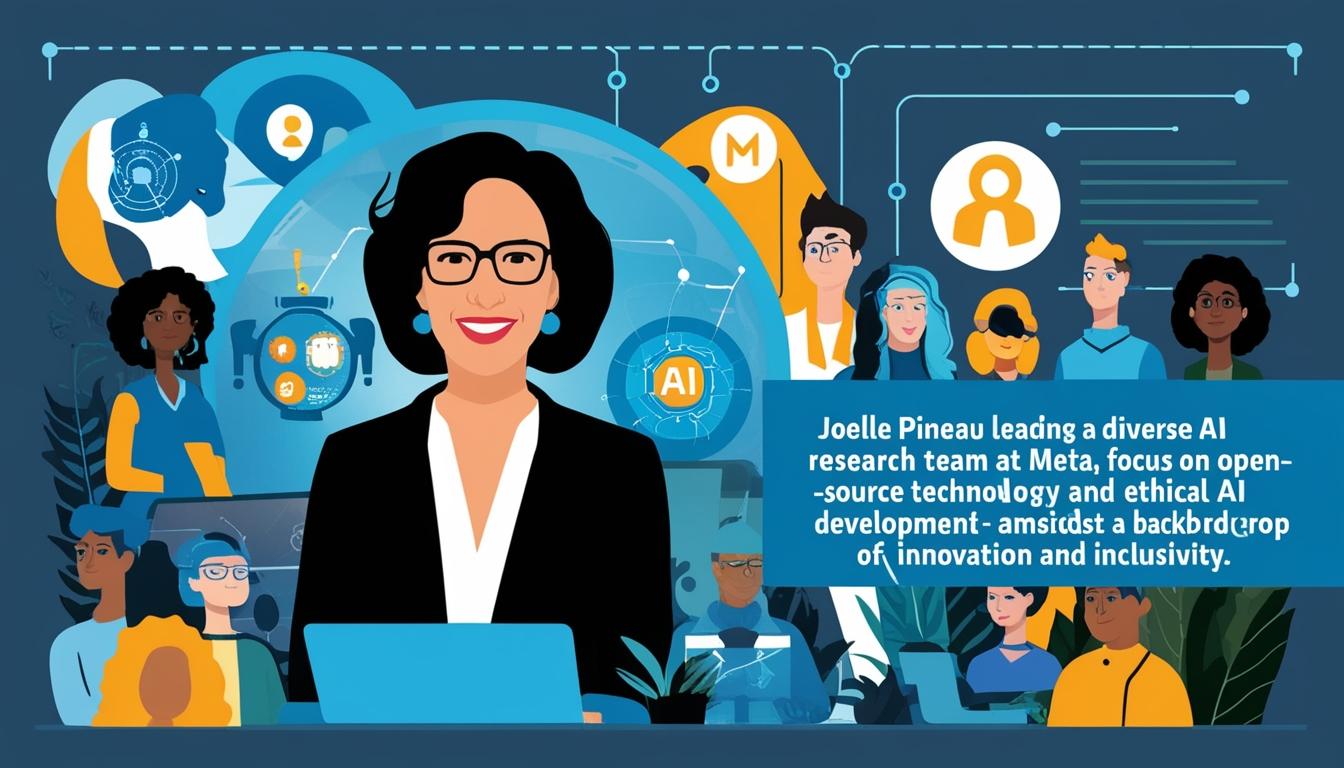
In the realm of artificial intelligence, few names are as influential as Joelle Pineau. Pineau, now vice-president of AI research at Meta, embarked on her AI journey a quarter of a century ago while studying at the University of Waterloo, Ontario. Her early involvement in training a voice recognition system for helicopter pilots exposed her to the complexities of bias in AI – an issue that continues to challenge the tech industry today.
Pineau recounts her involvement in the project where, due to a scarcity of female helicopter pilots, she was called upon to record her voice for the system. This experience highlighted the enduring challenge of ensuring diversity and fairness in technological developments. "It was very rigorous science," Pineau recalls, gaining insights into bias measurement and system performance that would lay the groundwork for her future endeavours.
Today, from Meta’s New York offices, Pineau leads a significant arm of the company’s AI endeavours through the Fundamental AI Research (Fair) lab. This lab is a vanguard in Meta’s mission to achieve long-term AI breakthroughs that integrate seamlessly across its platforms such as Facebook, Instagram, and WhatsApp.
Meta, under the leadership of CEO Mark Zuckerberg, has set its sights on developing artificial general intelligence, aiming to match human cognitive abilities. The company's commitment to open source technology stands out, contrasting with the proprietary approaches of competitors like OpenAI and Google. Their Llama series, a suite of open-source language models, reflects this philosophy and serves as a competitive counterpart to similar closed models.
Pineau oversees a team of approximately 1,000 individuals across 10 locations under Fair. Reflecting on her path to such a pivotal role, Pineau attributes her success to an early love of complex subjects, particularly mathematics, which she describes as a lifelong fascination. Her career began with modelling solar energy systems for Canada’s ministry of natural resources, eventually leading to fire research and a PhD in robotics at Carnegie Mellon University.
During her academic tenure, she explored early forms of AI, crafting algorithms and conversational systems that presaged today's advanced AI applications, including Meta AI and OpenAI’s ChatGPT. This evolution in AI technology from its nascent stages to current applications underpinning AI chatbots marks a significant trajectory of innovation bolstered by industry-level investment, a factor that attracted Pineau to Meta.
Pineau's career journey is marked by her decisive move from academia to industry in 2017 when she helped establish Meta’s Fair lab in Canada. Meta's dedication to open science resonated with her, prompting her exclusive collaboration with the tech giant.
In a largely male-dominated field, Pineau’s leadership role serves as a beacon for promoting diversity within the tech sector. She notes that her team within Fair has become more female than male, underscoring her influence and commitment to inclusivity. Despite acknowledging the enduring gender imbalance in tech, Pineau remains optimistic about strides made in academia and industry alike.
Pineau continues to be involved with McGill University and resides in Montreal, where she balances a demanding career with personal interests in music, running, and social activities. Her diverse experiences offer her a unique perspective on the rapid advancements in AI technology and its societal implications.
As AI becomes more prevalent in everyday life—highlighted by the transformative launch of ChatGPT—societal questions about innovation, safety, and ethics loom large. Pineau emphasises the necessity of engaging with these discussions to ensure a productive and secure future for AI. The ongoing pursuit in Fair and broader Meta initiatives persists, with Pineau at the helm, guiding efforts to address these critical questions and foster responsible innovation.
Source: Noah Wire Services