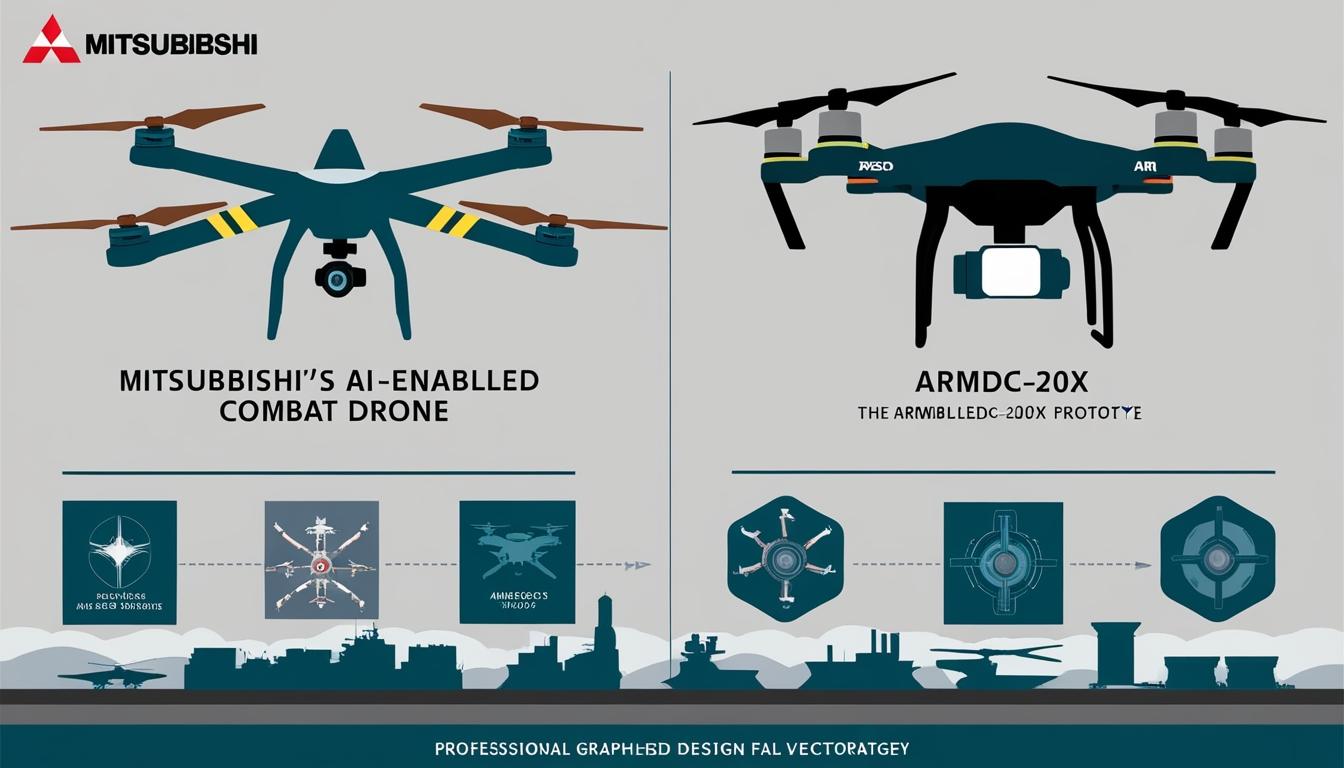
At the recent Japan International Aerospace Exhibition held in Tokyo, Mitsubishi Heavy Industries introduced two innovative concepts of artificial intelligence-enabled collaborative combat aircraft (CCA). The event marked a significant advancement in military technology, showcasing the potential role of unmanned systems in modern defence strategies.
The first concept presented was a tactical combat support drone, represented by a 1:10-scale model. This drone is engineered for a variety of mission profiles, primarily including launching from land, engaging with enemy forces, and returning to base. Its versatility is intended to enhance mission adaptability and capability.
The second concept unveiled was the "ARMDC-20X," an approximately 6-meter-long intelligence, surveillance, and reconnaissance (ISR) combat support drone. The abbreviation stands for "Affordable Rapid Prototype Missile Drone Concept," with the "X" signifying its conceptual and ongoing developmental status. Both drone models are designed with stealth technologies, adaptable to evolving missions through their open architecture and AI-updatable systems, enhancing their combat efficacy.
The introduction of these drones aligns with the increasing relevance of manned-unmanned teaming in military operations. The drones' design envisages a seamless integration into existing defence infrastructures, making them a valuable asset in response to emerging threats. They are also conceptualized to be low-cost and expendable, implying that they can be deployed in high-risk scenarios without significant concerns about losses.
During the exhibition, a video presentation demonstrated the prospective capabilities of the CCA. It showcased the drone's ability to detect and identify potential threats, including an aircraft resembling the Chinese Chengdu J-20 stealth fighter. The CCA was seen transmitting critical intelligence back to a crewed fighter jet, thereby enhancing the pilot's situational awareness. Following this, the pilot could command the drone to engage the target, effectively demonstrating the potential for human-robot collaboration in combat scenarios.
Mitsubishi Heavy Industries is under a government contract to conduct flight demonstrations of these drones by 2025. This timeline aligns with Japan's strategic efforts to strengthen its defence capabilities in light of escalating regional tensions, particularly concerning China.
This development is part of Japan’s broader military strategy, which includes collaborations on international defence projects. Notably, Japan is involved in the Global Combat Air Programme alongside the United Kingdom and Italy, aimed at developing a next-generation, sixth-generation stealth fighter. Additionally, plans are in place to partner with the United States for a drone wingman initiative, further underscoring Japan's commitment to enhancing its defence systems through advanced technology and strategic partnerships.
The unveiling of these concepts at the Tokyo event underscores Japan's proactive approach in modernising its defence forces to address contemporary security challenges while embracing cutting-edge technology to maintain regional stability.
Source: Noah Wire Services