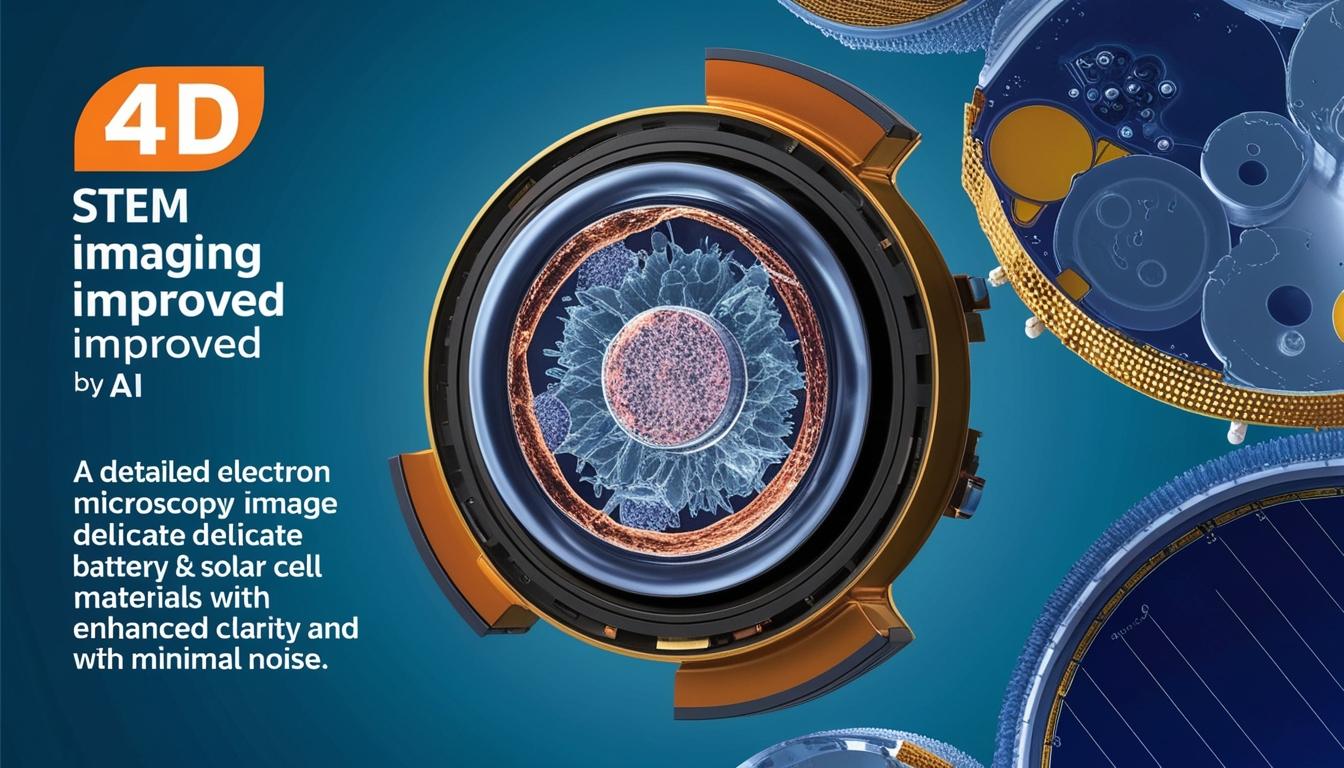
Researchers at Monash University in Melbourne, Australia, have announced a promising breakthrough in the realm of electron microscopy with the development of a pioneering artificial intelligence model aimed at improving the accuracy of four-dimensional scanning transmission electron microscopy (4D STEM) images. This advancement could be particularly impactful in the study of fragile materials, such as those utilised in the manufacturing of batteries and solar cells.
The innovative AI model, termed "unsupervised deep denoising," was developed by a team from Monash University's School of Physics and Astronomy, in conjunction with the Monash Center for Electron Microscopy. These findings have been detailed in a study published in the reputable journal, npj Computational Materials.
4D STEM is regarded as a cutting-edge technique that affords researchers the ability to observe the atomic structures of various materials with remarkable detail. Nevertheless, the technique has traditionally faced challenges when applied to delicate materials that are susceptible to damage from the electron beam used during imaging. In order to circumvent this, scientists typically resort to using lower doses of electrons, which consequently result in images characterized by significant noise and lack of clarity.
Addressing this limitation, the Monash research team devised a deep learning model capable of effectively denoising the 4D STEM images, thereby enhancing their clarity and detail. According to Dr. Alireza Sadri, the lead author and postdoctoral fellow at the Monash School of Physics and Astronomy, the model represents a significant leap forward for studying sensitive materials, stating, "Our new AI model dramatically improves the clarity of 4D STEM images, allowing us to study delicate materials that were previously too sensitive for detailed analysis."
Dr. Sadri further highlighted the broader implications of their work, noting that by reducing noise in low-dose imaging, the range of materials that can be studied has been expanded, potentially leading to crucial advancements in fields such as nanotechnology and electronics.
The underlying mechanism of the AI model revolves around leveraging the correlation between the positioning of the electron beam and the resultant scattering patterns as it traverses the material. By constraining the network's complexity, the model concentrates on identifying consistent patterns in the signal while effectively filtering out random noise. This approach allows the AI to generate clearer images without relying on pre-labeled data, ensuring its applicability to a wide array of materials without prior information.
The successful development of this unsupervised deep denoising model is anticipated to significantly boost the utility and effectiveness of 4D STEM, especially in disciplines where accurately characterizing beam-sensitive materials is of utmost importance. This technological advancement holds the promise of opening new avenues for research and innovation in material sciences and related fields.
Source: Noah Wire Services