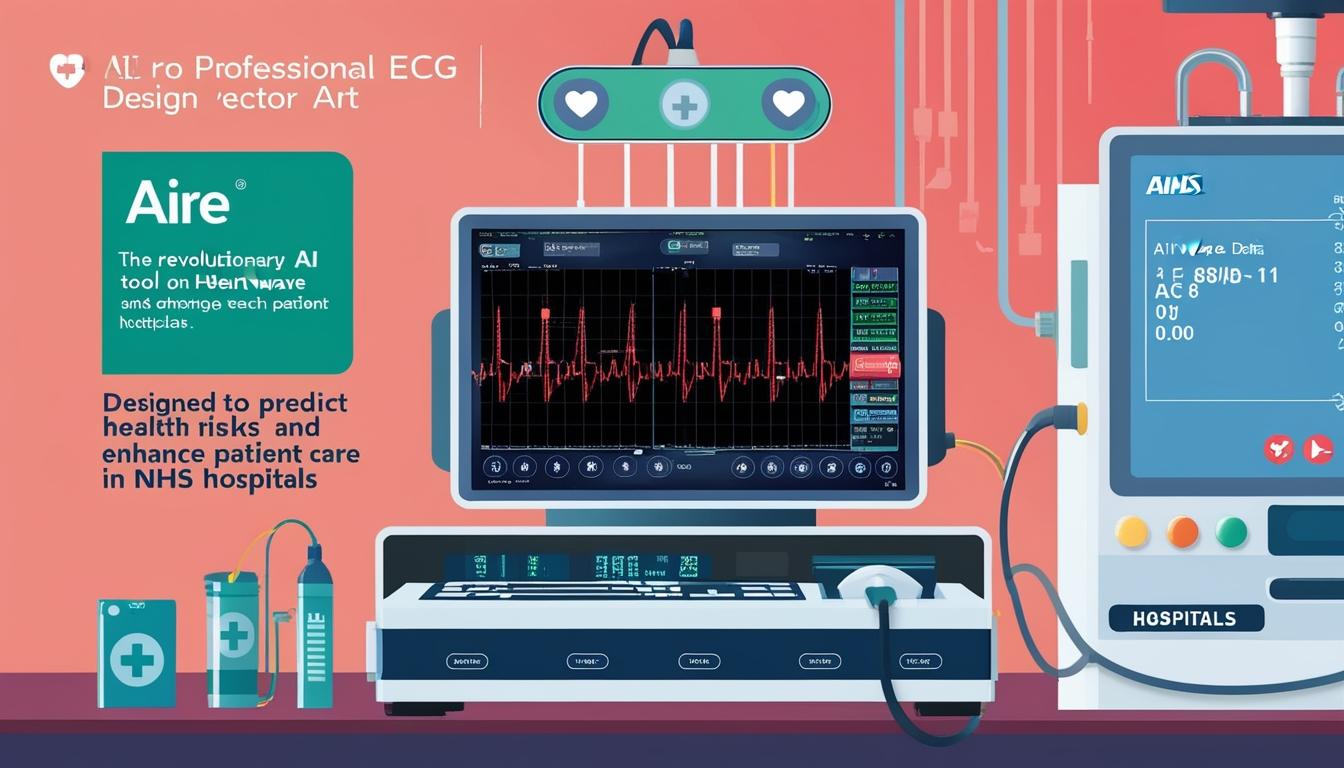
In a landmark initiative, NHS hospitals in England are gearing up to trial a pioneering artificial intelligence (AI) tool designed to predict patients' risk of disease and premature death based on heart test readings. This AI model, named AI-ECG risk estimation or Aire, is the result of extensive development and aims to enhance early diagnosis and intervention within the healthcare system.
The AI technology utilises the data from electrocardiogram (ECG) tests, a standard procedure recording the electrical activity of the heart, to detect anomalies that might not be visible to the naked eye of a clinician. By doing so, Aire acts as a diagnostic aid, flagging patients who could benefit from additional tests or treatments, potentially altering the trajectory of their health outcomes.
The trials for Aire are scheduled to commence in the middle of 2025 at Imperial College Healthcare NHS Trust and Chelsea and Westminster Hospital NHS Foundation Trust, with plans for expansion to other sites thereafter. The initial phase will involve several hundred patients, with numbers expected to grow as subsequent studies are launched.
Dr Fu Siong Ng, a cardiac electrophysiology expert at Imperial College London and a practising consultant at Imperial College Healthcare NHS Trust, explains that the trials are structured in multiple phases to first verify the accuracy of Aire in diagnosing conditions before assessing its potential impact on patient care. The vision underpinning this project is comprehensive integration, where ECG readings from any NHS facility could be processed by Aire, providing clinicians not just with a diagnosis, but a forecast of potential health risks.
The AI's predictive capabilities are grounded in substantial data analysis. In a study published in the Lancet Digital Health, Aire was trained using over a million ECG results from nearly 190,000 patients. The algorithm demonstrated its proficiency by accurately predicting a patient's ten-year risk profile for death, heart failure, serious rhythm problems, and atherosclerotic cardiovascular disease with a success rate of between 70% and 79%.
Dr Arunashis Sau, a British Heart Foundation clinical research fellow at Imperial College London, emphasises that Aire is designed to act as a complement rather than a replacement for medical professionals. The AI aims to perform tasks beyond human capacity, by interpreting complex patterns in heart data, including possible genetic markers, that are otherwise inaccessible to clinicians.
This initiative represents part of a broader trend in healthcare towards integrating advanced technologies to improve patient care. At the University of Portsmouth, a separate project led by the University and Portsmouth Hospitals University NHS Trust has been deploying AI to tackle complications in dialysis treatment. Using extensive data analytics, their model predicts the risk of intradialytic hypotension, a harmful drop in blood pressure during dialysis, enabling preventative clinical interventions.
The research, developing over two decades, has demonstrated high predictive accuracy using machine-learning algorithms, with plans to evolve into decision-support systems for clinicians. This innovative form of healthcare management highlights the potential for AI to not only enhance diagnostic accuracy but also pave the way for personalised medical care.
As AI continues to permeate healthcare systems, these projects underscore the immense potential for these technologies to transform patient outcomes by enabling early diagnosis, tailored treatments, and efficient healthcare delivery. The upcoming trials are eagerly anticipated as they promise to bring a new dimension to the predictive capability of medical assessments in the NHS.
Source: Noah Wire Services