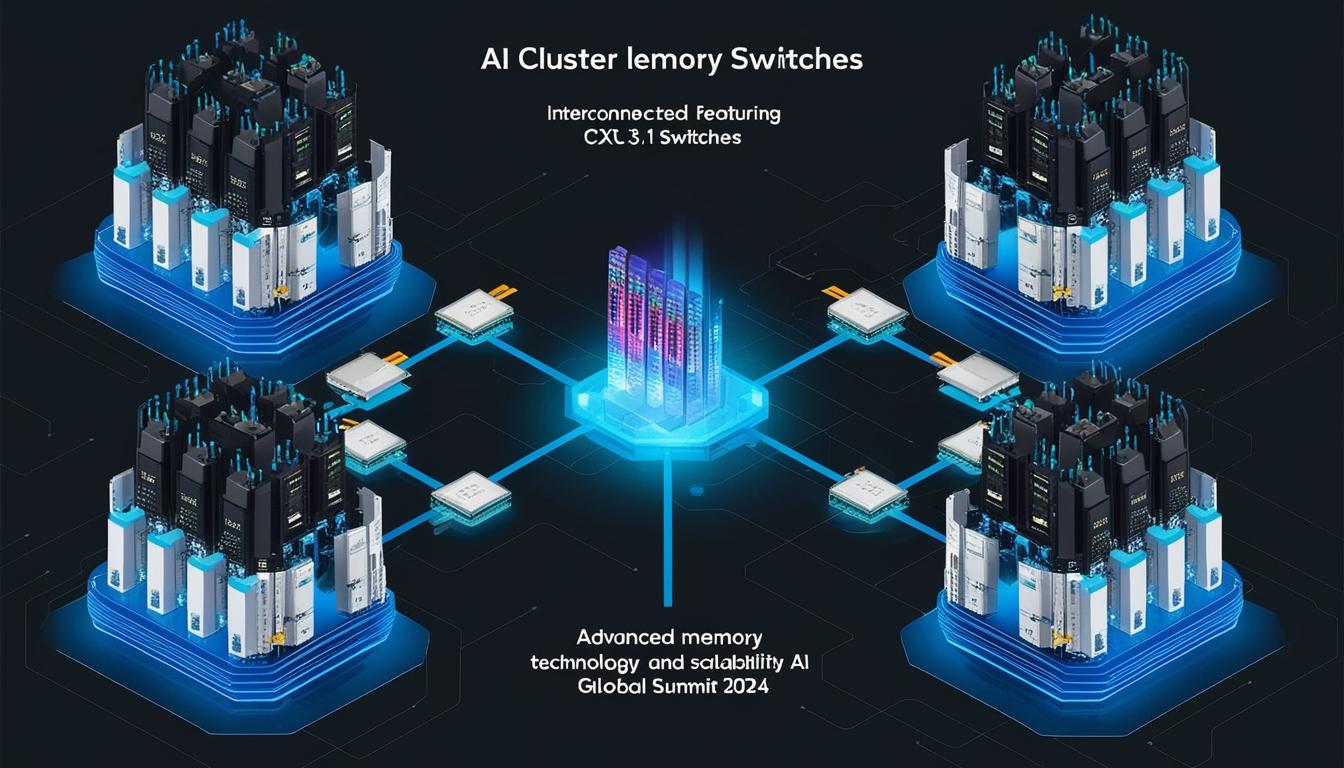
Panmnesia Unveils Innovative CXL-Enabled AI Cluster at OCP Global Summit 2024
San Jose, California – At the 2024 OCP Global Summit, South Korean fabless startup Panmnesia introduced what it claims to be the world’s first Compute Express Link (CXL)-enabled AI cluster. This groundbreaking development promises to revolutionise memory capabilities, offering the potential to significantly enhance the cost-efficiency of AI data centres.
The newly unveiled AI cluster utilises CXL 3.1 switches integrated into Panmnesia’s core products, such as the CXL 3.1 switch and CXL 3.1 IP. These components facilitate connections between CXL memory nodes and GPU nodes, effectively managing large data sets and expediting machine learning processes. By adopting this technology, enterprises can potentially expand their memory capacities by adding CXL devices, circumventing the need to purchase expensive server components.
The system is designed to be scalable to data centre levels, which may lead to overall cost reductions for users. Panmnesia’s solution supports connectivity with a variety of CXL devices, allowing hundreds of devices to connect within a single system. This flexibility and scalability could make the technology appealing for enterprises dealing with the increasingly large data workloads typical of modern AI applications.
However, despite these promising advancements, the financial viability of deploying such a system on a large scale remains a concern. The cost of memory components necessary for such setups can be prohibitively high. For instance, current market offerings such as Dell’s 370-AHHL memory modules, which support up to 512GB, are priced at nearly $2,400. This suggests that assembly of a system capable of drawing upon 100 petabytes of RAM would demand substantial financial investment from stakeholders.
While Panmnesia’s development ushers in significant technological advancements, it's noteworthy to mention Samsung’s developments in the same space. In 2023, the tech giant announced its intention to develop 1TB DRAM modules using its 32GB DDR5 DRAM memory die, aimed at handling immense AI workloads. The largest RAM units Samsung previously produced, at 512GB, have set a precedent for industry expectations, though they have yet to release a subsequent update on the 1TB module development.
The cost implications of expanding memory systems to their full potential, such as the one Panmnesia has proposed, will likely be determined by the market dynamics and pricing strategies of crucial memory manufacturers like Samsung. As of the last reported figures, Samsung’s anticipated top-end 1TB DRAM module was expected to be priced around $15,000, reflecting the significant financial implications for entities looking to embrace such advancements in memory technology.
Panmnesia’s latest introduction at the OCP Global Summit marks a pivotal moment in the ongoing evolution of AI technologies, presenting new opportunities and challenges for the future of memory expansion in AI data centres. As the tech industry continues to advance, the balance between innovation and cost will be crucial for widespread adoption of such complex systems.
Source: Noah Wire Services