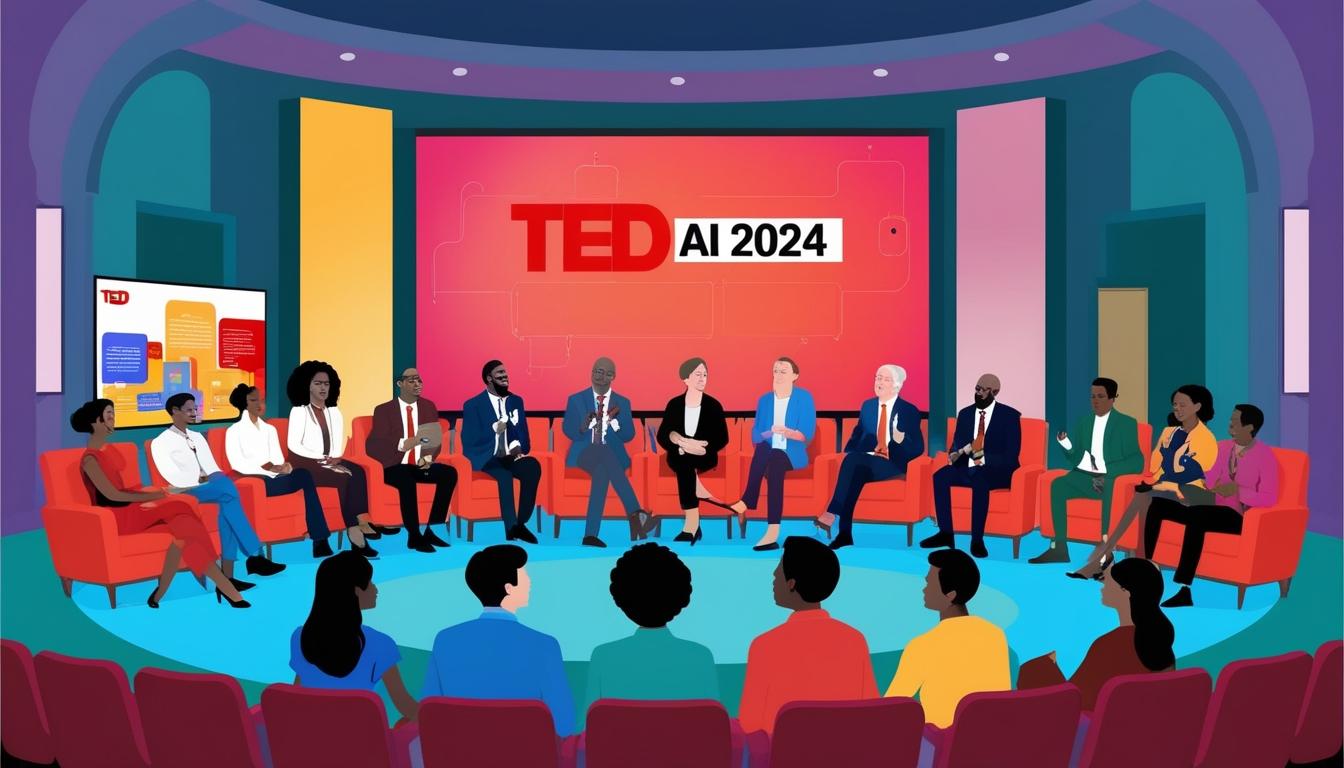
The TED AI 2024 conference commenced with notable vigour at San Francisco’s Herbst Theater on Tuesday, transitioning from its previous year’s concept-heavy discussions to more actionable insights on artificial intelligence. Organised by Walter and Sam De Brouwer, this year’s event gathered a diverse range of speakers, including researchers, entrepreneurs, and legal experts, to address AI's immediate and practical impacts on various sectors such as science, the arts, and society at large.
In contrast to the inaugural event that often likened AI to "the new electricity" with speculative discussions about artificial general intelligence, TED AI 2024 highlighted current challenges and developments. Important topics discussed included the contentious issue of training data rights, potential regulation of AI through hardware, the evolving dynamics of human-AI relationships, and the nuances of integrating AI into workplace practices.
Among the distinguished presentations, physicist Carlo Rovelli delved into the intricate concepts of consciousness and time, while Patricia Sharma from Project CETI demonstrated groundbreaking efforts to translate whale communication through AI technologies. Harvey Mason Jr., CEO of the Recording Academy, shared insights on adapting the music industry to the burgeoning influence of AI, describing strategies for what he labelled as a “survival guide for human creativity.”
One of the critical discussions was led by Ethan Mollick from the Wharton School. He examined a phenomenon he described as "the productivity paradox," highlighting the apparent gap between the measurable impacts of AI and its perceived benefits. Despite reports suggesting increased task efficiency among AI users, there exists a disconnect wherein many managers report a lack of AI usage within their organisations. Mollick's presentation, featuring a live demonstration of AI models, underlined the necessity for businesses to adapt traditional workflows to better integrate AI capabilities. The rise of "secret cyborgs," employees using AI tools without management awareness, was also noted. Mollick encouraged businesses to see AI as a means for growth rather than merely a tool for reducing expenses.
The conference further included captivating engagements, with sessions covering a broad range of AI applications and implications. Jerome Monceaux, founder of Enchanted Tools, introduced the Mirokaï robot, while linguist Jessica Coon shared her insights. These presentations collectively underscored a pivot from abstract notions to tangible realities concerning AI’s role in present-day contexts.
The TED AI 2024 event thus offered a platform for examining AI from pragmatic perspectives, initiating discussions that probed into the immediate and pressing implications of AI technologies, fostering a crucial dialogue about its role and influence in the contemporary world.
Source: Noah Wire Services