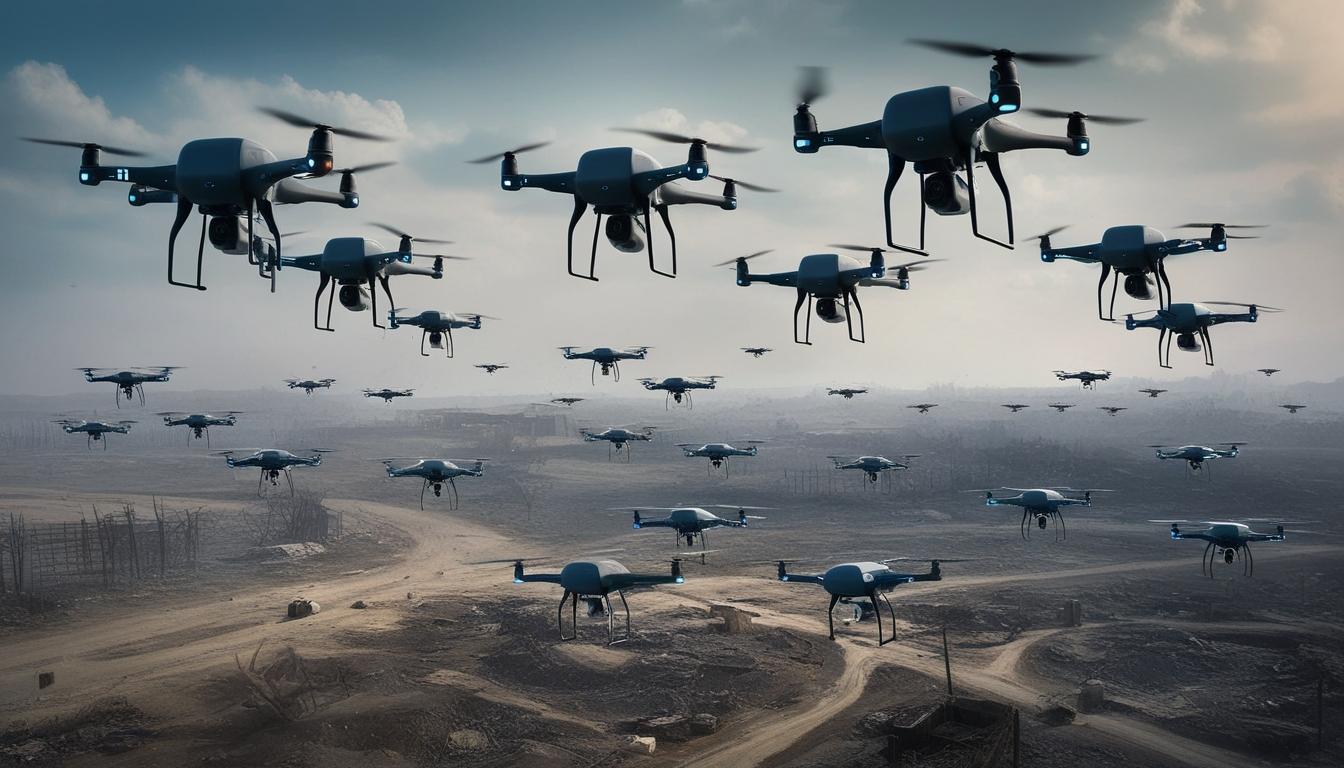
In March 2020, a significant technological milestone in warfare occurred amidst the chaos of the Libyan civil war. A convoy belonging to the Libyan National Army was targeted and destroyed by a fleet of autonomous quadcopter drones. These drones executed the attack without direct human intervention, marking a notable instance of artificial intelligence (AI) in military operations. The incident highlighted the growing sophistication and autonomy of military technology, raising crucial questions about the future of warfare.
The evolution of armed drones and robotic warfare has been rapidly transforming how conflicts are managed, keeping human operators increasingly distant from the battlefield. While traditionally, soldiers have been required on the ground, technological advancements now allow humans to engage in combat from afar. This detachment is significantly facilitated by military drones, such as the MQ-9 Reaper, which are operated from remote locations like Creech Air Force Base in Nevada, while deployed halfway around the globe. These machines are progressively becoming more self-reliant, capable of independently making decisions related to navigation and mission planning.
Samuel Bendett, an Adjunct Senior Fellow at the Center for a New American Security, discussed this shift, noting that as robotics becomes more cost-effective, their deployment in vast numbers may become routine. The introduction of more autonomous systems might necessitate the transfer of certain battlefield responsibilities from human soldiers to machines, particularly to manage and interpret various combat scenarios across different domains including cyber and information warfare.
Throughout history, the development of new weaponry has consistently distanced humans from direct combat, beginning with the invention of ranged weapons and evolving into the advanced weapon systems of today that allow for remote strikes. The possibility of fully autonomous lethal drones intensifies this disconnection. Despite these advances, a consensus exists among global military powers that humans must remain integral to the decision-making loop, especially regarding the use of lethal force. This human oversight is crucial to avoid errors that could result from faulty software or inaccurate sensor data.
However, this human safeguard may not be permanent. The advantage in warfare often lies in the ability to act swiftly, and decisions made by a machine could theoretically outpace human deliberation. This reality was underscored by a subsequent incident in March 2024, during the ongoing conflict in Ukraine, where autonomous ground vehicles were engaged by drones operated by Ukrainian forces. Although human operators controlled both sides' systems in this encounter, the role of autonomous technology is increasingly pivotal in modern warfare scenarios.
The reliance on AI-driven warfare has been particularly pronounced in Ukraine, where a shortage of manpower has led to a heavier dependence on drones for both offensive and defensive operations. Ukrainian volunteers working on drone technology have expressed the belief that robots should be deployed before humans in combat situations, highlighting the tactical shift towards autonomy.
Zach Kallenborn, an expert from the Schar School of Policy and Government, argues that the presence of a human controller remains crucial to prevent unintended consequences such as accidental fatalities or the escalation of conflict. Mistakes by autonomous weapons have potentially dire implications, ranging from engaging non-combatants to sparking international disputes.
Certain scenarios, such as naval engagements away from civilian environments, may benefit from greater autonomy without significant risk to non-combatants. Nevertheless, the moral question of responsibility in taking human lives persists. Historically, the notion of honour in warfare mandated direct human involvement in combat, a tradition that is challenged by the advent of autonomous killing machines.
As military technology continues to evolve, the pressing question is whether AI can ever reliably discern between combatants and civilians on the battlefield. The potential for autonomous systems to make life-and-death decisions raises profound ethical concerns and questions about the acceptance of civilian casualties in future conflicts. These issues remain unresolved, standing as critical considerations as the world edges closer to a new era of warfare dominated by machine autonomy.
Source: Noah Wire Services