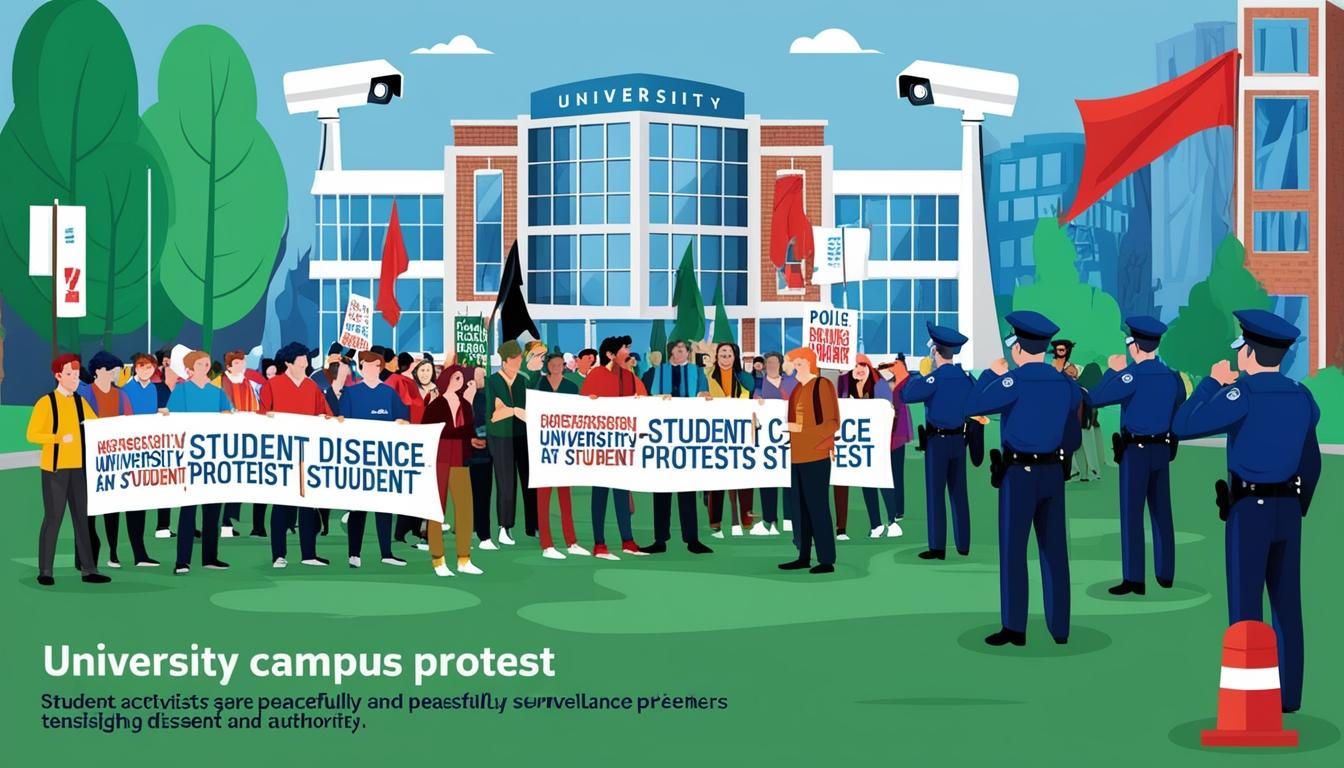
In a rapidly shifting landscape of protest and dissent, university campuses in the United States have become flashpoints for tension between student activists and institutional authorities. A notable instance of this is found at the University of North Carolina at Chapel Hill (UNC), where student protests in support of Palestinian rights have collided with increased university surveillance and policing.
In late April, a group of student activists, organized under the banner of UNC Students for Justice in Palestine (UNC SJP), set up the Triangle Gaza Solidarity Encampment on the university's Polk Place. This encampment was a public demonstration seeking to raise awareness and demand the divestment of university endowment funds from industries supporting what they termed the "genocidal state" policies against Gaza.
The encampment peacefully assembled on the university's upper quad, featuring cultural activities, community discussions, and interfaith prayers. However, this space of solidarity was soon under the watchful eye of law enforcement. The police presence, including officers from universities across the state and local police in militarized gear, reportedly escalated tensions, leading to the eventual dismantling of the encampment.
UNC's decision to disband the encampment was officially driven by concerns about campus disruption, although participants argue this was not the case. Following the breakdown of the encampment, the university significantly ramped up surveillance on campus, installing more cameras, some covertly coloured to blend into their surroundings, and temporarily fencing off the quad to prevent gatherings.
The deployment of these surveillance measures is part of a broader trend in American universities, where advanced technologies are increasingly used to manage and control protest activities. Tools such as facial recognition software and biometric surveillance have become more prevalent, allowing institutions to monitor and potentially identify individuals participating in campus protests.
The developments at UNC reflect a larger narrative of how institutions are responding to what some see as threats to the status quo. The heightened scrutiny and policing are perceived by critics as attempts to stifle dissent and fortify institutional power in the face of growing protest movements, particularly those that question U.S. foreign policies or advocate for marginalized communities.
The conflicts at UNC illustrate the intersection between student activism, technological surveillance, and institutional authority. This evolving dynamic raises significant questions about privacy, freedom of expression, and the role of educational institutions as spaces for critical thought and protest.
As surveillance technologies become more sophisticated and their use more widespread, the boundaries between public safety and civil liberties continue to be navigated by all parties involved. The incident at UNC is a microcosm of this larger societal debate—underscoring the tensions inherent in balancing order with the right to dissent.
Source: Noah Wire Services