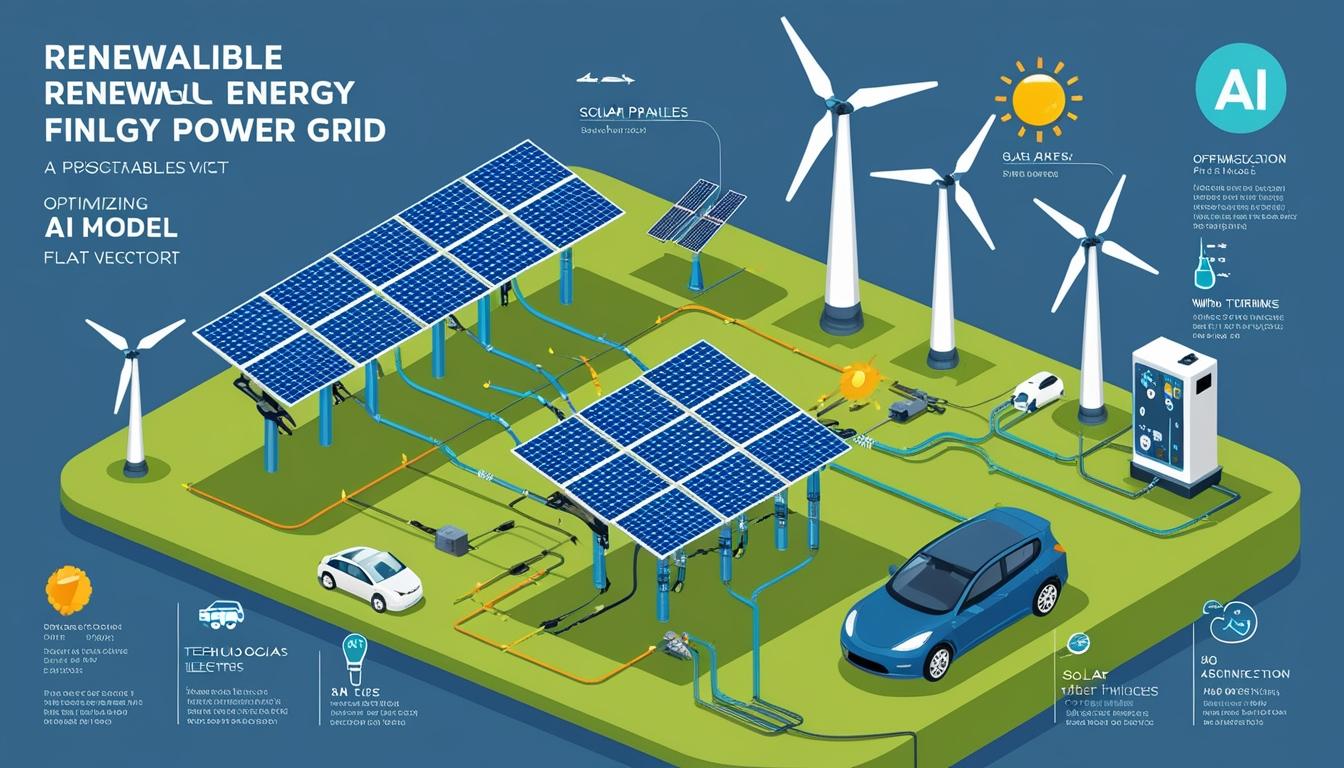
University of Virginia's AI Model Revolutionises Power Grid Management
In a significant advancement for the energy sector, researchers at the University of Virginia have unveiled a sophisticated artificial intelligence model aimed at transforming how power grids are managed amidst the growing prevalence of renewable energy sources. The focus of this development is to address the inherent uncertainties associated with wind and solar energy generation, as well as the increasing demand from electric vehicles.
The AI Model: Multi-Fidelity Graph Neural Networks
The pioneering model utilises multi-fidelity graph neural networks (GNNs), an innovative AI framework tailored to refine power flow analysis. This is a critical process that ensures electricity is distributed both safely and efficiently across the grid. The "multi-fidelity" aspect of the model is particularly noteworthy; it artfully combines large-scale, less precise data (low-fidelity) with smaller sets of highly accurate data (high-fidelity). This method enables expedited training of the AI model while simultaneously enhancing its accuracy and reliability.
Adapting to Real-Time Challenges
One of the standout features of this AI model is its enhanced flexibility and capability to manage real-time decisions and grid configurations. It adeptly addresses the "optimal power flow" challenge, a critical issue related to determining the optimal amount of power to generate from various sources. Traditional grid management strategies often falter under the pressures of renewable energy's unpredictable output and the fluctuating demands from technologies like electric vehicles. Here, the AI system integrates both comprehensive and simplified simulations, efficiently optimising solutions in mere seconds, and significantly improving grid performance even in the face of unexpected variables.
Negin Alemazkoor, an assistant professor of civil and environmental engineering and the project's lead researcher, said, "With renewable energy and electric vehicles changing the landscape, we need smarter solutions to manage the grid. Our model helps make quick, reliable decisions, even when unexpected changes happen."
Benefits and Implications of the AI Model
The application of this AI model marks a milestone in grid management with several distinct advantages:
Scalability: The model requires less computational power for training, making it feasible to apply across large and intricate power systems.
Higher Accuracy: By utilising widely available low-fidelity simulations, it offers more dependable power flow predictions.
Improved Generalisability: It is better equipped to handle changes in grid topology, such as power line failures, a capacity often lacking in conventional machine learning models.
The deployment of this AI innovation promises to significantly fortify power grid reliability in light of escalating unpredictabilities in energy generation and consumption.
Looking Towards the Future
The research team is optimistic about the broader implications of their work. Mehdi Taghizadeh, a Ph.D. student contributing to Alemazkoor's lab, commented, "Managing the uncertainty of renewable energy is a big challenge, but our model makes it easier." His colleague, Kamiar Khayambashi, who specialises in renewable energy integration, echoed this sentiment, adding, "It's a step towards a more stable and cleaner energy future."
As renewable energy continues to reshape the global energy landscape, the University of Virginia's AI model stands out as a beacon of innovation, potentially setting new standards for power grid management.
Source: Noah Wire Services